All species › Passerines › New World blackbirds, troupials and allies › Bronzed Cowbird
Bronzed Cowbird | Molothrus aeneus
Roodoogkoevogel | Tordo ojo rojo | Chupim-de-olho-vermelho
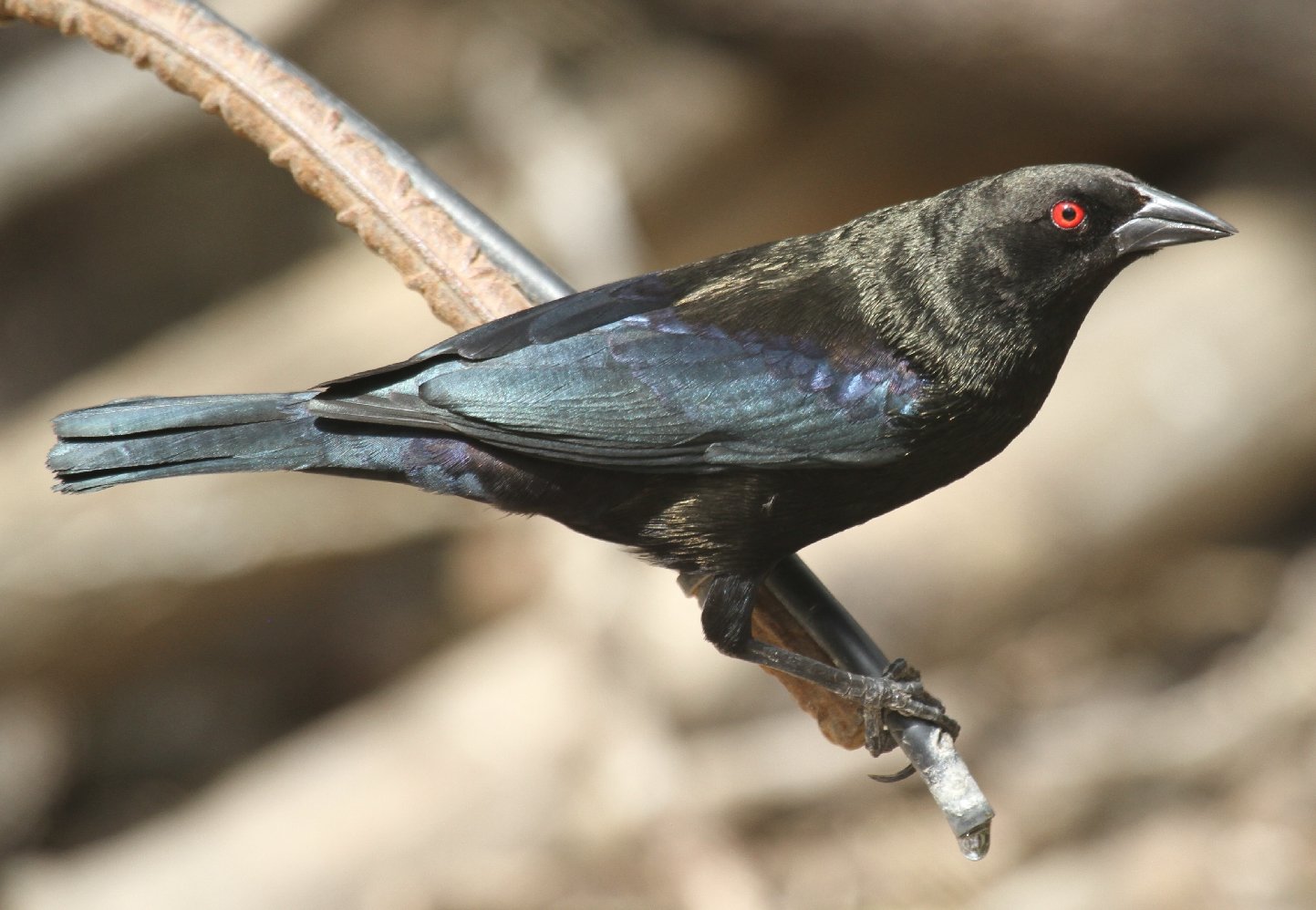
The Bronzed Cowbird is a bulky, red-eyed cowbird, widespread from the southern United States to Panama. In north-western Colombia it reaches the southern limit of its range. In display the male puffs out the feathers of the nape and back into a ruff and then hovers over the female on quivering wings.
Voice
High, thin, squeaky whistles and bubbling sounds during display; the call is a dry chek.
Recording: Manuel Grosselet — CC BY-NC-SA 4.0 · xeno-canto
Identification
18–22 cm; the male is larger than the female. The male is black with a bronzy-green gloss on the head and body and a bluer gloss on the wings and tail, and has a ruff of elongated nape feathers. In the south of the range the female is dull black to dark blackish brown, with little gloss. Both sexes have a red eye and a fairly thick black bill. Juveniles are dull brown with a dark eye.
Confusion species
Shiny Cowbird Molothrus bonariensis is slimmer, with a thinner bill, a dark eye and a purple rather than bronzy gloss. Bronze-brown Cowbird Molothrus armenti is smaller and bronzy brown, without an obvious ruff, and lives in the Caribbean coastal lowlands. Giant Cowbird Molothrus oryzivorus is much larger, with a small head and a long tail, and also has a red eye.
Habitat
Open country with shrubs, pastures, fields, forest edges, farmyards and villages in the lowlands. It forages in flocks on the ground for seeds and insects, often near cattle. A brood parasite of many species, including orioles Icterus, tanagers and sparrows.
Where the bird is most at home, classified by the vegetation units of the Andes and the west coast.


Range and movements
In Colombia in the north-west, mainly in the lowlands of Urabá and northern Chocó near the Panama border; it may be spreading further with deforestation. Absent from Ecuador, Peru, Bolivia and the Galápagos. Outside the guide area from the south-western United States through Mexico and Central America to Panama.
- Resident
- dark = core range, pale = thinly spread
How and when to look
In pastures and around farms in Urabá, search flocks of Shiny Cowbirds for bulkier birds with a red eye and a ruff on the nape.
Conservation status
Least Concern. It is expanding its range where forest gives way to pastures and fields.
Scientific name
Molothrus aeneus | (Wagler, 1829)
Wagler described the species in 1829 as Ps[arocolius] aeneus; because it was later moved to another genus, the author and year stand in brackets. The genus Molothrus was introduced in 1832 by Swainson. The genus name comes from Greek mōlos, 'struggle', and thrōskō, 'to impregnate', referring to the brood parasitism of cowbirds. The species name is Latin aeneus, 'bronze-coloured', for the bronzy sheen of the plumage. The specimen the first description was based on came from Laguna, Veracruz, Mexico.