All species › Woodpeckers and allies › Woodpeckers › Choco Woodpecker
Choco Woodpecker | Veniliornis chocoensis
Chocóspecht | Carpintero del Chocó | Pica-pau-do-chocó
The Choco Woodpecker is a small, golden-green woodpecker of the very wet rainforest of the Chocó in western Colombia and north-western Ecuador. It is closely related to the Red-stained Woodpecker and was formerly treated as a subspecies of it or of another Veniliornis species. It occurs only in the guide area and is scarce throughout its small range.
Voice
Sharp pik notes, softer quip calls, a rapid wicka-wicka and a soft rattle.
No recording with a suitable Creative Commons licence is available for this species yet.
Identification
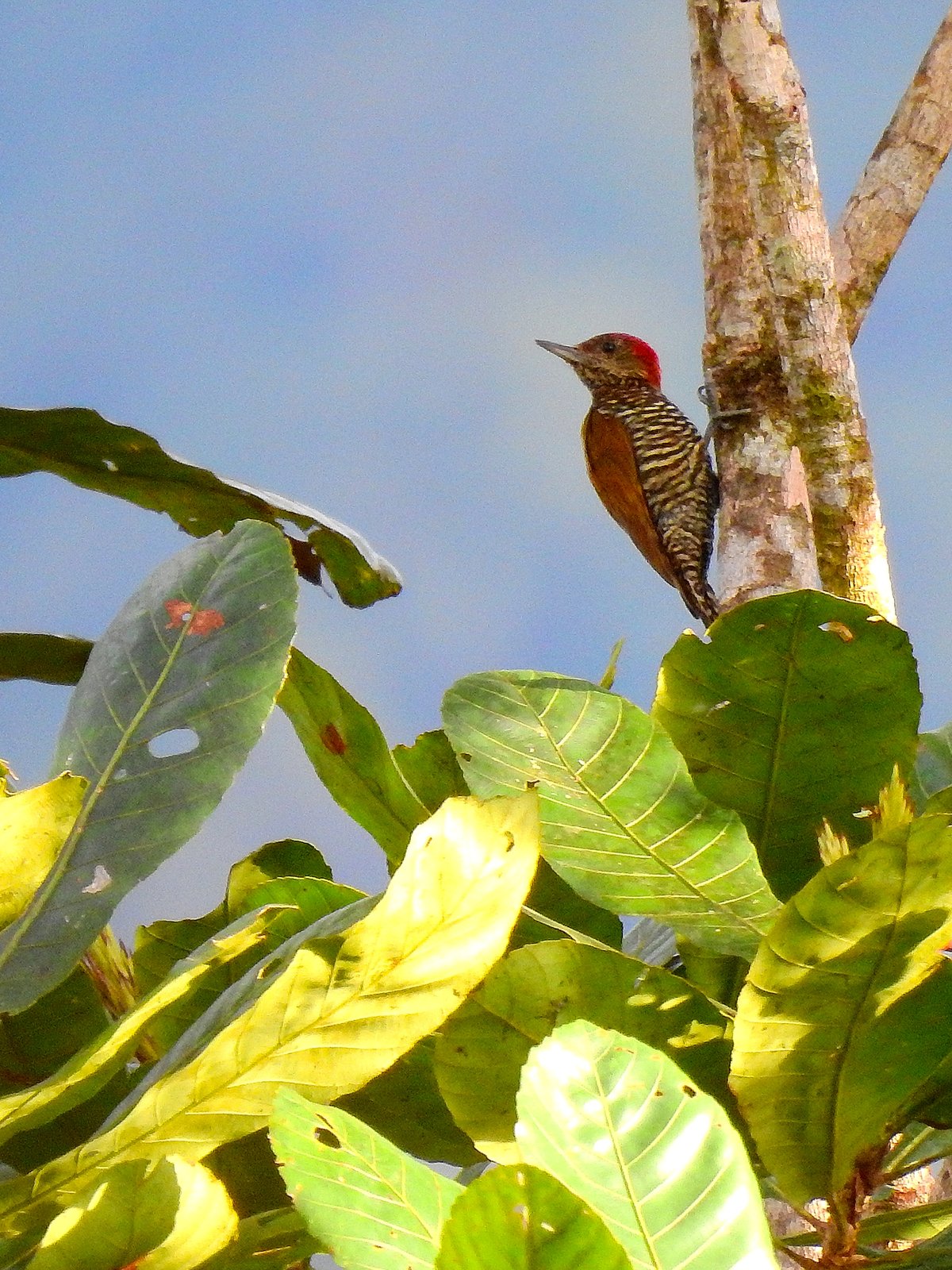
15–16 cm, with a straight, dark bill. The upperparts are golden olive-green, without a red rump. The face is brownish buff with dark streaks. The underparts are densely barred dark olive and yellowish white. The male has a red crown with black feather bases, the female a dark olive-brown crown without red.
Confusion species
Red-rumped Woodpecker Veniliornis kirkii has a red rump and usually lives in drier, more open forest edges. Smoky-brown Woodpecker Leuconotopicus fumigatus is uniformly brown, without bars on the underparts. Golden-olive Woodpecker Colaptes rubiginosus is larger, with a grey crown and a pale cheek.
Habitat
The interior and edges of humid to very wet lowland and foothill forest, up to about 1000 m, mostly below 700 m. It forages in the middle levels and canopy, sometimes with mixed flocks. Little is known about its diet and nest; probably similar to related Veniliornis woodpeckers.
Where the bird is most at home, classified by the vegetation units of the Andes and the west coast.


Range and movements
In Colombia along the Pacific slope and in the Chocó lowlands, from Antioquia south to Nariño. In Ecuador in the north-west, south to Pichincha. Absent from Peru, Bolivia, east of the Andes and from the Galápagos. Does not occur outside the guide area.
- Resident
- dark = core range, pale = thinly spread
How and when to look
Search wet lowland and foothill forests in Esmeraldas and north-western Pichincha, and follow mixed canopy flocks. Look for small, golden-green woodpeckers without a red rump.
Conservation status
Least Concern. The species was formerly considered Near Threatened. Forest within its small range is disappearing through logging, cattle ranching, mining and the planting of oil palm and coca, and the population is probably declining.
Scientific name
Veniliornis chocoensis | Todd, 1919
Todd described the species in 1919 and placed it straight away in the genus where it still stands. The genus Veniliornis was introduced in 1854 by Bonaparte. The genus name combines Venilia, a Roman deity, with Greek ornis, 'bird'. The species name refers to the Chocó of western Colombia, not necessarily the type locality. The specimen the first description was based on came from Malagita, Chocó, Colombia.