All species › Woodpeckers and allies › Woodpeckers › Lita Woodpecker
Lita Woodpecker | Piculus litae
Litaspecht | Carpintero de Lita | Pica-pau-de-lita
The Lita Woodpecker is a small, green woodpecker of the Chocó rainforest of western Colombia and north-western Ecuador. It was long treated as a subspecies of the White-throated Woodpecker Piculus leucolaemus, which lives east of the Andes. The name refers to Lita, a town in north-western Ecuador.
Voice
A long, hissing call, similar to that of the White-throated Woodpecker, and a short series of high notes.
Recording: Juan Freile — CC BY-NC-SA 4.0 · xeno-canto
Identification
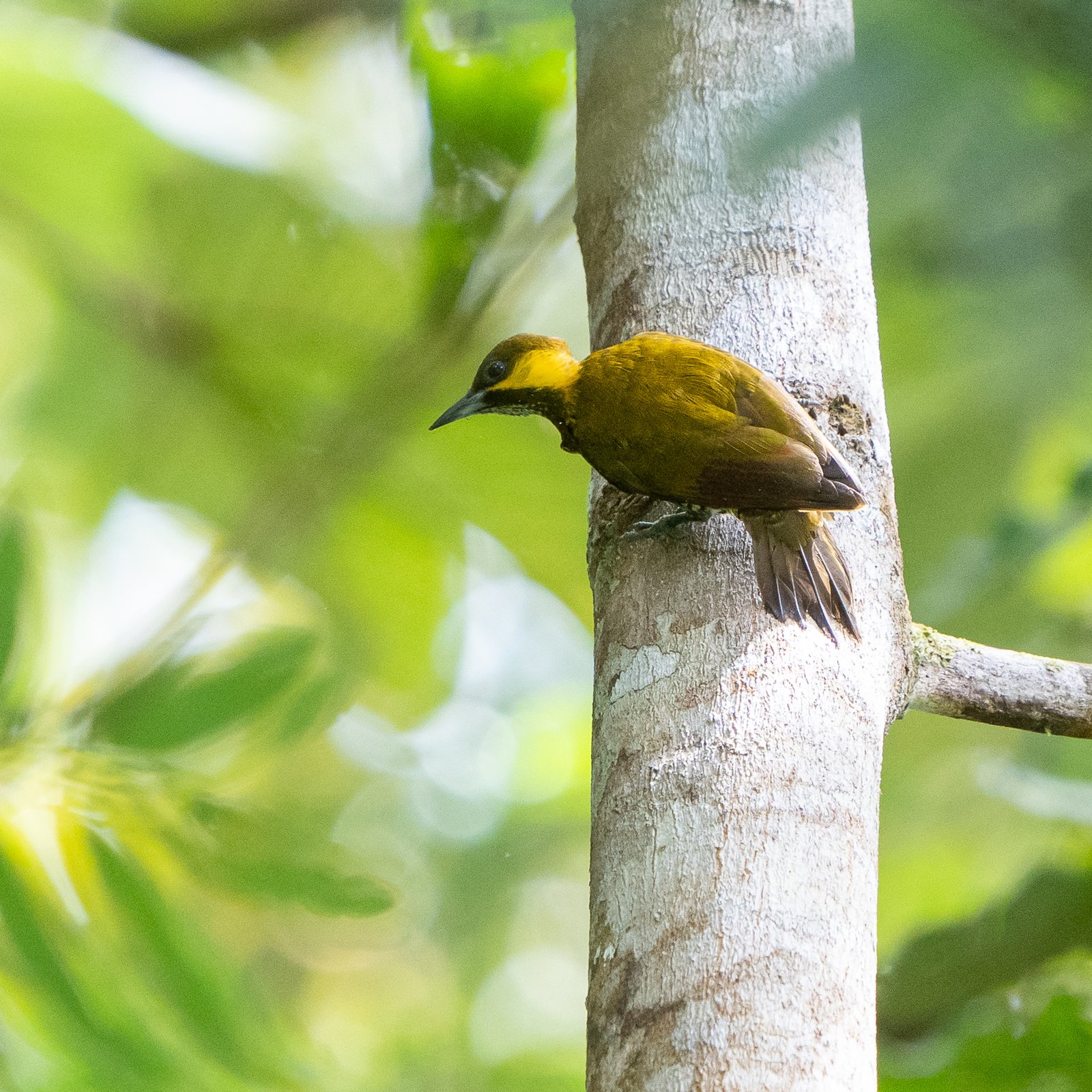
18–19 cm, with a straight, greyish bill. The upperparts are golden olive-green. A yellow stripe runs from the base of the bill below the eye to the side of the neck; the throat is whitish. The underparts are olive-green with pale, yellowish spots and bars. The male has a red crown and nape and a red malar stripe; the female has an olive-green crown and red only on the nape.
Confusion species
Golden-olive Woodpecker Colaptes rubiginosus is larger, with a grey crown bordered red, a whitish cheek and yellowish, barred underparts. Choco Woodpecker Veniliornis chocoensis is smaller, without a yellow cheek stripe, with a reddish wash on the back and finely barred underparts. Cinnamon Woodpecker Celeus loricatus is cinnamon-rufous, with black scales.
Habitat
Very wet lowland and hill forest and its edges, also tall secondary forest, from sea level to about 1200 m. It lives in the canopy, often in mixed flocks. It eats ants, termites and other insects. It nests in a self-excavated cavity in a tree.
Where the bird is most at home, classified by the vegetation units of the Andes and the west coast.


Range and movements
In Colombia in the Pacific lowlands and on the lower western slope of the Western Andes, from the Chocó south to Nariño. In Ecuador in the north-west, in Esmeraldas, Imbabura and north-western Pichincha. Absent from Peru, Bolivia and the Galápagos. Its range lies almost entirely within the guide area.
- Resident
- dark = core range, pale = thinly spread
How and when to look
Search mixed canopy flocks along roads and forest edges in the hills of north-western Ecuador, as around Lita and in Esmeraldas, and in the Chocó of Colombia.
Conservation status
Least Concern. The Chocó rainforest where the species lives is declining through logging, farming and oil-palm plantations.
Scientific name
Piculus litae | (Rothschild, 1901)
Rothschild described the species in 1901 as Chloronerpes litae; because it was later moved to another genus, the author and year stand in brackets. The genus Piculus was introduced in 1824 by Spix. The genus name is a diminutive of Latin picus, 'woodpecker'. The species name refers to Lita in north-western Ecuador, where the type was collected. The specimen the first description was based on came from Lita, Imbabura, Ecuador.