All species › Woodpeckers and allies › Woodpeckers › Red-necked Woodpecker
Red-necked Woodpecker | Campephilus rubricollis
Roodnekspecht | Carpintero cuellirrojo | Pica-pau-de-barriga-vermelha
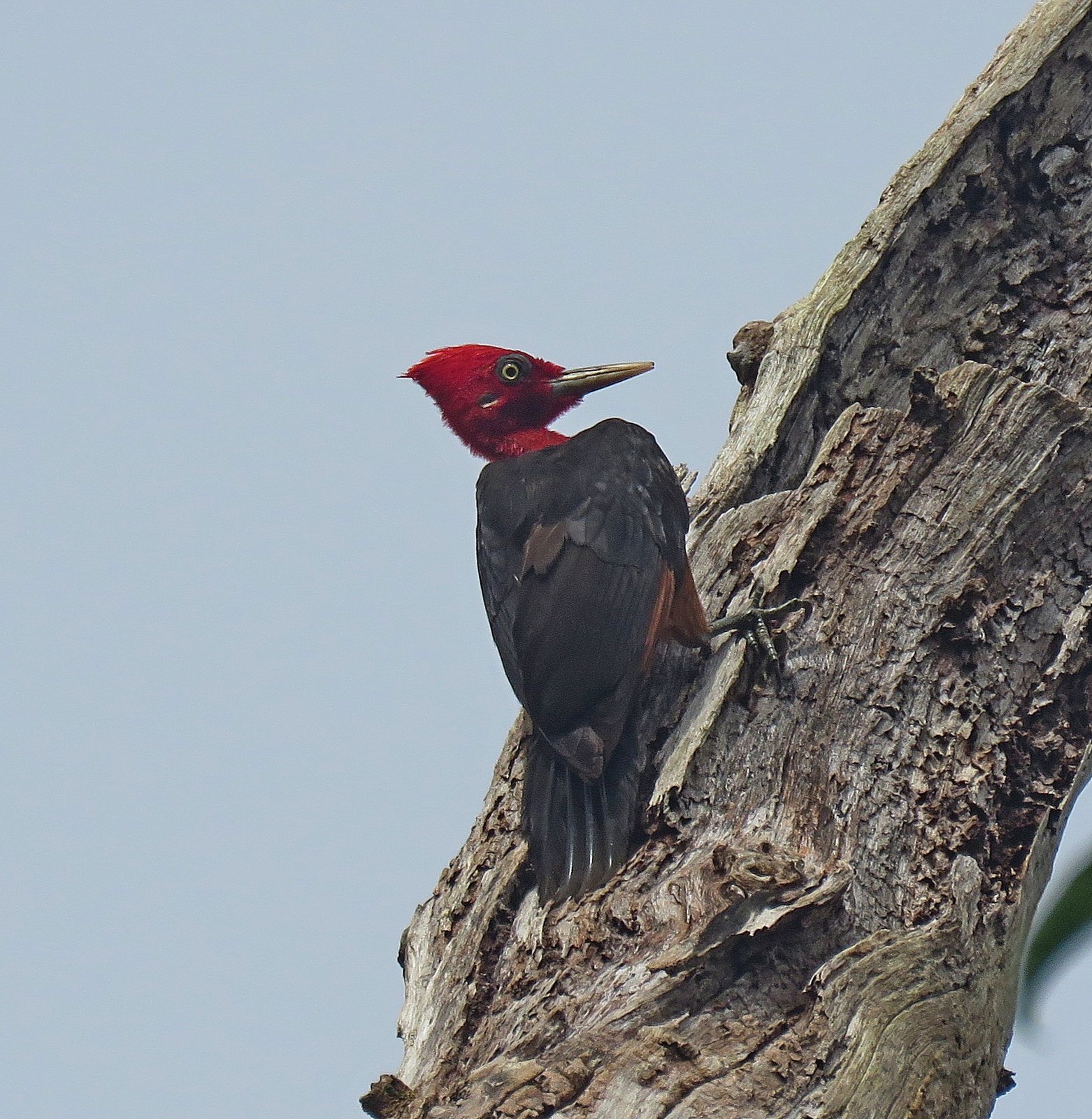
The Red-necked Woodpecker is a large Campephilus woodpecker with an entirely red head, neck and breast, found throughout the Amazonian lowlands and up onto the lower eastern slope of the Andes. It lives in pairs in tall, humid forest and is often heard by its loud, nasal call and the double knock of its drum. In Bolivia and southern Peru a subspecies occurs that ranges higher into the mountains.
Voice
A loud, nasal kee-ah or kwee-ah, often repeated, and a fast series of nasal notes. It drums with a loud double knock.
Recording: Richard E. Webster — CC BY-NC-SA 4.0 · xeno-canto
Identification
30–34 cm, with a long, straight, pale bill. The head, crest, neck and breast are red. The male has a small black-and-white spot at the base of the cheek, the female a broad, black-edged white stripe from the bill across the cheek. The back, wing coverts and tail are black, the belly rufous. The primaries are largely rufous and show in flight.
Confusion species
Crimson-crested Woodpecker Campephilus melanoleucos has a white V on the back, a black throat and breast and a pale, barred belly. Crimson-bellied Woodpecker Campephilus haematogaster on the eastern slope has a red rump, buff head stripes and red, dark-mottled underparts without rufous primaries. Lineated Woodpecker Dryocopus lineatus is black with white stripes and a barred belly.
Habitat
The interior and edges of tall humid terra firme forest, also foothill forest and lower montane forest, from the lowlands to about 1500 m, in Bolivia and southern Peru locally to over 2000 m. It searches trunks and large branches for beetle larvae and other insects. It nests in a self-excavated cavity in a tree.
Where the bird is most at home, classified by the vegetation units of the Andes and the west coast.


Range and movements
In Colombia in the Amazonian lowlands and on the eastern slope. In Ecuador in the eastern lowlands and foothills. In Peru in the Amazonian lowlands and on the lower eastern slope. In Bolivia in the north and in the Yungas. Absent from the Galápagos. Outside the guide area in Venezuela, the Guianas and Amazonian Brazil.
- Resident
- dark = core range, pale = thinly spread
How and when to look
In tall terra firme forest, listen for the nasal call and the double knock. Birds often perch at mid-level on large trunks; in flight the rufous primaries stand out.
Conservation status
Least Concern. The species has a very large range, but depends on large, continuous forest and disappears where forest becomes fragmented.
Scientific name
Campephilus rubricollis | (Boddaert, 1783)
Boddaert described the species in 1783 as Picus rubricollis; because it was later moved to another genus, the author and year stand in brackets. The genus Campephilus was introduced in 1840 by Gray. The genus name combines Greek kampē, 'caterpillar', with philos, 'loving'. The species name combines Latin ruber, 'red', with collum, 'neck', meaning 'red-necked'. The specimen the first description was based on came from Cayenne, French Guiana.