All species › Swifts › Hummingbirds › Reddish Hermit
Reddish Hermit | Phaethornis ruber
Rode heremietkolibrie | Ermitaño rojizo | Rabo-branco-rubro
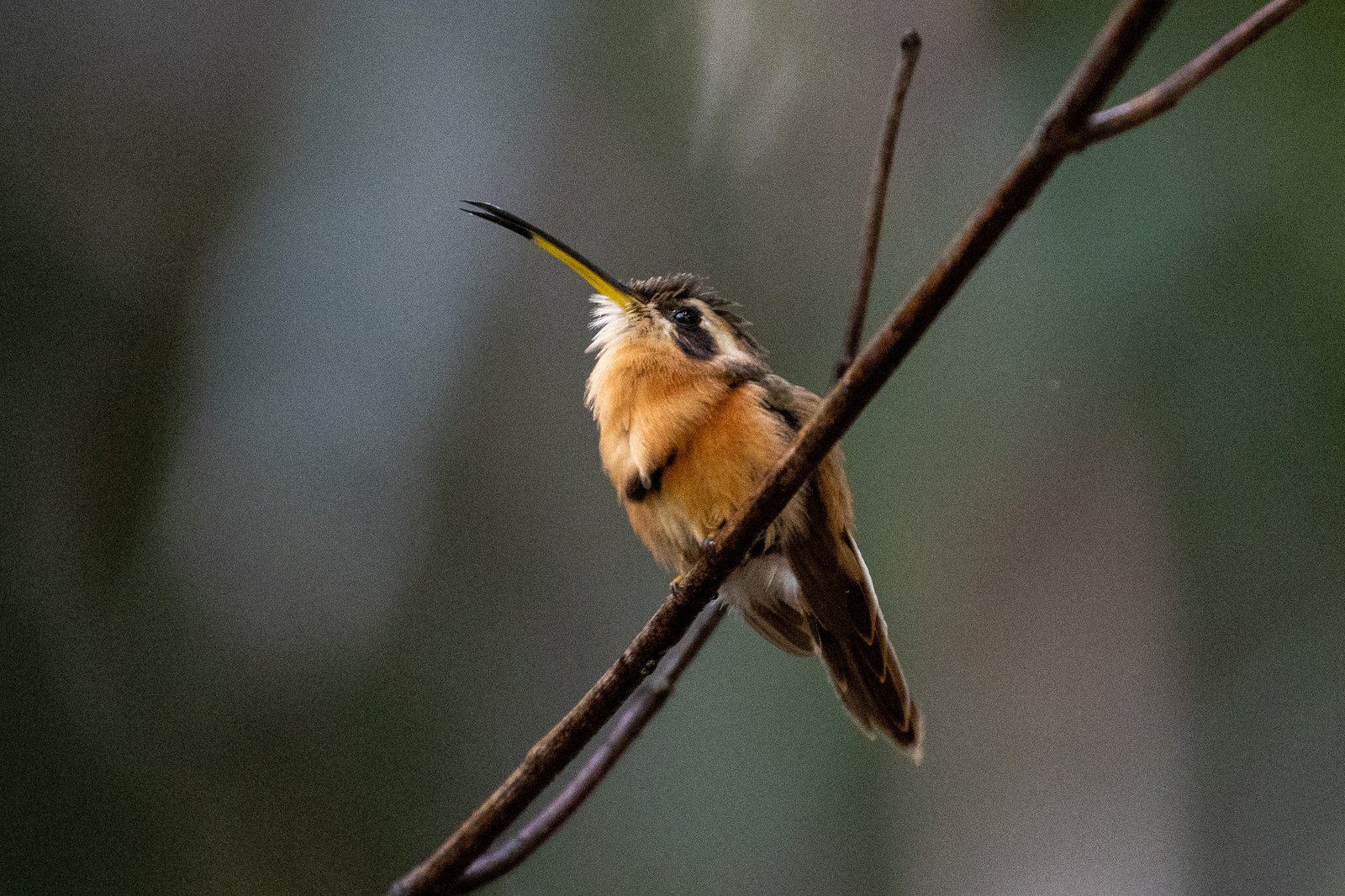
The Reddish Hermit is one of the smallest hummingbirds of Amazonia and the smallest hermit of the guide area. It moves fast and low through the forest understorey, with a humming wing sound like that of a large insect. Males sing in groups (leks) on low branches.
Voice
The song is a high, squeaky, rapidly repeated phrase of a few notes. The call is a thin tsip. In flight the wings make a soft hum.
Recording: Aran Rodrigues Cardoso — CC BY-NC-SA 4.0 · xeno-canto
Identification
8–9 cm, with a slightly decurved bill and a short, graduated tail. The upperparts are bronzy green, the rump rufous. The head has a blackish mask with a buff supercilium and malar stripe. The underparts are warm rufous. The male has a narrow black band across the breast; in the female it is absent or faint, and the underparts are paler. The tail is largely dark and rufous, with pale tips.
Confusion species
White-browed Hermit Phaethornis stuarti of south-eastern Peru and Bolivia is paler buff below, with a whitish supercilium, and lacks the black breast band. Black-throated Hermit Phaethornis atrimentalis has a blackish throat stripe and no breast band. Grey-chinned Hermit Phaethornis griseogularis has a grey throat and lives higher, in foothill and montane forest.
Habitat
Understorey and edges of humid terra firme and várzea lowland forest, secondary forest and scrub, up to about 1000 m. It visits small understorey flowers along a fixed route and catches small arthropods. The nest hangs from the underside of a leaf.
Where the bird is most at home, classified by the vegetation units of the Andes and the west coast.


Range and movements
In Colombia east of the Andes. In Ecuador in the Amazonian lowlands. In Peru throughout Amazonia. In Bolivia in the lowlands of the north and east. Absent from the Galápagos. Outside the guide area in southern Venezuela, the Guianas and Amazonian Brazil.
- Resident
- dark = core range, pale = thinly spread
How and when to look
In the lowlands, watch for a small rufous bird that flies fast and low along the trail and sometimes hovers right in front of you. At flowering understorey shrubs along forest edges it returns regularly on its route.
Conservation status
Least Concern. Widespread in Amazonia; it tolerates secondary forest.
Scientific name
Phaethornis ruber | (Linnaeus, 1758)
Linnaeus described the species in 1758 as Trochilus ruber; because it was later moved to another genus, the author and year stand in brackets. The genus Phaethornis was introduced in 1827 by Swainson. The genus name combines Ancient Greek phaethōn, 'sun', with ornis, 'bird'. The species name comes from Latin ruber, 'red', after the reddish plumage. The specimen the first description was based on came from Suriname.