All species › Passerines › Dippers › American Dipper
Position in the tree Birds Aves › Birds with a flexible palate Neognathae › All other modern birds Neoaves › Landbirds Telluraves › Falcons, parrots and passerines Australaves › Falcons and passerines Eufalconimorphae › Parrots and passerines Psittacopasserae
American Dipper | Cinclus mexicanus
Noord-Amerikaanse waterspreeuw | Mirlo acuático norteamericano
The American Dipper is a stocky, plain slate-grey songbird of fast-flowing mountain streams. It dives and walks underwater along the bottom in search of insect larvae, and is the only dipper of the guide area. It lives in the mountains of Mexico, northern Central America, Costa Rica and western Panama.

Voice
The song is a loud, clear series of whistled and trilled phrases, often repeated and easily heard above the roar of the water; it sings almost year-round. The call is a sharp, hard dzeet, often given in flight, which is low and straight over the water along the stream.
Recording: Yoann Blanchon — CC BY-NC-SA 4.0 · converted to mono · xeno-canto
Identification
16–20 cm. Stocky and round, with a short, often cocked tail, strong legs and a fairly short, straight dark bill. Plumage plain slate grey, slightly browner on the head. When it blinks, the white eyelid is conspicuous. Legs pale pink. Juveniles are paler grey with a pale throat, fine pale barring on the underparts and a pale bill. It constantly makes short bobbing movements on rocks in the stream. The sexes are alike.
Confusion species
In the guide area no other bird has the same shape and habits. Black Phoebe Sayornis nigricans, which also lives along mountain streams, is slimmer, with a white belly and a long tail, and hunts flying insects from rocks. Louisiana Waterthrush Parkesia motacilla also walks along streams in winter, but is brown with streaked white underparts and bobs its rear end.
Habitat
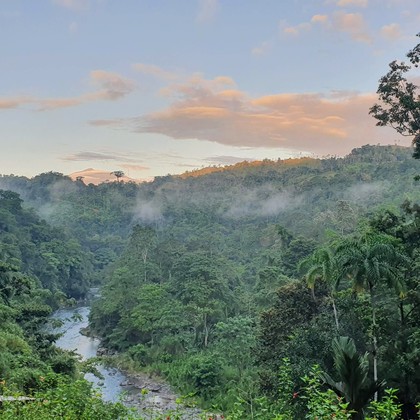
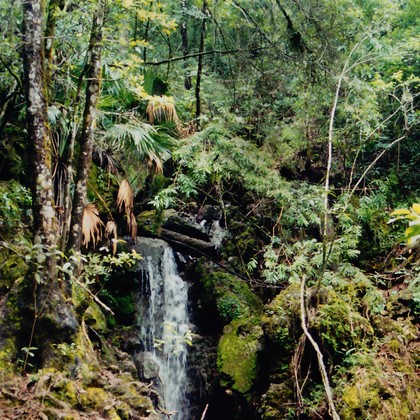
Clear, fast-flowing streams and rivers with rocks, rapids and waterfalls in forested mountains, mostly between about 800 and 3500 m. It feeds by putting its head underwater, diving or walking along the bottom underwater, and eats mainly larvae of aquatic insects and small fish. It builds a domed moss nest on a ledge or behind a waterfall, often above running water.
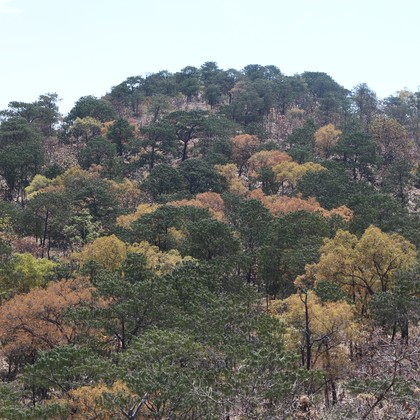
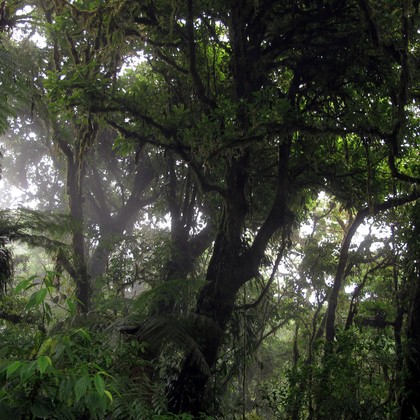
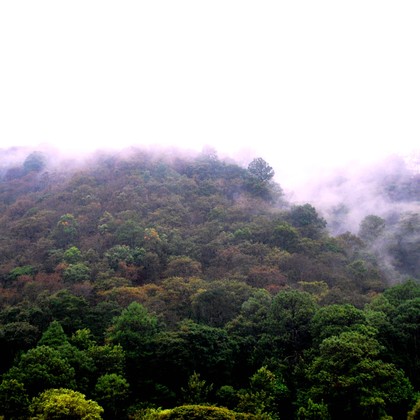
Where the bird is most at home, classified by the vegetation units of Mexico and Central America.
Range and movements
From Alaska through western North America to the south. In the guide area in the mountains of northern and central Mexico (Sierra Madre Occidental, Sierra Madre Oriental, the Trans-Mexican Volcanic Belt and the Sierra Madre del Sur), in Oaxaca and Chiapas, in the highlands of Guatemala and Honduras, and further south in the mountains of Costa Rica and western Panama.
- Resident
- dark = core range, pale = thinly spread
How and when to look
Best found by walking slowly along a rocky mountain stream and scanning the rocks in the current; watch for the short, low flight over the water and listen for the sharp call.
Conservation status
Not threatened (LC). Widespread, but sensitive to water pollution, silt from deforestation and the drying up or diversion of streams; its presence is regarded as a sign of clean running water.
Scientific name
Cinclus mexicanus | Swainson, 1827
Swainson described the species in 1827 and placed it straight away in the genus where it still stands. The genus Cinclus was introduced in 1797 by Borkhausen. Cinclus is from the Ancient Greek kinklos, a classical name for a small tail-wagging bird living by the water. mexicanus is Latin for 'Mexican', after the country where the first specimen was collected. The specimen the first description was based on came from Temascaltepec, State of México, Mexico.