All species › Passerines › New World blackbirds, troupials and allies › Bar-winged Oriole
Position in the tree Birds Aves › Birds with a flexible palate Neognathae › All other modern birds Neoaves › Landbirds Telluraves › Falcons, parrots and passerines Australaves › Falcons and passerines Eufalconimorphae › Parrots and passerines Psittacopasserae
Bar-winged Oriole | Icterus maculialatus
Witbandtroepiaal | Bolsero guatemalteco
The Bar-winged Oriole is a yellow oriole with a black mask and black back, named for the white bar across the black wing. It has a small range on the Pacific slope of northern Central America and lives mainly in semi-open montane forest and coffee plantations. In the guide area it occurs from southern Chiapas to El Salvador.

Voice
The song is a slow series of clear, somewhat plaintive whistles with pauses between them. Calls include a nasal nyeh and a dry chatter.
Recording: Manuel Grosselet — CC BY-NC-SA 4.0 · converted to mono · xeno-canto
Identification
20–21 cm. Head and underparts bright yellow, with a black mask running from the bill base across the eye and continuing into a black throat and upper breast. Back, wings and tail black; on the wing a yellow shoulder patch with a narrow white wing bar below it. Bill black with a bluish-grey base to the lower mandible. The female resembles the male but is duller, sometimes with an olive tinge on the back. Young birds are olive-yellow without a black mask.
Confusion species
Black-vented Oriole Icterus wagleri has a black hood that extends onto the breast, black undertail coverts and no white wing bar. Yellow-backed Oriole Icterus chrysater has a yellow back and no white wing bar. Spot-breasted Oriole Icterus pectoralis is more orange, has black spots on the sides of the breast and a broad white patch on the wing; it lives mainly lower down, in dry lowlands.
Habitat
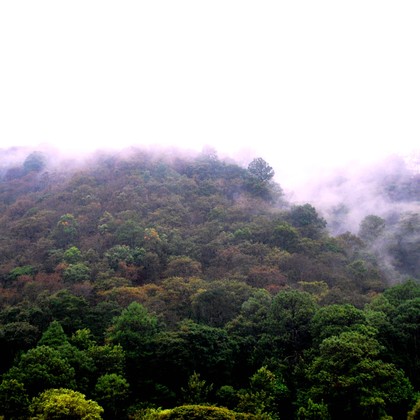
Semi-open pine-oak woodland, edges of humid and semi-humid foothill and montane forest and shade coffee, mostly between about 600 and 1800 m; locally also in drier woodland lower on the slope. It searches the canopy for insects, fruit and nectar, often in pairs or in mixed flocks. The nest is a hanging, woven pouch at the tip of a branch.
Where the bird is most at home, classified by the vegetation units of Mexico and Central America.



Range and movements
Endemic to the guide area: Pacific slope and adjacent interior valleys of southern Chiapas, Guatemala and El Salvador.
- Resident
- dark = core range, pale = thinly spread
How and when to look
Best looked for in shade coffee and forest edges on the Pacific slope of Guatemala and El Salvador. It often sits in flowering trees among other orioles and tanagers.
Conservation status
Not threatened (LC). Small range and locally rather scarce; loss of forest and the conversion of shade coffee into open plantations are the main threats.
Scientific name
Icterus maculialatus | Cassin, 1848
Cassin described the species in 1848 and placed it straight away in the genus where it still stands. The genus Icterus was introduced in 1760 by Brisson. Icterus is from Ancient Greek ikteros, a yellow bird usually taken to be the golden oriole, the sight of which was thought to cure jaundice. maculialatus is Latin, from macula 'spot' and alatus 'winged', after the white wing patch. The specimen the first description was based on came from Verapaz, Guatemala.