All species › Passerines › Cotingas › Bare-necked Umbrellabird
Position in the tree Birds Aves › Birds with a flexible palate Neognathae › All other modern birds Neoaves › Landbirds Telluraves › Falcons, parrots and passerines Australaves › Falcons and passerines Eufalconimorphae › Parrots and passerines Psittacopasserae
Bare-necked Umbrellabird | Cephalopterus glabricollis
Penseelparasolvogel | Paragüero cuellicalvo
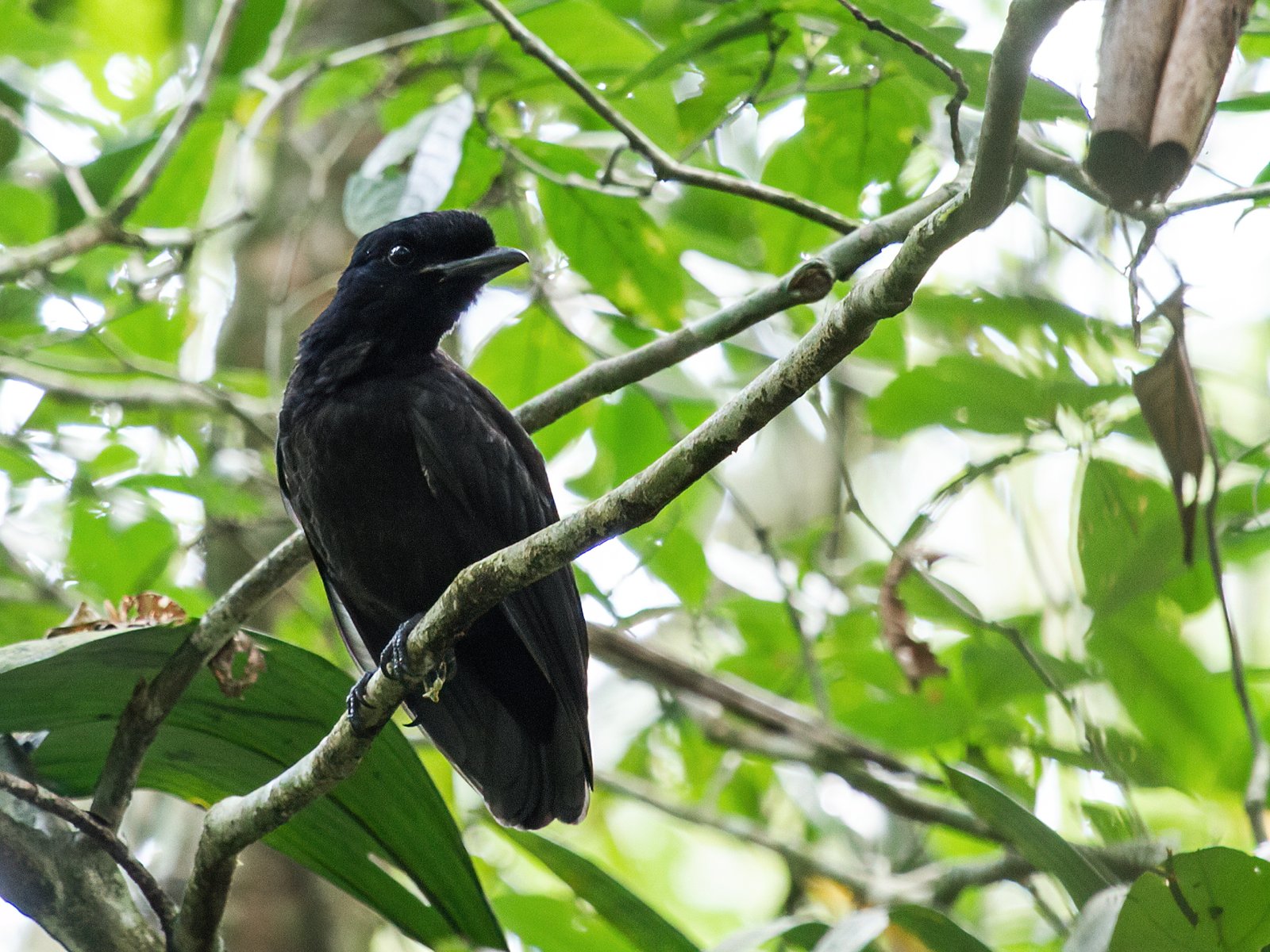
The Bare-necked Umbrellabird is a large black cotinga with an umbrella-like crest and, in the male, a bare scarlet throat. It breeds in montane forest on the Caribbean slopes and then moves to lower elevations. The species occurs only in Costa Rica and western Panama and is therefore endemic to the guide area.
Voice
Usually silent. The displaying male gives a very low, humming hmmm that carries far but is hard to locate.
Recording: UCAN, Phoebe David, Alana Zammit — CC BY-NC-SA 4.0 · converted to mono · xeno-canto
Identification
35–41 cm; the male is clearly larger than the female. Entirely black, with a dense crest of forward-curling feathers that falls over the bill. The male has a bare scarlet throat and neck with a hanging wattle, which it inflates into a red pouch during display. The female is duller black, with a smaller crest and a feathered throat without red. Bill black and stout.
Confusion species
Purple-throated Fruitcrow Querula purpurata is smaller, lacks a crest, has a blue-grey bill and, in the male, a feathered purplish-red throat patch; it lives in groups in lowland forest. Other large black forest birds, such as oropendolas and corvids, lack the crest.
Habitat
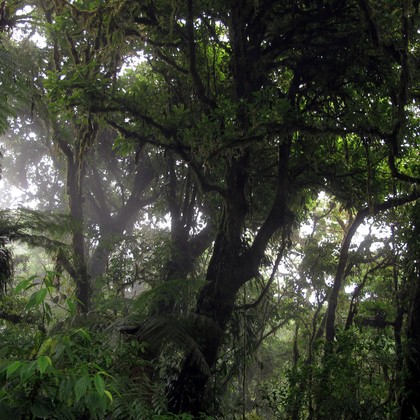
Breeds in humid montane and foothill forest from about 800 to 2000 m on the Caribbean slopes. Outside the breeding season many birds move to foothill and lowland forest on the Caribbean side, locally almost to sea level. Males display in loose groups (leks) in the middle storey of the forest. It eats mainly fruit, also large insects and small vertebrates.
Where the bird is most at home, classified by the vegetation units of Mexico and Central America.



Range and movements
Caribbean slopes of the mountain ranges of Costa Rica (Cordillera de Guanacaste, Tilarán, Central and Talamanca) and western Panama (mainly Bocas del Toro, Chiriquí and Veraguas). Does not occur outside the guide area.
- Resident
- dark = core range, pale = thinly spread
How and when to look
In the breeding season it can be looked for in the forest around Arenal volcano and in Braulio Carrillo (Quebrada González sector) in Costa Rica. Birds often sit quietly in the middle storey and are noticed more by their silhouette than by their call.
Conservation status
Endangered. The population is small and declining, mainly because of the loss of the lowland forest the birds need outside the breeding season. Its dependence on continuous forest from ridge to lowland makes the species especially vulnerable.
Scientific name
Cephalopterus glabricollis | Gould, 1851
Gould described the species in 1851 and placed it straight away in the genus where it still stands. The genus Cephalopterus was introduced in 1809 by Geoffroy Saint-Hilaire. Cephalopterus is Greek, from kephalē 'head' and pteron 'feather, wing', after the large umbrella-shaped crest. glabricollis is Latin, from glaber 'bare' and collum 'neck', after the male's bare red throat sac. The specimen the first description was based on came from Cordillera de Chiriquí (c. 2,400 m), Panama.