All species › Passerines › Antbirds › Barred Antshrike
Position in the tree Birds Aves › Birds with a flexible palate Neognathae › All other modern birds Neoaves › Landbirds Telluraves › Falcons, parrots and passerines Australaves › Falcons and passerines Eufalconimorphae › Parrots and passerines Psittacopasserae
Barred Antshrike | Thamnophilus doliatus
Gebandeerde mierklauwier | Batará barrado
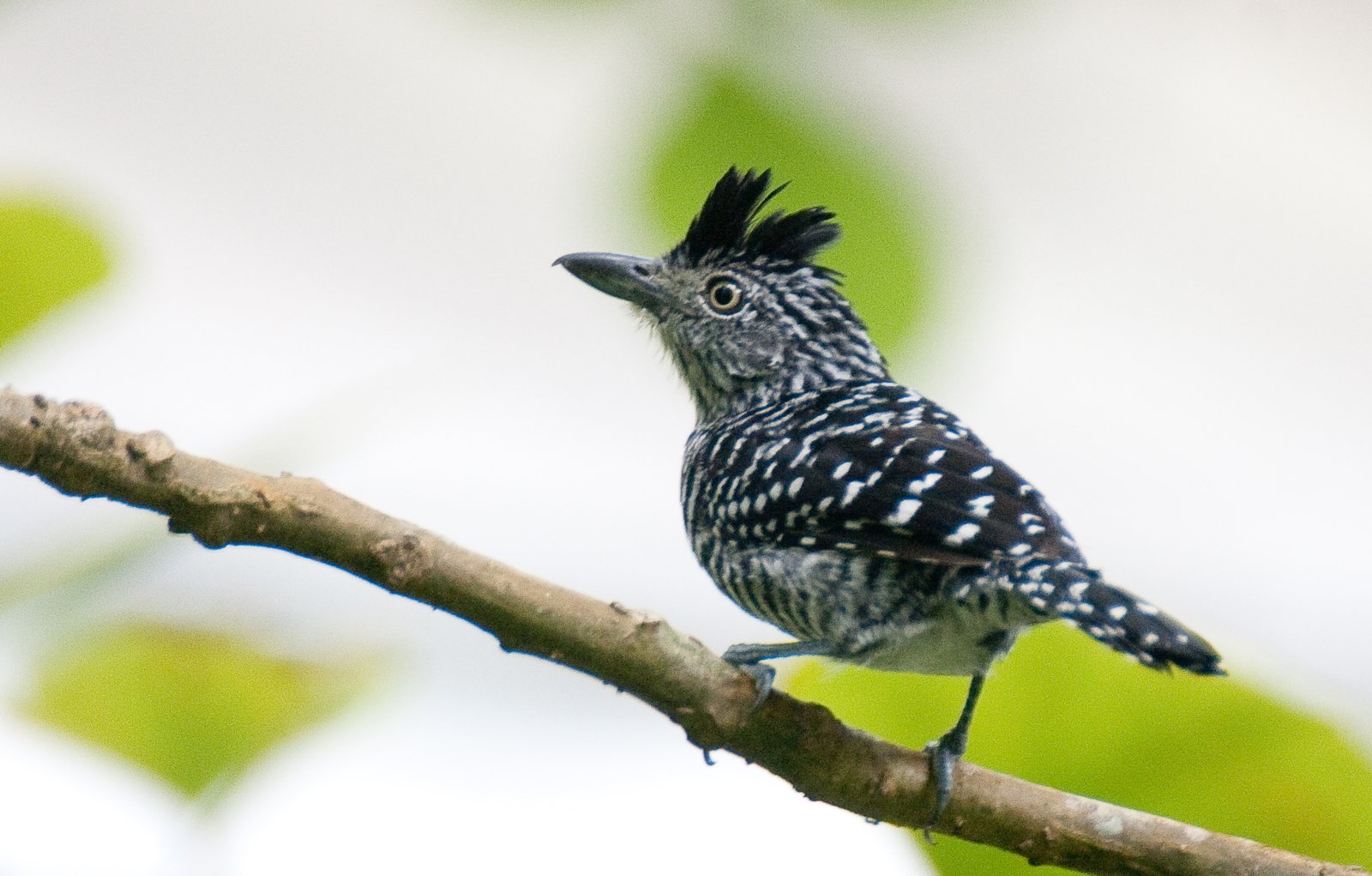
The Barred Antshrike is a medium-sized antshrike of dense thickets and forest edge, with an erectile crest and a heavy, hooked bill. The sexes differ strongly: the male is barred black and white all over, the female rufous and ochre. It usually stays hidden in dense scrub but is often heard. In the guide area it is one of the most widespread antshrikes.
Voice
The song is an accelerating series of nasal, laughing notes ending in an emphatic final note. Male and female often sing in turn. Also various growling and chattering calls.
Recording: Edgar Romero — CC BY-NC-SA 4.0 · converted to mono · xeno-canto
Identification
15–17 cm. Male: head, upperparts and underparts densely barred black and white; crown and erectile crest black, iris pale yellow. Female: crown, upperparts, wings and tail warm rufous; underparts ochre to buff; sides of head and neck finely streaked black and white; iris pale. Bill fairly heavy with a hooked tip.
Confusion species
Fasciated Antshrike Cymbilaimus lineatus (Caribbean slope from Honduras to Panama) has finer, denser barring, a red iris and a heavier bill; the female is barred too. It lives in the interior of humid forest, not in scrub. The female Barred Antshrike is told by its plain rufous upperparts without bars.
Habitat
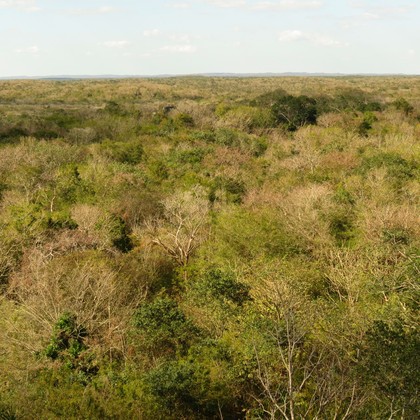
Dense thickets, scrub, second growth and forest edge, in both humid and dry country; also hedgerows, overgrown gardens and open land with bushes. Mainly in the lowlands and lower slopes. It eats insects and other invertebrates, gleaned from twigs and leaves. The nest is an open cup slung in the fork of a branch.
Where the bird is most at home, classified by the vegetation units of Mexico and Central America.






Range and movements
From eastern Mexico (from southern Tamaulipas) and the Yucatán Peninsula through Central America to Panama. Outside the guide area across much of tropical South America to northern Argentina, and on Trinidad and Tobago.
- Resident
- dark = core range, pale = thinly spread
How and when to look
Easier to hear than to see. Wait at the edge of a dense thicket until the pair call to each other; the male then often comes briefly into view with raised crest.
Conservation status
Not threatened. Common and widespread; benefits from scrub and second growth after forest clearance.
Scientific name
Thamnophilus doliatus | (Linnaeus, 1764)
Linnaeus described the species in 1764 as Lanius doliatus; because it was later moved to another genus, the author and year stand in brackets. The genus Thamnophilus was introduced in 1816 by Vieillot. Thamnophilus is Greek, from thamnos 'bush' and philos 'loving': 'bush-lover'. doliatus is Latin, from dolium 'barrel', 'hooped like a barrel', after the black-and-white barring. The specimen the first description was based on came from Suriname (designated later).