All species › Passerines › Wrens › Bay Wren
Position in the tree Birds Aves › Birds with a flexible palate Neognathae › All other modern birds Neoaves › Landbirds Telluraves › Falcons, parrots and passerines Australaves › Falcons and passerines Eufalconimorphae › Parrots and passerines Psittacopasserae
Bay Wren | Cantorchilus nigricapillus
Kastanjewinterkoning | Cucarachero cabecinegro
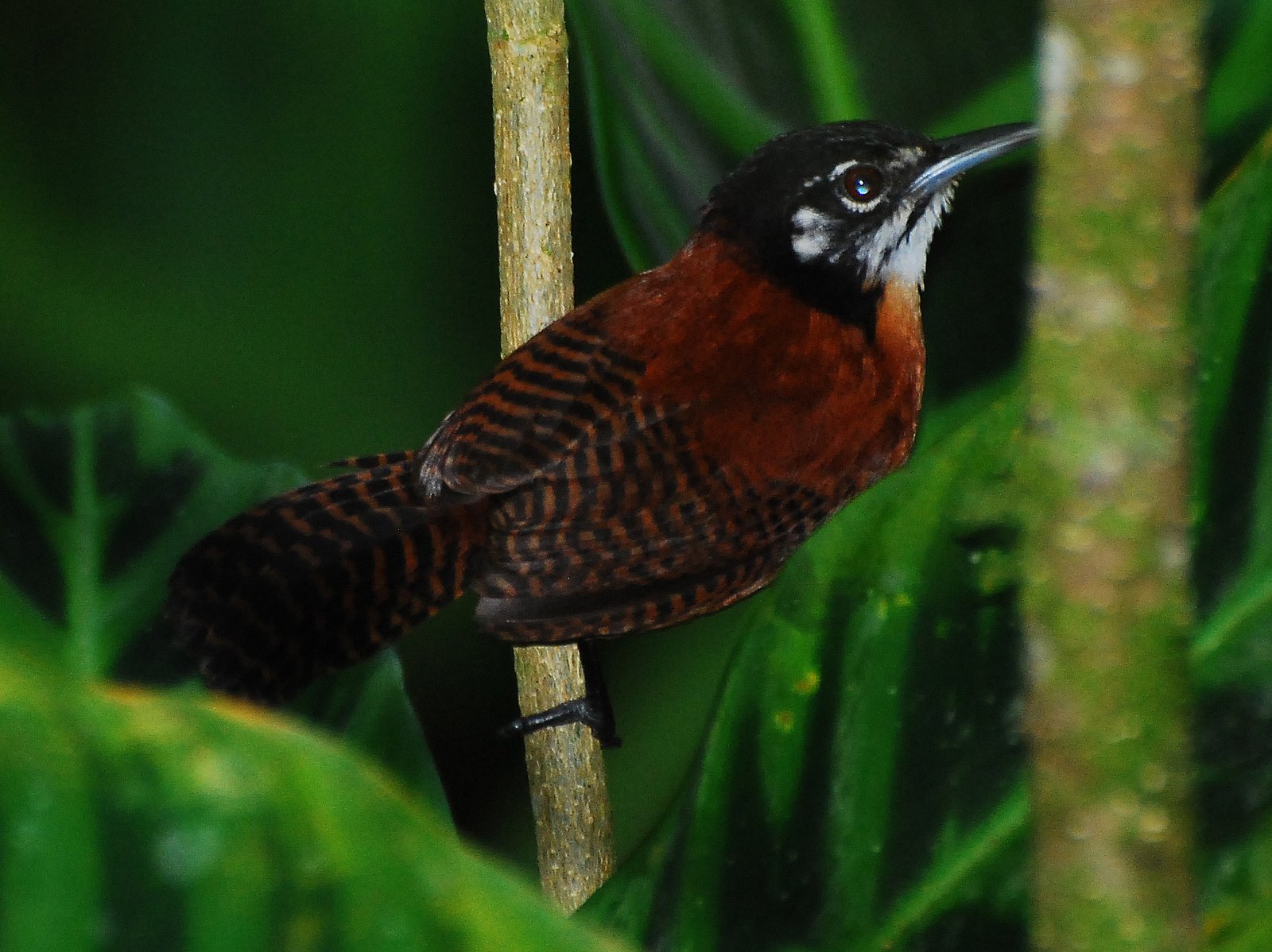
The Bay Wren is a chestnut Cantorchilus wren with a black head, a white patch on the face and a white throat. It lives in dense vegetation near water in humid lowland forest and is a strikingly loud singer.
Voice
One of the loudest singers of lowland forest: pairs sing duets of clear, rolling whistled phrases, rapidly alternated and repeated. Also a harsh rattle and sharp calls.
Recording: Juan Freile — CC BY-NC-SA 4.0 · shortened to the first 60 s, mono · xeno-canto
Identification
14–15 cm. Crown, nape and sides of the head black, with a white patch or stripe behind the eye and white streaks on the cheek. Throat white. Body deep chestnut, wings and tail with narrow black bars. Underparts plain chestnut. Sexes alike.
Confusion species
Riverside Wren Cantorchilus semibadius (Pacific slope of Costa Rica and western Panama) lacks the black crown and has a finely black-and-white barred belly. Black-bellied Wren Pheugopedius fasciatoventris has a white breast and a blackish belly. Rufous-breasted Wren Pheugopedius rutilus has a speckled face and an orange-brown breast.
Habitat
Dense growth of Heliconia, vines and thickets along streams, rivers and marshes, at forest edges and in secondary forest, from the lowlands into the foothills. It forages low to mid-level for insects and spiders.
Where the bird is most at home, classified by the vegetation units of Mexico and Central America.





Range and movements
Caribbean slope of Nicaragua and Costa Rica and much of Panama. Outside the guide area in western Colombia and Ecuador.
- Resident
- dark = core range, pale = thinly spread
How and when to look
Regularly heard at La Selva in Costa Rica and along Pipeline Road (Camino del Oleoducto) in Panama. The loud duet is easy to hear; the bird itself usually stays in dense cover.
Conservation status
Not threatened. Common in suitable habitat and benefits from forest edges and secondary growth.
Scientific name
Cantorchilus nigricapillus | (Sclater, 1860)
Sclater described the species in 1860 as Thryothorus nigricapillus; because it was later moved to another genus, the author and year stand in brackets. The genus Cantorchilus was introduced in 2006 by Mann, Barker, Graves, Dingess-Mann & Slater. Cantorchilus combines Latin cantus 'song' with Greek orkhilos 'wren': 'song wren'. nigricapillus is Latin, from niger 'black' and capillus 'hair of the head', after the black crown. The specimen the first description was based on came from Nanegal, Pichincha, Ecuador.