All species › Passerines › Tityras, becards and allies › Black-and-white Becard
Position in the tree Birds Aves › Birds with a flexible palate Neognathae › All other modern birds Neoaves › Landbirds Telluraves › Falcons, parrots and passerines Australaves › Falcons and passerines Eufalconimorphae › Parrots and passerines Psittacopasserae
Black-and-white Becard | Pachyramphus albogriseus
Eksterbekarde | Cabezón blanquinegro
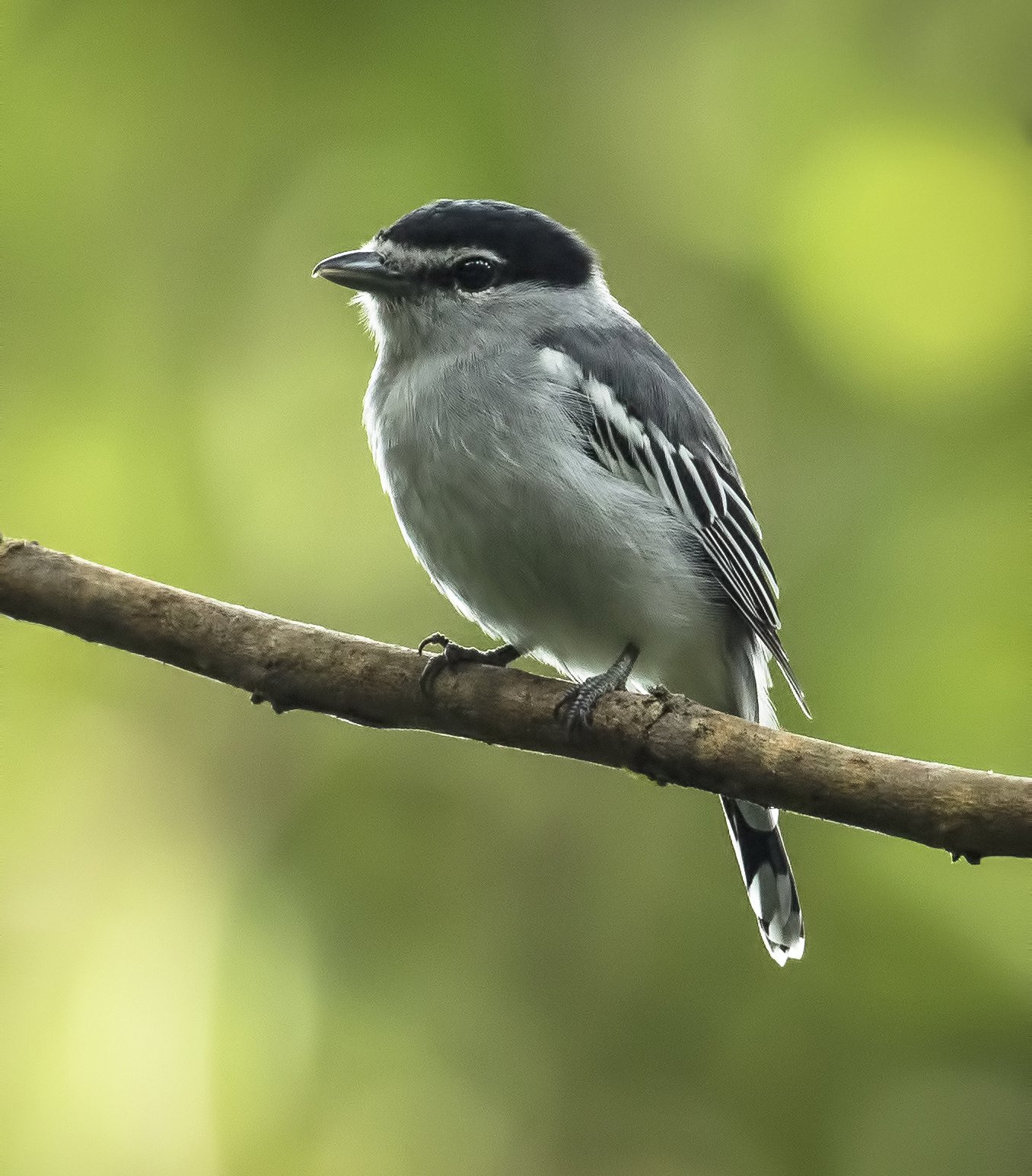
The Black-and-white Becard is a small Pachyramphus becard of montane forest. The male is grey, black and white with a black cap and a white stripe above the eye; the female is olive-green with a chestnut crown. In the guide area it lives only in the mountains of Costa Rica and western Panama.
Voice
A soft, clear whistled series that swells and then fades; also a few short, high call notes.
Recording: rudy gelis — CC BY-NC-SA 4.0 · shortened to the first 60 s, mono · xeno-canto
Identification
14–15 cm. Stocky, with a fairly large head and a short bill. Male with a glossy black crown, a white stripe from the base of the bill to above the eye and black lores; back and rump blue-grey, underparts pale grey. Wings black with two white wing bars and white-edged tertials, tail black with white tips. Female with a chestnut crown bordered black, a white supraloral stripe; back olive-green, underparts yellowish; wing coverts edged cinnamon.
Confusion species
The male White-winged Becard Pachyramphus polychopterus lives mainly lower down, has a black back and lacks the white stripe above the eye. Barred Becard Pachyramphus versicolor, which shares the same montane forest, is smaller, with finely barred underparts and, in the male, a yellow wash on the face.
Habitat
Edges, clearings and the canopy of humid montane and cloud forest, also mature second growth, mainly between about 700 and 2000 m. It eats insects and small fruit, often in mixed flocks moving through the canopy. It builds a large, globular nest.
Where the bird is most at home, classified by the vegetation units of Mexico and Central America.



Range and movements
Mountains of Costa Rica, mainly the Cordillera Central and Cordillera de Talamanca, and western Panama (Chiriquí and Veraguas). Outside the guide area in the Andes and the coastal mountains of Colombia and Venezuela to northern Peru.
- Resident
- dark = core range, pale = thinly spread
How and when to look
Look for it in mixed flocks in cloud forest, for example in the Cordillera de Talamanca in Costa Rica and in the Chiriquí highlands of Panama. It often stays high in the canopy and is best found by its song.
Conservation status
Not threatened. In the guide area fairly scarce and local; dependent on montane forest.
Scientific name
Pachyramphus albogriseus | Sclater, 1857
Sclater described the species in 1857 and placed it straight away in the genus where it still stands. The genus Pachyramphus was introduced in 1840 by Gray. Pachyramphus is Greek, from pakhus 'thick' and rhamphos 'bill', after the stout, broad bill. albogriseus is Latin, from albus 'white' and griseus 'grey', after the black, white and grey male. The specimen the first description was based on came from 'Bogotá', Colombia (trade skin).