All species › Passerines › Tanagers and allies › Black-and-yellow Tanager
Position in the tree Birds Aves › Birds with a flexible palate Neognathae › All other modern birds Neoaves › Landbirds Telluraves › Falcons, parrots and passerines Australaves › Falcons and passerines Eufalconimorphae › Parrots and passerines Psittacopasserae
Black-and-yellow Tanager | Chrysothlypis chrysomelas
Citroentangare | Tangara negriamarilla
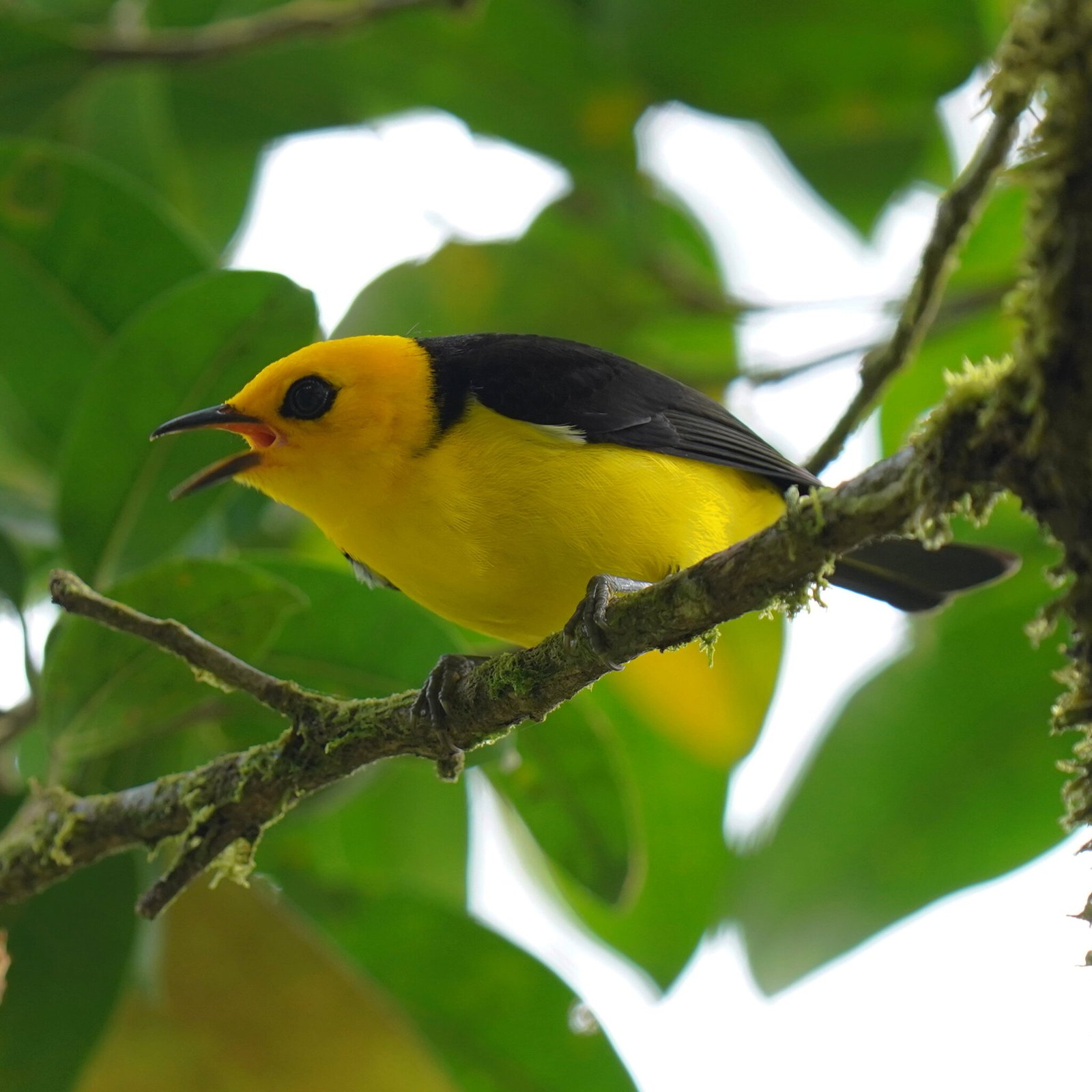
The Black-and-yellow Tanager is a small, active tanager of the foothills that behaves among the leaves more like a warbler than a tanager. The male is bright yellow and black. Its range lies almost entirely within the guide area, from Costa Rica to eastern Panama.
Voice
Calls with high, thin tsit notes. The song is a fast, high series of chipping notes.
Recording: Tyler Wenzel — CC BY-NC-SA 4.0 · converted to mono · xeno-canto
Identification
11–12 cm. A small, slender tanager with a thin, pointed bill. Male bright yellow with black mantle, wings and tail; in some birds the black extends over the crown or nape. Female olive-green above, yellow below, paler on the belly, with darker wings and tail.
Confusion species
Yellow-backed Tanager Hemithraupis flavicollis (eastern Panama) has a black head, a yellow throat and a whitish belly. The female resembles female warblers such as Wilson's Warbler Cardellina pusilla, but has a slightly thicker bill, no cap and moves in flocks with other tanagers. Female White-shouldered Tanagers Loriotus luctuosus have a grey head.
Habitat
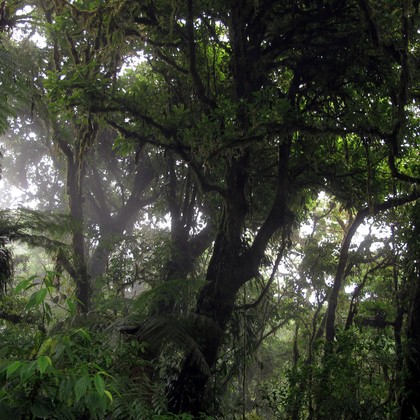
Canopy and middle levels of humid evergreen foothill and lower montane forest, mainly between 300 and 1200 m; also forest edges and tall secondary forest. It travels with mixed flocks and searches the foliage for insects and fruit.
Where the bird is most at home, classified by the vegetation units of Mexico and Central America.


Range and movements
Caribbean slope of Costa Rica and, in the south, also the Pacific slope; in Panama in the foothills of both slopes, east to Darién. Beyond that only in extreme north-western Colombia.
- Resident
- dark = core range, pale = thinly spread
How and when to look
In Panama often seen in mixed flocks on Cerro Azul and Cerro Jefe; in Costa Rica in the Caribbean foothills, for example in Braulio Carrillo.
Conservation status
Not threatened (LC). Fairly common within a rather small range; sensitive to the loss of foothill forest.
Scientific name
Chrysothlypis chrysomelas | (Sclater & Salvin, 1869)
Sclater & Salvin described the species in 1869 as Tachyphonus chrysomelas; because it was later moved to another genus, the author and year stand in brackets. The genus Chrysothlypis was introduced in 1912 by Berlepsch. Chrysothlypis is Greek, from khrusos 'gold' and thlupis, an unidentified small bird, used in ornithology for thin-billed tanagers and warblers. chrysomelas is Greek, from khrusos 'gold' and melas 'black', after the male's yellow and black plumage. The specimen the first description was based on came from Cordillera del Chucú, Veraguas, Panama.