All species › Passerines › Tyrant flycatchers and allies › Black Phoebe
Position in the tree Birds Aves › Birds with a flexible palate Neognathae › All other modern birds Neoaves › Landbirds Telluraves › Falcons, parrots and passerines Australaves › Falcons and passerines Eufalconimorphae › Parrots and passerines Psittacopasserae
Black Phoebe | Sayornis nigricans
Zwarte phoebe | Mosquero negro
The Black Phoebe is a black-and-white tyrant flycatcher almost always found near running or still water. It perches low on a rock, branch or wall, constantly pumps its tail and catches insects in short sallies, often just above the water. In the guide area it lives from northern Mexico to Panama.

Voice
The call is a sharp, short tsip or teep. The song consists of two alternating high two-note phrases, a rising tee-hee and a falling tee-hoo.
Recording: Richard E. Webster — CC BY-NC-SA 4.0 · shortened to the first 60 s, mono · xeno-canto
Identification
16–17 cm. Head, breast and upperparts sooty black, belly and undertail coverts sharply demarcated white. Wing coverts and flight feathers with narrow greyish-white edges; the outer tail feathers have a white outer web. Bill and legs black. Male and female are alike. Juveniles are browner black, with cinnamon wing bars.
Confusion species
The combination of black head and breast with a white belly makes it hard to confuse. Eastern Phoebe Sayornis phoebe (winter visitor in eastern Mexico) is grey-brown above and paler below, without a sharp black-and-white border; Say's Phoebe Sayornis saya is grey-brown with a rusty belly and lives in dry, open country. Torrent Tyrannulet Serpophaga cinerea (Costa Rica and Panama) also perches along fast streams, but is smaller and pale grey with a black cap.
Habitat
Banks of streams and rivers with stones and rocks, lakes, ponds and canals, also in villages and towns where there is water; mainly in mountains and hill country, in the north also in the lowlands. It catches insects from a low perch. The nest, made of mud and plant material, is placed against a rock face, under a bridge or an overhanging roof.
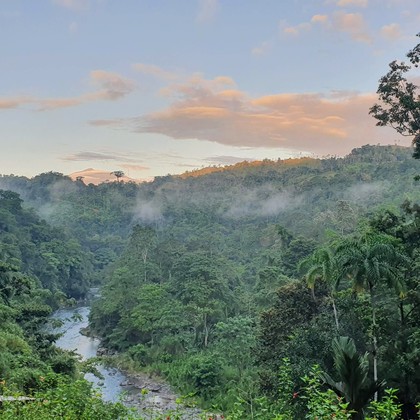
Where the bird is most at home, classified by the vegetation units of Mexico and Central America.



Range and movements
From Baja California and northern Mexico through much of Mexico (absent from the lowlands of the Yucatán Peninsula) and the highlands and hill country of Central America to Panama. Outside the guide area in the south-western United States and in South America, mainly along the Andes to north-western Argentina.
- Resident
- dark = core range, pale = thinly spread
How and when to look
Best found by checking streams and rivers in the mountains; it gives itself away by constant tail-pumping and the sharp tsip call.
Conservation status
Not threatened. Common along water and benefits from bridges and buildings as nest sites.
Scientific name
Sayornis nigricans | (Swainson, 1827)
Swainson described the species in 1827 as Tyrannula nigricans; because it was later moved to another genus, the author and year stand in brackets. The genus Sayornis was introduced in 1854 by Bonaparte. Sayornis honours the American naturalist Thomas Say (1787–1834), via Bonaparte's Muscicapa saya, with Greek ornis 'bird': 'Say's bird'. nigricans is Latin for 'blackish', after the largely black plumage. The specimen the first description was based on came from Valley of Mexico.