All species › Passerines › New World blackbirds, troupials and allies › Brewer's Blackbird
Position in the tree Birds Aves › Birds with a flexible palate Neognathae › All other modern birds Neoaves › Landbirds Telluraves › Falcons, parrots and passerines Australaves › Falcons and passerines Eufalconimorphae › Parrots and passerines Psittacopasserae
Brewer's Blackbird | Euphagus cyanocephalus
Brewers troepiaal | Tordo ojo amarillo
Brewer's Blackbird is a blackbird of open country in western North America. In the guide area it is mainly a winter visitor to northern and central Mexico, where flocks roam over fields, pastures and cattle pens. A small population breeds in northern Baja California.
Voice
The song is a short, creaking kssh-eek, like a squeaky hinge. The call is a dry, metallic check, often repeated in flocks.
Recording: Paul Marvin — CC BY-NC-SA 4.0 · converted to mono · xeno-canto
Identification
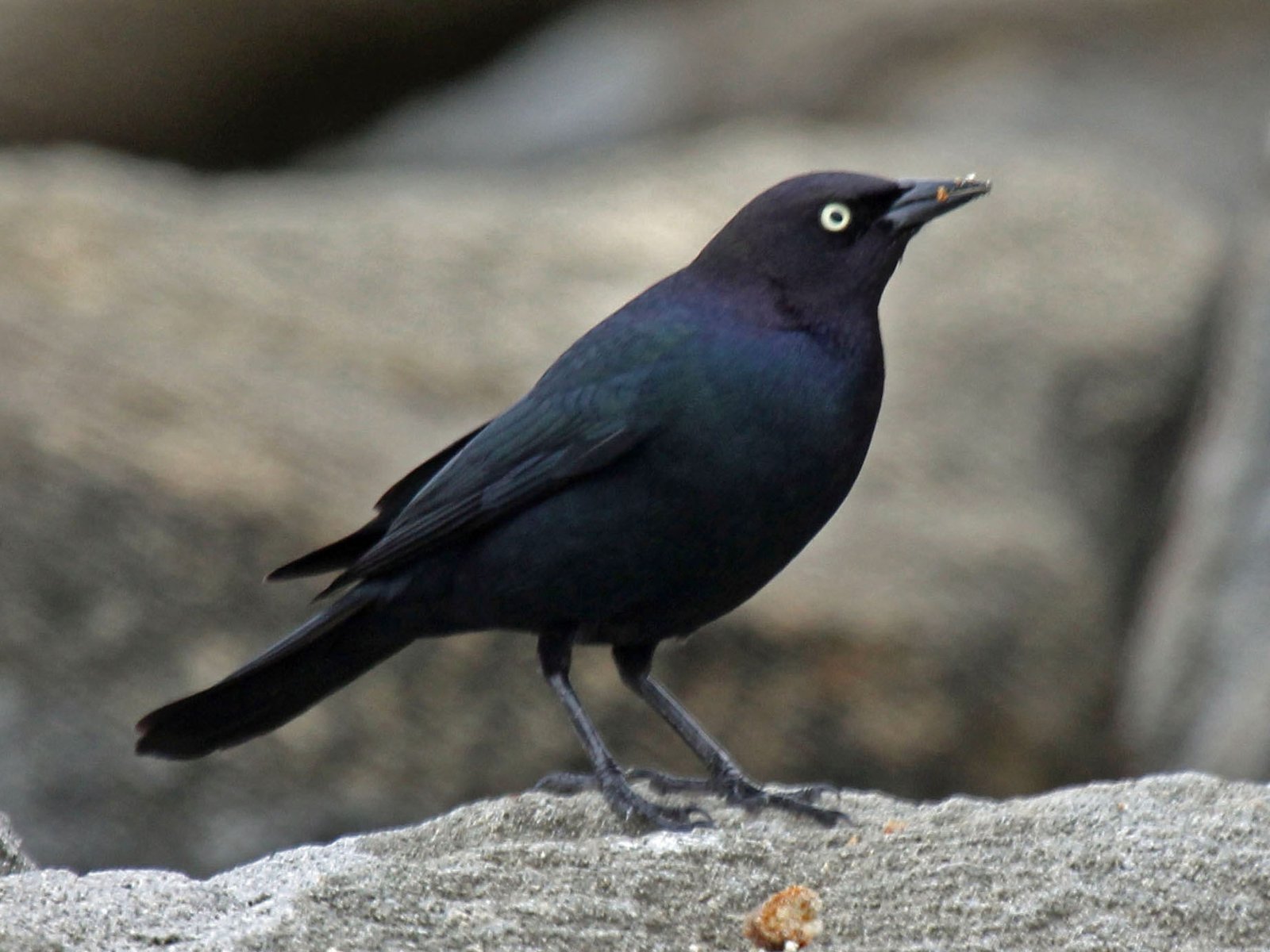
20–25 cm. Male entirely black with a purple gloss on the head and a green-blue gloss on the body; eye pale yellow. Bill straight, pointed and fairly slim. Tail medium-long and square-ended. In winter the male sometimes shows narrow brownish feather edges. Female plain grey-brown, slightly darker on wings and tail, with a dark eye. It walks on the ground with a nodding head.
Confusion species
Common Grackle Quiscalus quiscula, a vagrant in the guide area, is larger, with a longer, keeled tail and a heavier bill. The male Great-tailed Grackle Quiscalus mexicanus is much larger, with a very long tail; the female is warmer brown with a pale throat and supercilium. The female Brown-headed Cowbird Molothrus ater is smaller, with a short, thick bill and a shorter tail. Melodious Blackbird Dives dives has a dark eye and barely overlaps in range.
Habitat
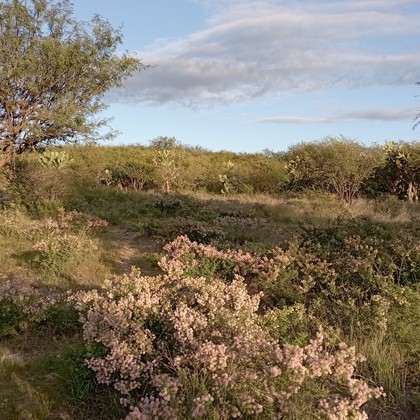
Fields, cattle pastures, feedlots, semi-desert grassland, banks and marsh edges, and in winter also villages and towns with lawns. It forages walking on the ground and eats seeds, grain and insects. Outside the breeding season it forms flocks, often mixed with other blackbirds and cowbirds.
Where the bird is most at home, classified by the vegetation units of Mexico and Central America.



Range and movements
Breeds in south-western Canada and the western and central United States, locally into northern Baja California. Winters in the south of this range and in Mexico. In the guide area in winter scattered across Baja California, northern Mexico and the central plateau, south to about Jalisco, Michoacán, Puebla and Veracruz; rare further south, with a single record in Guatemala.
- Winter visitor (c. Oct–Mar)
- dark = core range, pale = thinly spread
How and when to look
In winter best looked for at cattle pens, feeding sites and freshly ploughed fields on the plateau; males are identified by the yellow eye, females by the dark eye and plain grey-brown colour.
Conservation status
Near Threatened (NT). Still numerous, but the world population has been declining steadily for decades, probably because of changes in agriculture and pesticide use.
Scientific name
Euphagus cyanocephalus | (Wagler, 1829)
Wagler described the species in 1829 as Ps[arocolius] cyanocephalus; because it was later moved to another genus, the author and year stand in brackets. The genus Euphagus was introduced in 1867 by Cassin. Euphagus is Greek, from eu 'good' and -phagos '-eating': 'good eater', probably after the varied diet. cyanocephalus is Greek, from kuanos 'dark blue' and -kephalos '-headed', after the purplish-blue gloss on the male's head. The specimen the first description was based on came from Temascaltepec, State of México (Mexico).