All species › Waders, gulls and terns › Skimmers, noddies, terns and gulls › Bridled Tern
Position in the tree Birds Aves › Birds with a flexible palate Neognathae › All other modern birds Neoaves › Birds of the elements Elementaves › Cranes and waders Gruimorphae
Bridled Tern | Onychoprion anaethetus
Brilstern | Charrán embridado
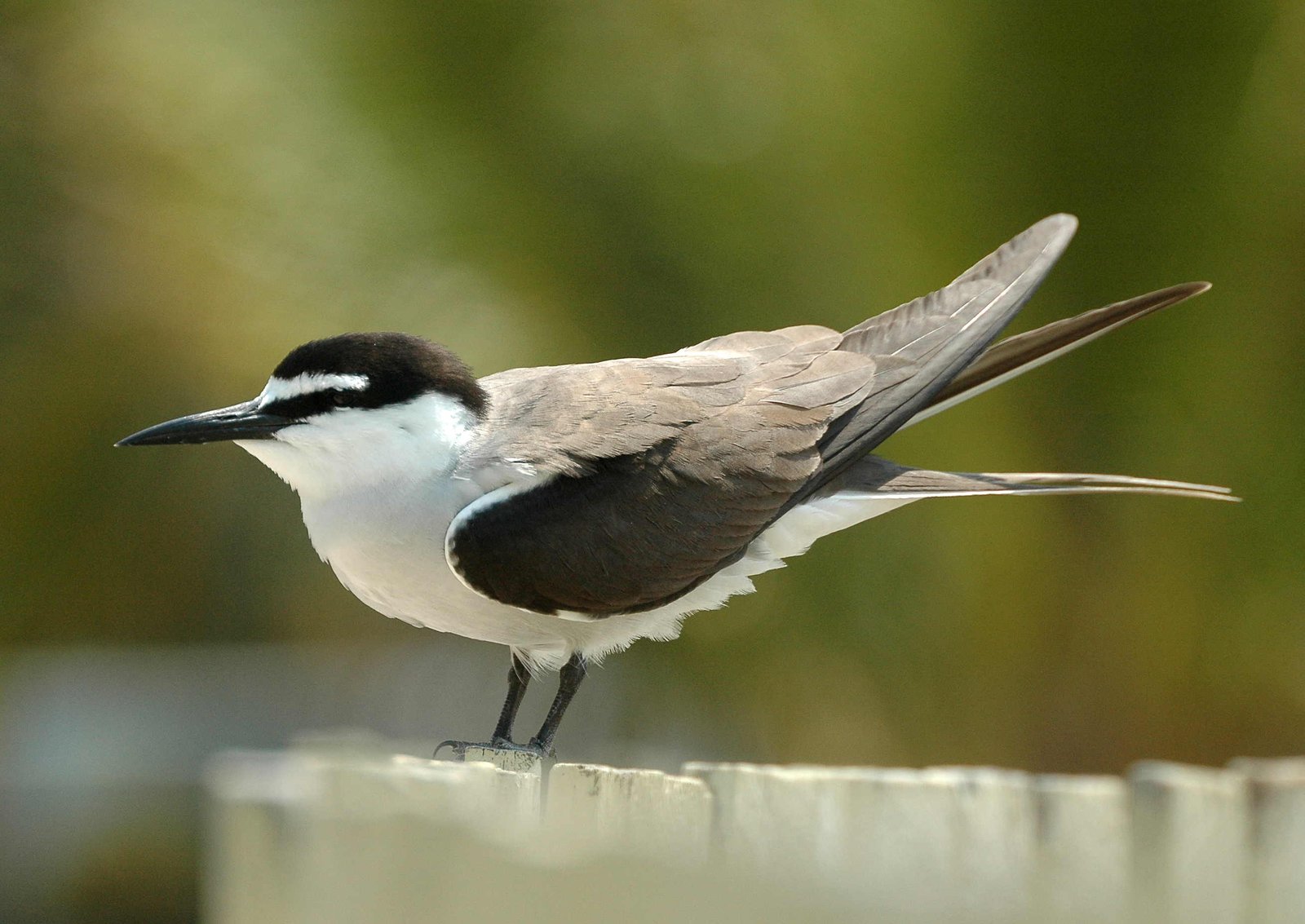
The Bridled Tern is a slender tern with a black cap, a grey-brown back and a white supercilium. It breeds scattered in rock crevices and under vegetation on small islets, and feeds inshore and at sea, often over floating seaweed. It readily rests on driftwood, buoys and posts.
Voice
A barking, yapping wep-wep and a rising, whining wup-weeeoo, mainly at the colony; mostly silent at sea.
Recording: David Darrell-Lambert — CC BY-NC-SA 4.0 · converted to mono · xeno-canto
Identification
30–32 cm excluding the elongated outer tail feathers, with long, narrow wings and a deeply forked tail. The cap is black, the narrow white forehead extends as a supercilium behind the eye, and a black loral stripe runs to the bill. A pale band across the hindneck separates the cap from the grey-brown back and wings. Underparts white; the underwing is largely white with dark tips to the primaries. Bill and legs black. The sexes are alike. Juveniles have pale fringes above, a streaked crown and white underparts.
Confusion species
Sooty Tern Onychoprion fuscatus is larger, with a black back that does not contrast with the cap, no pale collar, a broader white forehead patch that does not extend behind the eye and a darker underwing; juvenile Sooty Terns are largely dark. Sandwich Tern Thalasseus sandvicensis and Common Tern Sterna hirundo are pale grey above.
Habitat
Coastal waters and open sea over the continental shelf and reefs, often along floating mats of seaweed. It breeds in loose colonies on rocky islets, coral cays and cliffs, in crevices, under boulders or under shrubs.
Where the bird is most at home, classified by the vegetation units of Mexico and Central America.





Range and movements
Breeds on cays and islets on the Caribbean side, off the Yucatán Peninsula and Quintana Roo, Belize and Honduras, and locally on rocky islets off the Pacific coast of Mexico and Central America. Elsewhere seen at sea and offshore along both coasts, from western Mexico to Panama. Outside the guide area in tropical seas of the Atlantic and Indian Oceans and the western Pacific; in the eastern Pacific almost confined to the waters off Mexico and Central America.
- Summer visitor (c. Apr–Sep)
- dark = core range, pale = thinly spread
How and when to look
From boats along reefs and cays in the breeding season; resting birds often perch on buoys, posts and floating wood, where the grey-brown back and pale collar show well.
Conservation status
Not threatened. The world population is large. Because nests are scattered in rock crevices, the species is less vulnerable to egg collecting than Sooty Tern, but introduced rats and cats and disturbance on breeding islands are a local threat.
Scientific name
Onychoprion anaethetus | (Scopoli, 1786)
Scopoli described the species in 1786 as Sterna Anaethetus; because it was later moved to another genus, the author and year stand in brackets. The genus Onychoprion was introduced in 1832 by Wagler. Onychoprion comes from Greek onux 'nail, claw' and prion 'saw'. anaethetus goes back to Greek anaisthētos and means 'senseless, stupid'. The specimen the first description was based on came from Panay, Philippines.