All species › Swifts › Hummingbirds › Buff-bellied Hummingbird
Position in the tree Birds Aves › Birds with a flexible palate Neognathae › All other modern birds Neoaves › Birds of the elements Elementaves › Nightjars and swifts Strisores
Buff-bellied Hummingbird | Amazilia yucatanensis
Yucatánamazilia | Colibrí yucateco
The Buff-bellied Hummingbird is the hummingbird of the Gulf lowlands of Mexico and the Yucatán Peninsula. It has a glittering green throat, a pale buff belly and a rufous tail. The northern limit of its range lies in southern Texas.

Voice
A hard, dry chik or chip, and in chases a rapid, squeaky twitter.
Recording: Manuel Grosselet — CC BY-NC-SA 4.0 · converted to mono · xeno-canto
Identification
10–11 cm, with a straight red bill with a dark tip. The upperparts are green, with a rufous, slightly forked tail with bronze edges. Throat and breast are glittering green, the belly and undertail coverts pale buff to cinnamon. The sexes are similar; the female has a less glittering throat and more black on the bill.
Confusion species
Rufous-tailed Hummingbird Amazilia tzacatl has a grey rather than buff belly and a more rufous tail. Cinnamon Hummingbird Amazilia rutila has a cinnamon rather than green throat and breast. Violet-crowned Hummingbird Ramosomyia violiceps has white underparts and a blue-violet crown.
Habitat
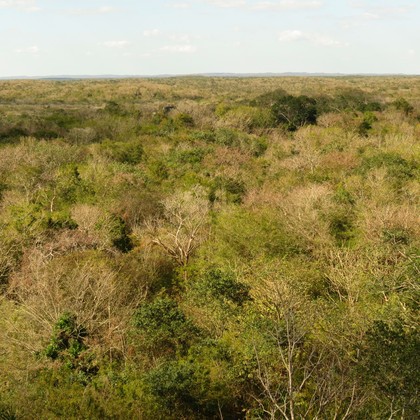
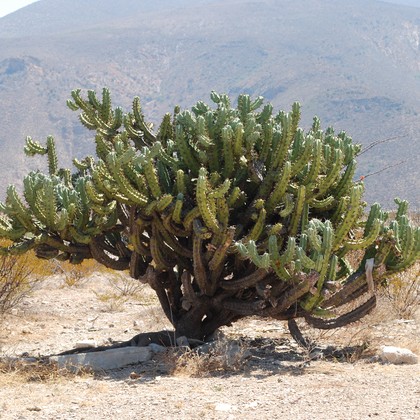
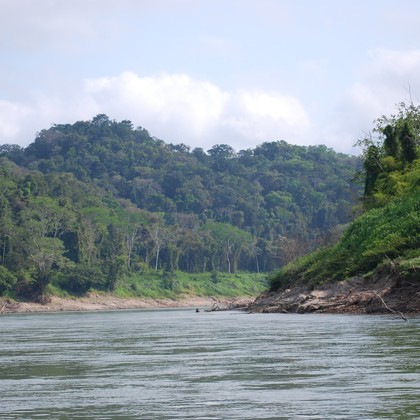
Semi-deciduous forest, thorn scrub, forest edges, riparian woodland, citrus plantations, farmyards and gardens, from sea level to about 1000 m. It feeds at flowers of shrubs and trees, often low down.
Where the bird is most at home, classified by the vegetation units of Mexico and Central America.



Range and movements
In the guide area in north-east Mexico in Nuevo León, Tamaulipas and San Luis Potosí, along the Gulf coast through Veracruz and Tabasco, and on the Yucatán Peninsula; further in northern Belize and Guatemala (Petén). Outside the guide area in southern Texas; from there some birds wander along the Gulf coast of the United States outside the breeding season.
- Resident
- Summer visitor (c. Apr–Sep)
- Winter visitor (c. Oct–Mar)
- dark = core range, pale = thinly spread
How and when to look
In gardens and parks in Mérida and at the ruins of Yucatán, such as Chichén Itzá; on the Gulf coast of Veracruz around La Mancha and Cardel. Often at flowering shrubs and hedges around farmyards.
Conservation status
Least Concern. Common in most of its range.
Scientific name
Amazilia yucatanensis | (Cabot, 1845)
Cabot described the species in 1845 as Trochilus yucatanensis; because it was later moved to another genus, the author and year stand in brackets. The genus Amazilia was introduced in 1843 by Lesson. Amazilia comes from Amazili, an Inca heroine in Jean-François Marmontel's novel Les Incas (1777). yucatanensis means 'of Yucatán', the peninsula in south-eastern Mexico where the species was described. The specimen the first description was based on came from Yucatán, Mexico.