All species › Pigeons and doves › Doves and pigeons › Buff-fronted Quail-Dove
Position in the tree Birds Aves › Birds with a flexible palate Neognathae › All other modern birds Neoaves › Doves, turacos and allies Columbaves › Doves and sandgrouse Columbimorphae
Buff-fronted Quail-Dove | Zentrygon costaricensis
Costaricaanse kwartelduif | Paloma perdiz costarricense
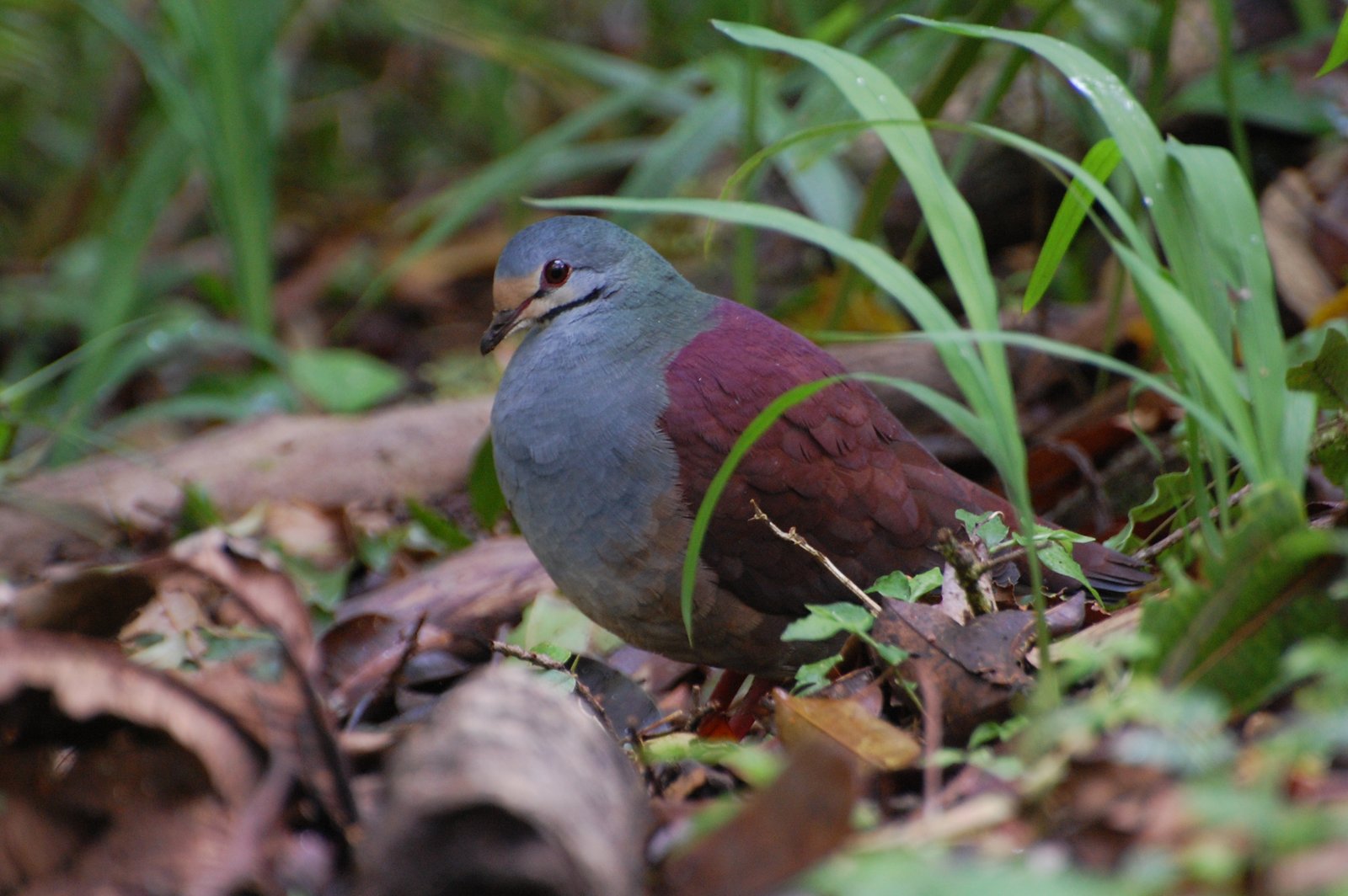
Buff-fronted Quail-Dove is the quail-dove of high montane forest in Costa Rica and western Panama, and the quail-dove that occurs highest there. It lives on the forest floor and, for a quail-dove, is fairly often seen, because at some lodges and gardens it appears on forest trails and at feeding stations. Its name refers to the buff forehead.
Voice
A deep, hollow, somewhat mournful call, woooo, first rising slightly and then falling, repeated for long periods at intervals of a few seconds. It is heard mainly in the early morning, from the ground or a low branch.
Recording: Jorge Gabriel Campos — CC BY-NC-SA 4.0 · converted to mono · xeno-canto
Identification
28–30 cm; a compact quail-dove with a short tail and pink to red legs. The forehead is buff to ochre, the crown and nape blue-grey. The hindneck and upper mantle are glossed green to golden bronze; the rest of the upperparts is warm chestnut with a purple tinge. The face is buff to whitish, with a black moustachial stripe and a white throat. The breast is grey, the belly and undertail coverts ochre-buff. Male and female are almost alike; juveniles are duller, with fine rufous fringes.
Confusion species
Chiriqui Quail-Dove Zentrygon chiriquensis, which lives slightly lower but overlaps locally, has a cinnamon-rufous face and rufous underparts, without a grey breast and without green gloss on the hindneck. Purplish-backed Quail-Dove Zentrygon lawrencii lives lower on the Caribbean slope and has a white face, a purple mantle and olive-brown wings. Ruddy Quail-Dove Geotrygon montana occurs mainly in the lowlands and is plain rusty brown above, with a pale cheek stripe.
Habitat
Wet montane forest and cloud forest from about 1000 to 3000 m, mainly above 1500 m, with abundant moss, epiphytes and bamboo undergrowth; also in old secondary forest and along ravines. It forages on foot on the forest floor for seeds, fallen fruit and small invertebrates and flies off low when disturbed. The nest is a platform of twigs and moss, low in shrubs, bamboo or creepers.
Where the bird is most at home, classified by the vegetation units of Mexico and Central America.

Range and movements
In the mountains of Costa Rica, from the Cordillera de Guanacaste and Cordillera de Tilarán through the Cordillera Central to the Talamanca range, and in western Panama in Chiriquí, Bocas del Toro and the Comarca Ngäbe-Buglé. The species does not occur outside the guide area.
- Resident
- dark = core range, pale = thinly spread
How and when to look
San Gerardo de Dota and the area around Cerro de la Muerte in the Talamanca range, the slopes of Volcán Poás and Monteverde are well-known sites; in Panama the forest trails around Volcán Barú near Boquete and Cerro Punta. At a few lodges birds regularly visit feeding stations or walk across the trails at dusk.
Conservation status
Not threatened. Fairly common in the large protected forests of the Talamanca range and the Cordillera Central. Elsewhere vulnerable to the loss of montane forest.
Scientific name
Zentrygon costaricensis | (Lawrence, 1868)
Lawrence described the species in 1868 as Geotrygon costaricensis; because it was later moved to another genus, the author and year stand in brackets. The genus Zentrygon was introduced in 2013 by Banks, Weckstein, Remsen & Johnson. Zentrygon is a blend of the genera Zenaida and Geotrygon, reflecting these quail-doves' close relationship with Zenaida. costaricensis means 'of Costa Rica', where the species was described from. The specimen the first description was based on came from Costa Rica.