All species › Passerines › New World blackbirds, troupials and allies › Bullock's Oriole
Position in the tree Birds Aves › Birds with a flexible palate Neognathae › All other modern birds Neoaves › Landbirds Telluraves › Falcons, parrots and passerines Australaves › Falcons and passerines Eufalconimorphae › Parrots and passerines Psittacopasserae
Bullock's Oriole | Icterus bullockiorum
Bullocks troepiaal | Bolsero de Bullock
Bullock's Oriole is the western counterpart of Baltimore Oriole. It breeds in western North America, including northern Mexico, and winters mainly in western and central Mexico. Together with Baltimore Oriole and Black-backed Oriole it was formerly treated as a single species; where Bullock's and Baltimore Orioles meet on the Great Plains, hybrids occur.
Voice
The song is a short, irregular series of whistles and rattling notes, less fluid and less melodious than that of Baltimore Oriole. The call is a dry rattle, as well as a short, sharp chek.
Recording: Richard E. Webster — CC BY-NC-SA 4.0 · converted to mono · xeno-canto
Identification
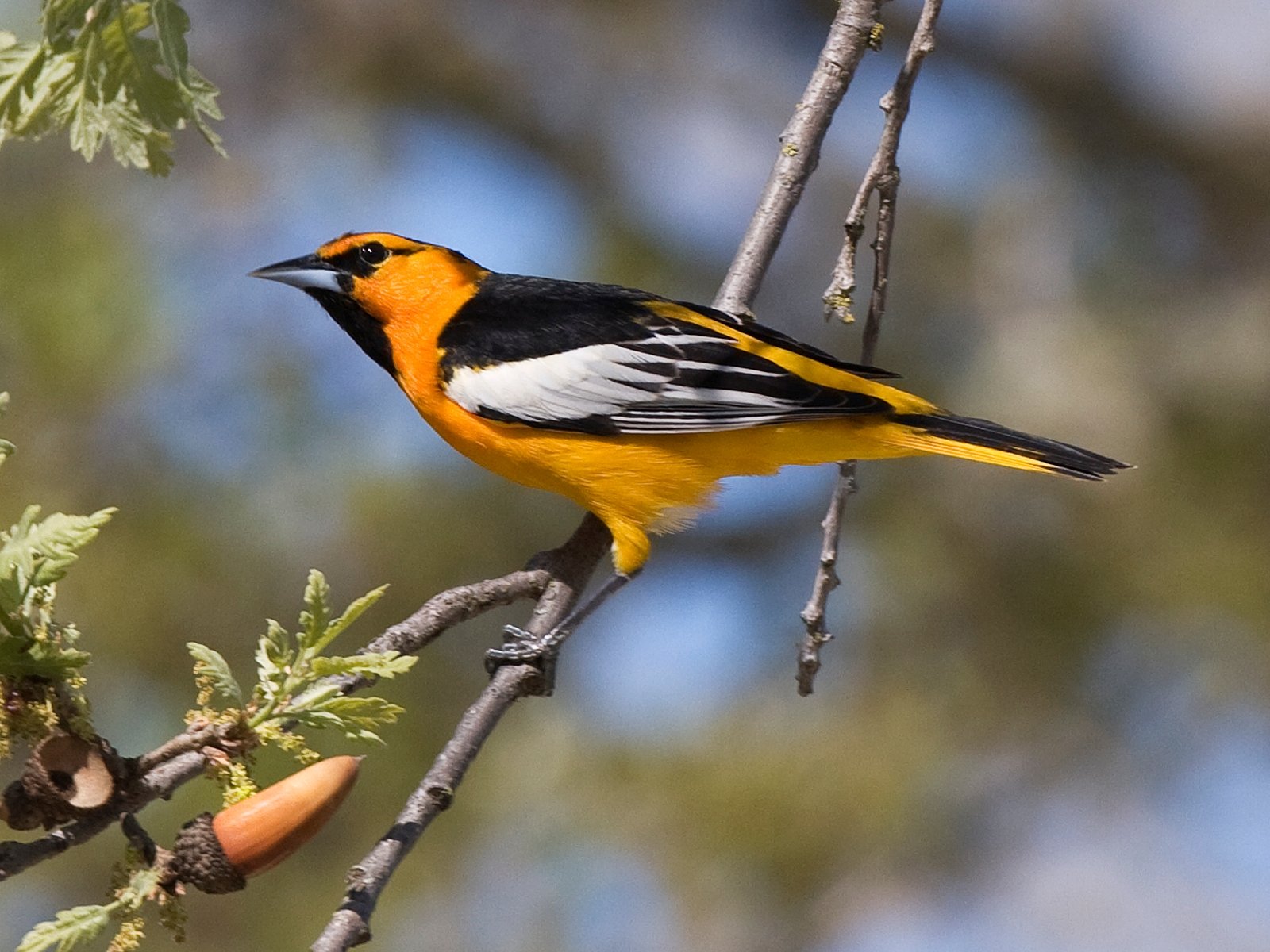
17–19 cm. Medium-sized oriole with a straight, pointed bill. The male is orange with a black crown, nape and back, a black eye-stripe and a narrow black throat patch; supercilium and cheeks are orange. The black wing has a large white patch on the wing coverts; the tail has orange sides and a black centre and tip. The female is greyish on the back, with a yellowish head and breast and a pale greyish-white belly; she has two white wing bars. Young males resemble the female but have a black throat patch and black between eye and bill.
Confusion species
The male Baltimore Oriole Icterus galbula has an all-black head without orange cheek and supercilium and only a single white wing bar; the female is usually more orange on breast and belly and lacks a grey belly. The male Black-backed Oriole Icterus abeillei of the Mexican highlands has an almost entirely black head and black flanks. Hooded Oriole Icterus cucullatus has a thinner, slightly curved bill, an orange or yellow crown and two narrow wing bars instead of a large white patch. Streak-backed Oriole Icterus pustulatus has a streaked back.
Habitat
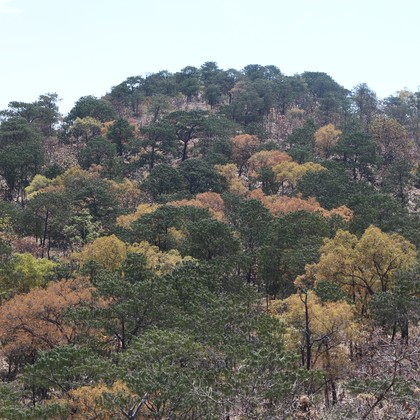
Breeds in open woodland along rivers, especially with cottonwoods and willows, in oak woodland and in parks and orchards in dry regions. In winter in dry forest, forest edges, open country with scattered trees and gardens, often at flowering trees where it drinks nectar. It also eats insects, caterpillars and fruit. The nest is a hanging pouch at the end of a branch.
Where the bird is most at home, classified by the vegetation units of Mexico and Central America.



Range and movements
Breeds from south-western Canada through the western United States to northern Mexico, in the guide area mainly in Baja California, Sonora, Chihuahua, Coahuila, Durango and Nuevo León. Winters in western and central Mexico, from Sinaloa and Durango to Guerrero, Oaxaca and Puebla; in small numbers further south to Guatemala and rarely to Costa Rica.
- Resident
- Summer visitor (c. Apr–Sep)
- Winter visitor (c. Oct–Mar)
- Passage (Mar–Apr, Oct–Nov)
- dark = core range, pale = thinly spread
How and when to look
In winter often found in flowering trees in dry forest and villages on the Pacific side of Mexico, where other orioles also come to drink nectar; in females, check for the grey belly.
Conservation status
Not threatened (LC). Widespread and common in western North America. The loss of riparian woodland in dry regions is a local threat.
Scientific name
Icterus bullockiorum | (Swainson, 1827)
Swainson described the species in 1827 as Xanthornus Bullockii; because it was later moved to another genus, the author and year stand in brackets. The genus Icterus was introduced in 1760 by Brisson. Icterus is from Ancient Greek ikteros, a yellow bird usually taken to be the golden oriole, the sight of which was thought to cure jaundice. bullockiorum honours 'the Bullocks': the English naturalist and showman William Bullock (c. 1773–1849) and his son William (c. 1796–c. 1827), who collected in Mexico. The specimen the first description was based on came from Temascaltepec, Mexican tableland.