All species › Passerines › Tyrant flycatchers and allies › Cattle Tyrant
Position in the tree Birds Aves › Birds with a flexible palate Neognathae › All other modern birds Neoaves › Landbirds Telluraves › Falcons, parrots and passerines Australaves › Falcons and passerines Eufalconimorphae › Parrots and passerines Psittacopasserae
Cattle Tyrant | Machetornis rixosa
Veetiran | Picabuey
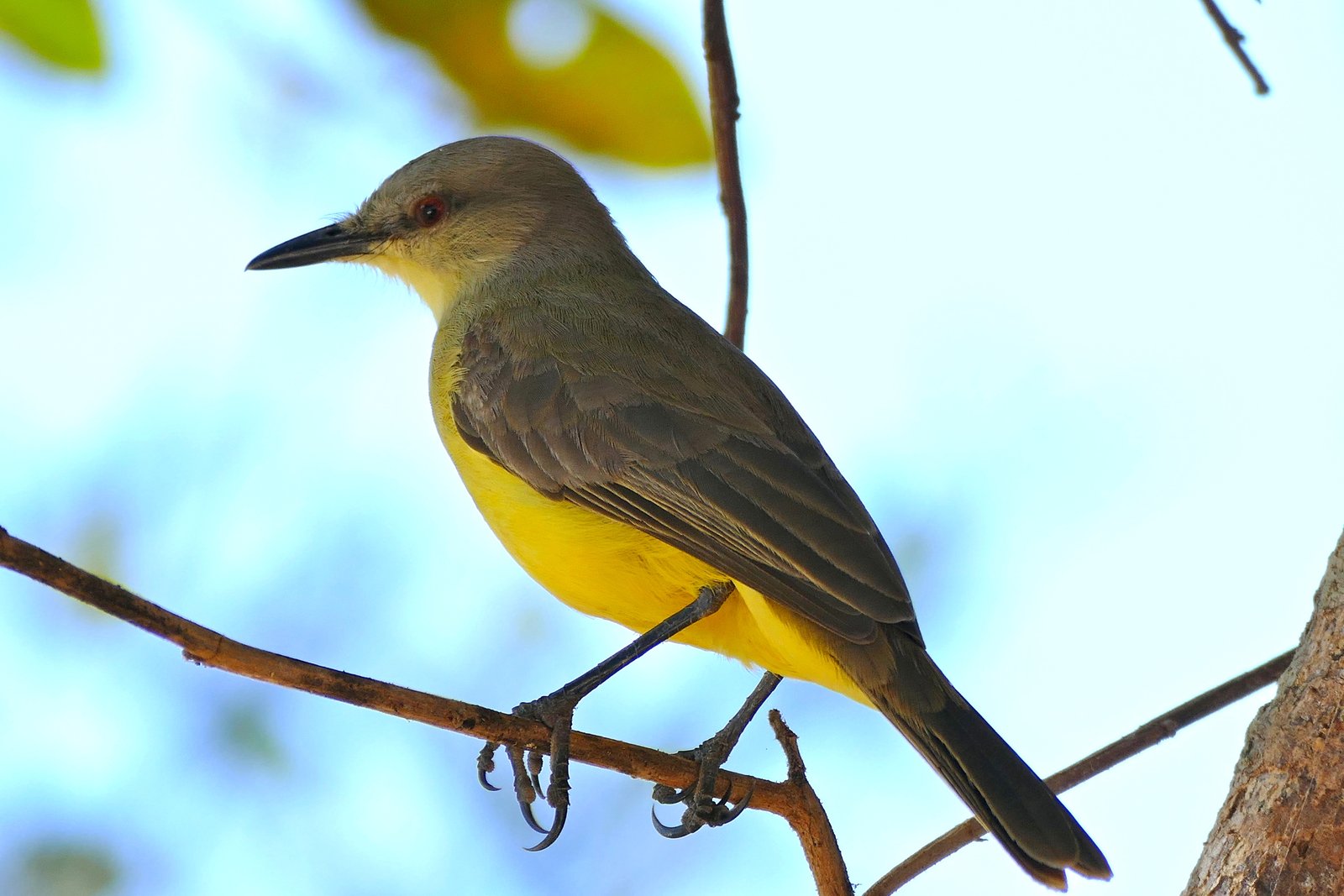
The Cattle Tyrant is a long-legged tyrant flycatcher of open grazed land that spends much time on the ground and likes to feed among grazing livestock, sometimes even riding on the back of a cow or horse. It resembles a kingbird, but runs over the ground. In the guide area it occurs only in eastern Panama, where it has colonised from Colombia.
Voice
High, thin, squeaky calls, and a rapid series of such notes as song, mainly at dusk and dawn. Often silent.
Recording: Glauko Corrêa da Silva — CC BY-NC-SA 4.0 · converted to mono · xeno-canto
Identification
19–20 cm, with long legs and a fairly short, slender black bill. Head grey with a dark eye-stripe; an orange-red crown patch is usually concealed. Back and wings greyish-brown to olive-brown, tail brown with paler tips. Throat yellowish-white, rest of the underparts bright yellow. The eye is reddish. Male and female are alike.
Confusion species
Tropical Kingbird Tyrannus melancholicus perches upright on wires and exposed branches, hunts in the air and hardly ever walks on the ground; it has a greyer head and a notched tail. Great Kiskadee Pitangus sulphuratus and Social Flycatcher Myiozetetes similis have a striking black-and-white striped head.
Habitat
Pasture with livestock, grassland with scattered trees, farmyards and the edges of villages, often near water. It walks and runs over the ground and catches insects flushed by grazing animals; it also perches on the backs of livestock or on fences and roofs. The nest is a cup of grass and other material in a cavity, among palm fronds or in an old nest of another bird.
Where the bird is most at home, classified by the vegetation units of Mexico and Central America.


Range and movements
In the guide area only in eastern Panama, where the species has appeared only in recent decades and is spreading westward. Outside the guide area in northern Colombia and Venezuela and over much of the open country of South America, to northern Argentina and Uruguay.
- Resident
- dark = core range, pale = thinly spread
How and when to look
Best seen in pastures with livestock in eastern Panama, where it walks among the legs of grazing animals or rides on their backs.
Conservation status
Not threatened. Benefits from deforestation and the creation of pasture; in Panama still rather scarce and local, but increasing.
Scientific name
Machetornis rixosa | (Vieillot, 1819)
Vieillot described the species in 1819 as Tyrannus rixosus; because it was later moved to another genus, the author and year stand in brackets. The genus Machetornis was introduced in 1841 by Gray. Machetornis is Greek, from makhētēs 'fighter' and ornis 'bird', after its combative behaviour and habit of taking over other species' nests. rixosa is from Latin rixosus 'quarrelsome', after its combative behaviour. The specimen the first description was based on came from Paraguay.