All species › Passerines › New World warblers › Chestnut-capped Warbler
Position in the tree Birds Aves › Birds with a flexible palate Neognathae › All other modern birds Neoaves › Landbirds Telluraves › Falcons, parrots and passerines Australaves › Falcons and passerines Eufalconimorphae › Parrots and passerines Psittacopasserae
Chestnut-capped Warbler | Basileuterus delattrii
Delattres zanger | Reinita cabecicastaña
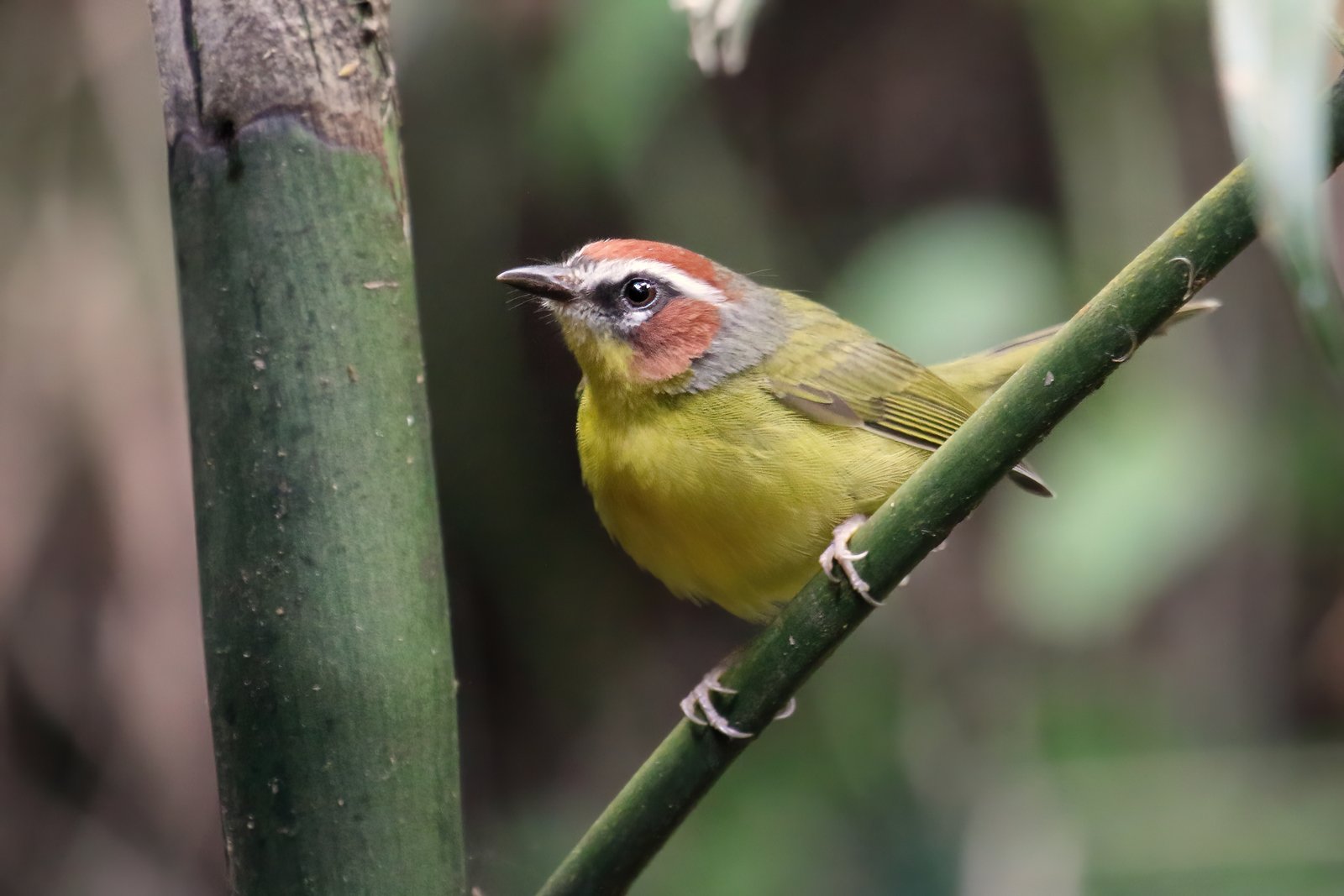
The Chestnut-capped Warbler is a small warbler with a chestnut crown and cheek, a white eyebrow and entirely yellow underparts. It lives in scrub, forest edges and coffee plantations from Guatemala to Panama and on into northern South America. It was long regarded as a subspecies of Rufous-capped Warbler.
Voice
The song is an accelerating series of dry chips ending in a short, clear flourish, roughly chip chip chip chip-chewee-chee, similar to that of Rufous-capped Warbler. The call is a dry tsik.
Recording: Paul Driver — CC BY-NC-SA 4.0 · converted to mono · xeno-canto
Identification
12–13 cm. Crown and cheek patch chestnut, separated by a narrow white eyebrow; below that a short white stripe. Upperparts olive-green. Underparts entirely bright yellow from throat to undertail coverts, with an olive-green wash on the flanks. Tail long, often flicked and held cocked. Sexes alike.
Confusion species
Rufous-capped Warbler Basileuterus rufifrons, whose range meets this species' in Guatemala, has a dull white belly and a more rufous head; intermediates occur. Golden-browed Warbler Basileuterus belli has a yellow eyebrow. Black-cheeked Warbler Basileuterus melanogenys in the mountains of Costa Rica and western Panama has a black cheek patch and yellowish or greyish-white underparts.
Habitat
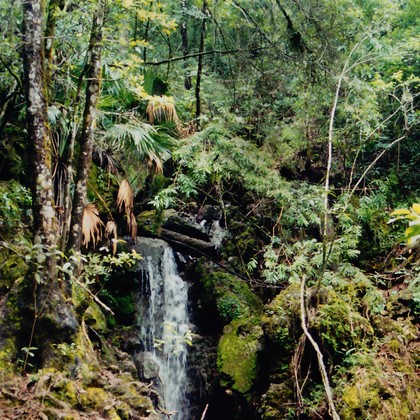
Scrub, forest edges, secondary forest, shade coffee and hedgerows with trees in dry and humid regions, from sea level to about 2000 m. It searches for insects low in the vegetation, usually in pairs.
Where the bird is most at home, classified by the vegetation units of Mexico and Central America.





Range and movements
Occurs from southern Guatemala and El Salvador through Honduras, Nicaragua and Costa Rica to Panama, and on into northern Colombia and western Venezuela; in Costa Rica and Panama mainly on the Pacific slope and in the central highlands.
- Resident
- dark = core range, pale = thinly spread
How and when to look
Common in coffee plantations and scrub around the Central Valley of Costa Rica and in the Chiriquí highlands of Panama; the dry, accelerating song is often heard first.
Conservation status
Not threatened (LC). Common and widespread; benefits from scrub and farmland with trees.
Scientific name
Basileuterus delattrii | Bonaparte, 1854 (GBIF: Basileuterus rufifrons)
Bonaparte described the species in 1854 and placed it straight away in the genus where it still stands. The genus Basileuterus was introduced in 1848 by Cabanis. Basileuterus is Greek, from basileuteros 'more kingly', after the coloured crown stripe recalling a little crown. delattrii honours the French naturalist and collector Adolphe Delattre (1805–1854), who collected in Nicaragua and Mexico. The specimen the first description was based on came from Nicaragua.