All species › Passerines › Tanagers and allies › Cinnamon-bellied Flowerpiercer
Position in the tree Birds Aves › Birds with a flexible palate Neognathae › All other modern birds Neoaves › Landbirds Telluraves › Falcons, parrots and passerines Australaves › Falcons and passerines Eufalconimorphae › Parrots and passerines Psittacopasserae
Cinnamon-bellied Flowerpiercer | Diglossa baritula
Mexicaanse berghoningkruiper | Picaflor canelo
The Cinnamon-bellied Flowerpiercer is a small mountain tanager with an upturned bill hooked at the tip. With it, it pierces flowers at the base and drinks nectar without pollinating the flower. The male is slate-grey with cinnamon underparts. The species lives only in the guide area, from western Mexico to Honduras and northern Nicaragua.

Voice
Song a high, thin and rapid twitter, a jumbled series of fine notes and trills often lasting more than two seconds. Call a high, sharp tsit.
Recording: Manuel Grosselet — CC BY-NC-SA 4.0 · converted to mono · xeno-canto
Identification
10.5–11.5 cm. Male dark slate-grey to bluish-grey above and on head and throat, breast and belly uniform cinnamon. Bill black, short, with an upturned lower mandible and a hooked tip to the upper mandible. The female is greyish olive-brown above, pale buff to dull cinnamon below, with faint streaks on the breast. Young birds resemble the female.
Confusion species
Hardly confusable because of the bill shape. The male Cinnamon-rumped Seedeater Sporophila torqueola has a short, thick bill, a white throat and small wing patches. Females can suggest female warblers or seedeaters, but the thin, hooked bill and the behaviour at flowers are distinctive. Slaty Flowerpiercer Diglossa plumbea occurs only in Costa Rica and Panama and lacks cinnamon underparts.
Habitat
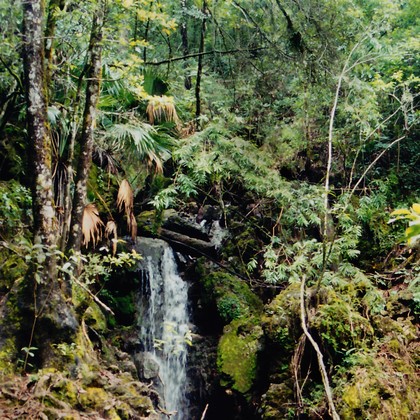
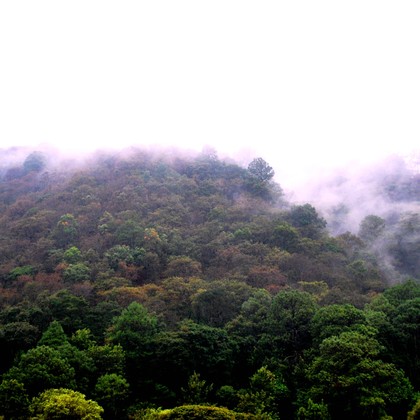
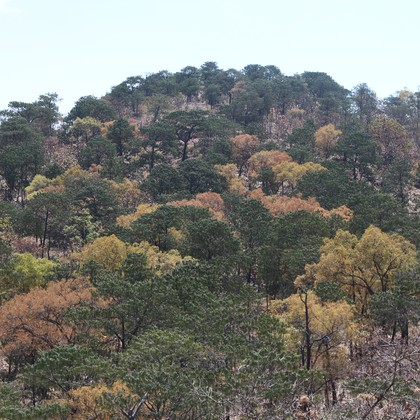
Edges and clearings of cloud forest, oak and pine-oak forest, scrub, flowery slopes, hedges and gardens in the mountains, mostly between 1200 and 3500 m. It visits flowering shrubs such as sage and fuchsia and eats small insects as well as nectar. Outside the breeding season it sometimes moves to lower areas.
Where the bird is most at home, classified by the vegetation units of Mexico and Central America.

Range and movements
Mountains of western and southern Mexico, from Jalisco and Michoacán east to Puebla and Veracruz and south through Guerrero, Oaxaca and Chiapas, further in Guatemala, El Salvador, Honduras and northern Nicaragua. It does not occur outside the guide area.
- Resident
- dark = core range, pale = thinly spread
How and when to look
Often seen at flowering sage and other tubular flowers in gardens and along roads in the mountains, for example around San Cristóbal de las Casas in Chiapas and in the highlands of Guatemala. Hummingbirds regularly chase it from the flowers.
Conservation status
Not threatened (LC). Common in the mountains; it adapts to gardens and flowery scrub.
Scientific name
Diglossa baritula | Wagler, 1832
Wagler described the species in 1832 and placed it straight away in the genus where it still stands. He introduced the genus Diglossa in that same work. Diglossa is Greek, from diglōssos 'double-tongued' (di- 'double', glōssa 'tongue'), after the split tongue of these nectar-feeders. baritula is a diminutive of Barita, Cuvier's genus name for the Australian butcherbirds: 'little Barita', after the hooked bill. The specimen the first description was based on came from Mexico.