All species › Woodpeckers and allies › Woodpeckers › Cinnamon Woodpecker
Position in the tree Birds Aves › Birds with a flexible palate Neognathae › All other modern birds Neoaves › Landbirds Telluraves › Raptors, owls, kingfishers and woodpeckers Afroaves › Mousebirds, rollers and woodpeckers Coraciimorphae › Trogons and cavity nesters Cavitaves › Hornbills, kingfishers and woodpeckers Picocoraciae › Kingfishers, bee-eaters and woodpeckers Picodynastornithes
Cinnamon Woodpecker | Celeus loricatus
Roodkeelspecht | Carpintero canelo
The Cinnamon Woodpecker is a medium-sized, cinnamon-brown woodpecker with a short, bushy crest and densely black-scaled underparts. It lives in the canopy of humid lowland forest and mainly gives itself away by its clear, falling whistled call. In the guide area it occurs from south-eastern Nicaragua to Panama.

Voice
A clear, loud, falling series of whistles, pee-pee-pee-pew, often with the last note lower. Also a rasping chew or weet-trr. Drums briefly and rarely.
Recording: Juan Freile — CC BY-NC-SA 4.0 · shortened to the first 60 s, mono · xeno-canto
Identification
20–22 cm. Head, back and wings are warm cinnamon-brown, the back with narrow, scattered black bars. The head carries a short, rounded, bushy crest. The underparts are paler, pale cinnamon to creamy white, with bold black, scale-like barring on the breast and flanks. The rump is paler than the back. The male has a red throat and red moustache; the female lacks red. The bill is fairly short and pale grey to yellowish.
Confusion species
Chestnut-colored Woodpecker Celeus castaneus (south to western Panama) is larger and much darker chestnut, with a strikingly pale, yellowish to cinnamon head with a long crest and black V-shaped marks on the body; the male has red on the cheek rather than the throat. No other cinnamon-coloured woodpeckers occur in the guide area.
Habitat
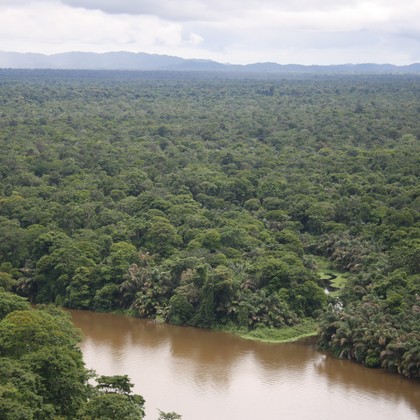
Canopy and middle layer of humid lowland forest and tall secondary forest, also forest edges, swamp forest and semi-open areas with tall trees, from sea level to about 750 m. It feeds mainly on ants and termites, which it digs from branches and nests in the treetops, and also eats fruit. It excavates a nest hole in a dead tree or branch.
Where the bird is most at home, classified by the vegetation units of Mexico and Central America.




Range and movements
From south-eastern Nicaragua (Caribbean slope) through Costa Rica, mainly on the Caribbean slope, to Panama, where it occurs on both slopes but is commonest on the Caribbean side and in the east. Outside the guide area in western Colombia and western Ecuador.
- Resident
- dark = core range, pale = thinly spread
How and when to look
Regularly heard and seen along Pipeline Road (Camino del Oleoducto) and in Soberanía National Park in Panama and at La Selva and Tortuguero in Costa Rica. The falling whistle gives the bird away; then it pays to search high in the crowns.
Conservation status
Not threatened. Locally fairly common in humid lowland forest, but dependent on forest with tall trees.
Scientific name
Celeus loricatus | (Reichenbach, 1854)
Reichenbach described the species in 1854 as Meiglyptes loricatus; because it was later moved to another genus, the author and year stand in brackets. The genus Celeus was introduced in 1831 by Boie. Celeus comes from Greek keleos, a name for a green woodpecker. loricatus is Latin for 'clad in mail, breast-plated', after the scaled pattern on the breast. The specimen the first description was based on came from Peru.