All species › Passerines › New World sparrows › Clay-colored Sparrow
Position in the tree Birds Aves › Birds with a flexible palate Neognathae › All other modern birds Neoaves › Landbirds Telluraves › Falcons, parrots and passerines Australaves › Falcons and passerines Eufalconimorphae › Parrots and passerines Psittacopasserae
Clay-colored Sparrow | Spizella pallida
Bleke gors | Gorrión pálido
The Clay-colored Sparrow is a small, buff-brown sparrow with a streaked crown and a sharply outlined cheek patch. It breeds on the northern prairies of North America and winters mostly in Mexico, where it occurs in flocks in dry, open country with shrubs.

Voice
The song consists of two to four low, buzzy, insect-like notes, such as bzzz bzzz bzzz; in the guide area sometimes heard in spring. The call is a soft, short tsip.
Recording: Stanislas Wroza — CC BY-NC-SA 4.0 · shortened to the first 60 s, mono · xeno-canto
Identification
12–14 cm. Small and slim with a fairly long tail. Crown brown with black streaks and a distinct pale median stripe. Broad, pale supercilium; buff-brown cheek patch sharply outlined by a dark post-ocular stripe and a dark moustachial stripe, with a pale submoustachial stripe and a thin dark malar stripe below. Nape grey. Back buff-brown with black streaks, rump brown. Underparts unstreaked, breast and flanks pale buff. Bill pink with a dark tip. The sexes are alike; in autumn especially young birds are buffier.
Confusion species
Chipping Sparrow Spizella passerina in non-breeding plumage has a dark eye-stripe reaching the bill, a less sharply outlined cheek and a grey rump. Brewer's Sparrow Spizella breweri is greyer and more finely streaked, with a white eye-ring, a fainter cheek patch, no pale median crown stripe and a less grey nape.
Habitat
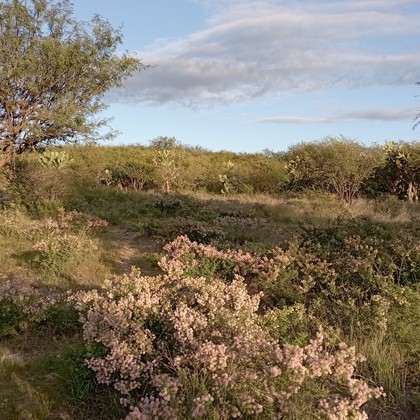
In winter semi-desert grassland, dry, open country with shrubs, thornscrub, field edges, hedgerows and pasture with shrubs, from sea level up to the plateau. It lives in flocks, often together with other Spizella species, and forages for seeds on the ground close to the cover of shrubs.
Where the bird is most at home, classified by the vegetation units of Mexico and Central America.




Range and movements
Breeds in southern Canada and the northern and central United States, mainly on the Great Plains. Migrates through the southern Great Plains and winters in southern Texas and in Mexico, from Baja California Sur and Sonora to Tamaulipas and south to Oaxaca and Chiapas; scarce in Guatemala.
- Winter visitor (c. Oct–Mar)
- dark = core range, pale = thinly spread
How and when to look
In winter best found by checking flocks of sparrows along scrubby edges in dry farmland; Clay-colored Sparrow often mixes with Chipping and Brewer's Sparrows, and the sharply outlined cheek patch and grey nape help to pick it out.
Conservation status
Not threatened (LC). Common, but numbers have declined on the breeding grounds through the conversion of shrubby grassland to cropland.
Scientific name
Spizella pallida | (Swainson, 1832)
Swainson described the species in 1832 as Emberiza pallida; because it was later moved to another genus, the author and year stand in brackets. The genus Spizella was introduced in 1831 by Bonaparte. Spizella is a diminutive of the Greek spiza 'finch': 'little finch'. pallida is Latin for 'pale', after the pale, sandy plumage. The specimen the first description was based on came from Carlton House, Saskatchewan (Canada).