All species › Swifts › Swifts › Costa Rican Swift
Position in the tree Birds Aves › Birds with a flexible palate Neognathae › All other modern birds Neoaves › Birds of the elements Elementaves › Nightjars and swifts Strisores
Costa Rican Swift | Chaetura fumosa
Costaricaanse gierzwaluw | Vencejo costarricense
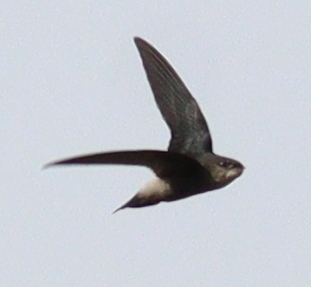
The Costa Rican Swift is a small, dark swift with a small world range: the Pacific slope of south-western Costa Rica and adjacent western Panama. It was long regarded as a subspecies of the Band-rumped Swift, which occurs further east in Panama. It hunts in groups over forest, forest edges and open farmland, often together with Vaux's Swift.
Voice
A rapid, dry twittering of short chip notes and a high, buzzy tsee-tsee, mainly from groups hunting low over forest or a clearing.
No recording with a suitable Creative Commons licence is available for this species yet.
Identification
11 cm. Small, with a short tail with spiny feather shafts and narrow wings that are broadest in the middle. The upperparts are blackish brown, with a greyish-white band across the rump that contrasts with the dark back and dark uppertail coverts. The throat is pale grey, blending into the sooty brown underparts. Male and female are alike. In flight, rapid fluttering wingbeats with short glides.
Confusion species
Vaux's Swift Chaetura vauxi, which occurs in the same area, has a rump only slightly paler greyish brown than the back, without a distinct band. The Grey-rumped Swift Chaetura cinereiventris has a broad grey rump, a glossy blue-black back and paler grey underparts, and lives mainly on the Caribbean side. The Band-rumped Swift Chaetura spinicaudus is very similar to the Costa Rican Swift but occurs only further east in Panama. The Chimney Swift Chaetura pelagica is larger and uniformly dark and only passes through in spring and autumn.
Habitat
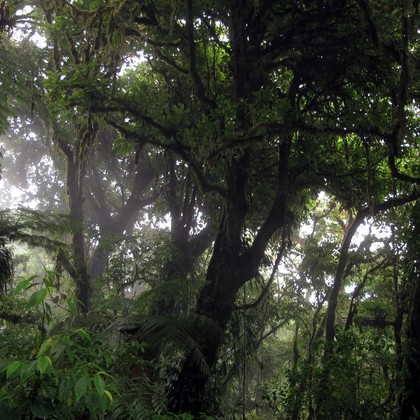
Hunts above the canopy and edges of lowland rainforest and humid foothill forest, over secondary forest, pastures with trees, plantations and river valleys, from sea level to about 1500 m. Hunts small flying insects in groups. Probably nests in hollow trees, like related species; little is known about its breeding.
Where the bird is most at home, classified by the vegetation units of Mexico and Central America.





Range and movements
Endemic to the guide area. In Costa Rica on the Pacific side, from the area around the Gulf of Nicoya and Carara south through the valleys of El General and Coto Brus to the Osa Peninsula and around the Golfo Dulce. In Panama in western Chiriquí. Not known from the rest of the guide area.
- Resident
- dark = core range, pale = thinly spread
How and when to look
Groups are regularly seen over forest edges and clearings in Carara National Park, on the Osa Peninsula and in the El General valley around San Isidro. When sorting through groups of swifts, the contrasting pale rump band is the main difference from Vaux's Swift.
Conservation status
Not threatened. The species has a small range but is fairly common within it and also hunts over man-made landscapes. The loss of old trees with cavities may locally limit the number of nest sites.
Scientific name
Chaetura fumosa | Salvin, 1870
Salvin described the species in 1870 and placed it straight away in the genus where it still stands. The genus Chaetura was introduced in 1826 by Stephens. Chaetura is Greek, from khaitē 'hair, bristle' and oura 'tail', after the spiny projecting shafts of the tail feathers. fumosa is Latin for 'smoky', after the dark, sooty plumage. The specimen the first description was based on came from Bugaba, Chiriquí, Panama.