All species › Passerines › Tyrant flycatchers and allies › Couch's Kingbird
Position in the tree Birds Aves › Birds with a flexible palate Neognathae › All other modern birds Neoaves › Landbirds Telluraves › Falcons, parrots and passerines Australaves › Falcons and passerines Eufalconimorphae › Parrots and passerines Psittacopasserae
Couch's Kingbird | Tyrannus couchii
Texaanse koningstiran | Tirano silbador
Couch's Kingbird is a grey-headed kingbird with a yellow belly that, apart from its voice, is almost impossible to separate from the Tropical Kingbird. It lives on the Atlantic slope of the northern part of the guide area, from north-eastern Mexico to Belize and northern Guatemala.

Voice
A nasal, repeated kip or keep and a falling bree-eer; the dawn song combines both, kip-kip-kip-breeeer. Tropical Kingbird, by contrast, gives a high, twittering trill.
Recording: Jacob R. Saucier — CC BY-NC-SA 4.0 · converted to mono · xeno-canto
Identification
20–23 cm, with a heavy dark bill, slightly shorter and thicker than that of the Tropical Kingbird, and a shallowly notched brown tail without white edges. Head grey with a darker grey mask and a concealed orange crown patch. Back olive-green, wings brown with pale edges. Throat whitish, breast yellow washed olive, belly bright yellow. Male and female are alike.
Confusion species
Tropical Kingbird Tyrannus melancholicus can be told in the field almost only by voice; it has a slightly longer, narrower bill, a slightly greyer back and a more deeply notched tail. Western Kingbird Tyrannus verticalis has a pale grey head and breast and a black tail with white outer edges. Cassin's Kingbird Tyrannus vociferans has a darker grey head and breast with a sharply defined white chin.
Habitat
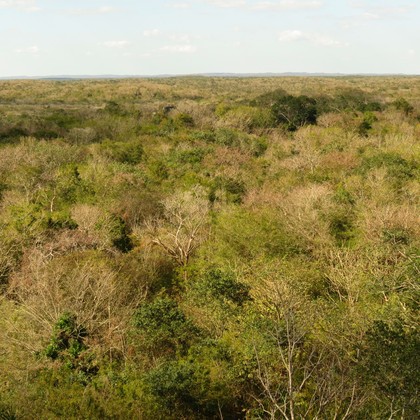
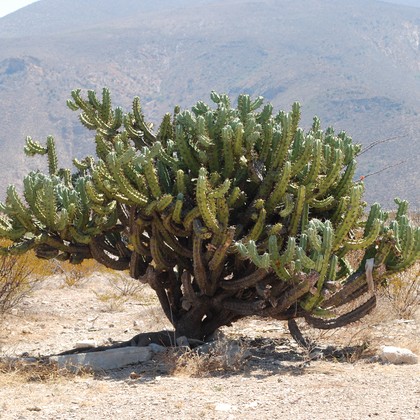
Open woodland, forest edges, gallery forest, clearings, pasture with trees, villages and gardens in the lowlands, also in seasonal forest and thorn scrub. It hunts flying insects from a high perch and also eats fruit. The nest is an open cup in a tree.
Where the bird is most at home, classified by the vegetation units of Mexico and Central America.




Range and movements
Atlantic slope of Mexico from Nuevo León and Tamaulipas south to the Yucatán Peninsula, and on into Belize and northern Guatemala. Outside the guide area in southern Texas, where some birds leave in winter.
- Resident
- dark = core range, pale = thinly spread
How and when to look
On the Yucatán Peninsula and in north-eastern Mexico, voice is the only certain way to separate it from the Tropical Kingbird; silent birds often remain unidentified.
Conservation status
Not threatened. Common in semi-open country within its range.
Scientific name
Tyrannus couchii | Baird, 1858
Baird described the species in 1858 and placed it straight away in the genus where it still stands. The genus Tyrannus was introduced in 1799 by De Lacépède. Tyrannus is Latin (from Greek turannos) for 'tyrant, despot', after the aggressive way these birds drive off even raptors. couchii honours the American army officer and naturalist Darius Nash Couch (1822–1897), who collected the type in northeastern Mexico. The specimen the first description was based on came from San Diego, Nuevo León, Mexico.