All species › Swifts › Hummingbirds › Emerald-chinned Hummingbird
Position in the tree Birds Aves › Birds with a flexible palate Neognathae › All other modern birds Neoaves › Birds of the elements Elementaves › Nightjars and swifts Strisores
Emerald-chinned Hummingbird | Abeillia abeillei
Smaragdkeelkolibrie | Colibrí pico corto
The Emerald-chinned Hummingbird is a small, short-billed hummingbird of the humid montane forests from southern Mexico to northern Nicaragua. It feeds inconspicuously low in the understorey and is therefore easily overlooked. It is the only species in the genus Abeillia.

Voice
A high, thin tsi or chip; the song is a series of high, squeaky notes.
Recording: Guillermo Funes — CC BY-NC-SA 4.0 · converted to mono · xeno-canto
Identification
7–8 cm, with a short, straight black bill. The upperparts are bronze-green, with a white spot behind the eye. The male has a glittering emerald-green chin and throat, dark grey underparts with green flanks, and a short dark tail with grey tips to the outer feathers. The female has pale grey underparts with green flanks and a similar tail.
Confusion species
Female Canivet's Emerald Cynanthus canivetii has a red base to the bill, a white stripe behind the eye and a forked tail. Stripe-tailed Hummingbird Eupherusa eximia is larger, with a rufous patch in the wing and white outer tail feathers. Green-throated Mountaingem Lampornis viridipallens is larger, with a longer bill and white underparts. Female coquettes have a pale band across the rump.
Habitat
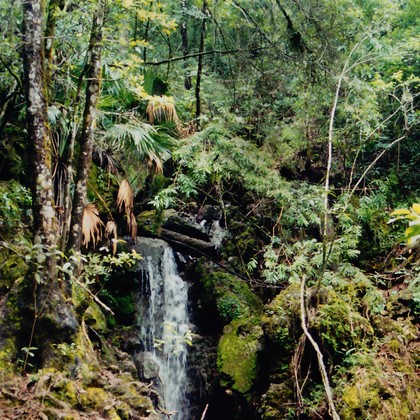
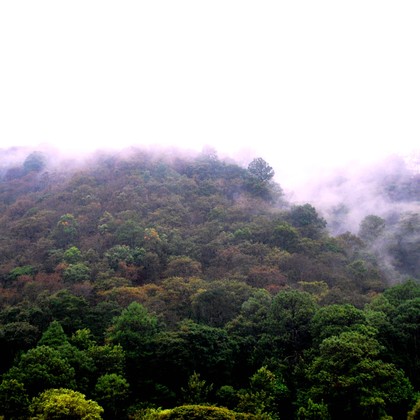
Humid montane forest and cloud forest, also humid pine-oak forest, forest edges and dense undergrowth, at about 900 to 2200 m. It feeds low in the understorey at small flowers.
Where the bird is most at home, classified by the vegetation units of Mexico and Central America.


Range and movements
Endemic to the guide area. In south-eastern Mexico in the mountains of Veracruz, Oaxaca and Chiapas, and further in the highlands of Guatemala, El Salvador, Honduras and northern Nicaragua.
- Resident
- dark = core range, pale = thinly spread
How and when to look
In the El Triunfo Biosphere Reserve in Chiapas, in the cloud forest of the Guatemalan highlands and in Cusuco National Park in Honduras; in Nicaragua in the montane forests around Matagalpa. Often low along forest trails.
Conservation status
Not threatened. Fairly common in suitable montane forest. Loss of cloud forest affects the species locally.
Scientific name
Abeillia abeillei | (Lesson & Delattre, 1839)
Lesson & Delattre described the species in 1839 as Ornismya Abeillei; because it was later moved to another genus, the author and year stand in brackets. The genus Abeillia was introduced in 1850 by Bonaparte. Abeillia honours the French physician, ornithologist and collector Grégoire Abeillé (1798–1848) of Bordeaux. abeillei honours the French physician, ornithologist and collector Grégoire Abeillé (1798–1848) of Bordeaux. The specimen the first description was based on came from Xalapa, Veracruz, Mexico.