All species › Passerines › New World sparrows › Fox Sparrow
Position in the tree Birds Aves › Birds with a flexible palate Neognathae › All other modern birds Neoaves › Landbirds Telluraves › Falcons, parrots and passerines Australaves › Falcons and passerines Eufalconimorphae › Parrots and passerines Psittacopasserae
Fox Sparrow | Passerella iliaca
Vossegors | Gorrión rascador
The Fox Sparrow is a large, sturdy sparrow with a rufous tail that searches the leaf litter by scratching with both feet at once. It breeds in North America and reaches the guide area as a winter visitor, mainly in north-western Mexico. The species consists of several well-marked groups, which are sometimes treated as separate species.

Voice
In winter mainly the call: a loud, dry chek; in the Thick-billed group a metallic chink. The song, a varied series of clear whistles and trills, is heard only occasionally in winter.
Recording: Valerie Heemstra — CC BY-NC-SA 4.0 · converted to mono · xeno-canto
Identification
16–19 cm. Large and stocky, with a heavily spotted breast whose spots often merge into a dark central spot. Rump and tail rufous. Appearance varies greatly between groups. Most birds in the guide area have a grey head and back with rufous wings and tail; in the Thick-billed group the grey bill is strikingly thick. Birds of the Sooty group are uniformly dark brown with dense brown spotting. Reddish birds from the north and east, with rufous streaks on head and back, are exceptional in the guide area. The sexes are alike.
Confusion species
Song Sparrow Melospiza melodia is smaller and slimmer, with a longer tail, a distinct head pattern and finer breast streaks. Hermit Thrush Catharus guttatus also has a reddish tail and a spotted breast, but has a thin bill, a pale eye-ring and the posture of a thrush. Lincoln's Sparrow Melospiza lincolnii is much smaller, with fine black streaks on a buff breast.
Habitat
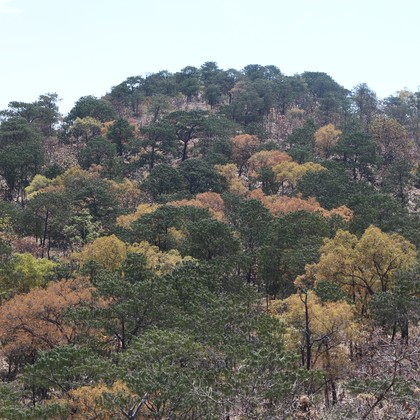
In winter dense shrub layer: chaparral, scrub in ravines and along streams, and the understorey of oak and conifer forest in the mountains. It forages on the ground, scratching backwards with both feet at once to clear the leaf litter; it eats seeds and insects.
Where the bird is most at home, classified by the vegetation units of Mexico and Central America.



Range and movements
Breeds from Alaska and Canada to the mountains of the western United States. Winters mainly along the Pacific coast and in the south-eastern United States. In the guide area mainly in northern Baja California, in the Sierra Juárez, the Sierra San Pedro Mártir and the coastal region; rare elsewhere in northern Mexico.
- Winter visitor (c. Oct–Mar)
- dark = core range, pale = thinly spread
How and when to look
Best found by listening for the rustling of scratching birds under dense shrubs and for the loud call; often in the company of juncos and other sparrows.
Conservation status
Not threatened (LC). Widespread and common in North America; in the guide area a rather scarce winter visitor.
Scientific name
Passerella iliaca | (Merrem, 1786)
Merrem described the species in 1786 as Fringilla iliaca; because it was later moved to another genus, the author and year stand in brackets. The genus Passerella was introduced in 1837 by Swainson. Passerella is a diminutive of Latin passer 'sparrow': 'little sparrow'. iliaca is Late Latin iliacus 'of the flanks', from ilia 'flanks', after the heavily spotted flanks. The specimen the first description was based on came from Quebec, Canada.