All species › Passerines › Tyrant flycatchers and allies › Greater Pewee
Position in the tree Birds Aves › Birds with a flexible palate Neognathae › All other modern birds Neoaves › Landbirds Telluraves › Falcons, parrots and passerines Australaves › Falcons and passerines Eufalconimorphae › Parrots and passerines Psittacopasserae
Greater Pewee | Contopus pertinax
Grote piewie | Pibí tengofrío
The Greater Pewee is the pewee of the pine-oak forests in the mountains of Mexico and northern Central America: a large, grey flycatcher with a pointed crest and a bright orange lower mandible. Its whistled song, rendered in Spanish as tengo frío ('I am cold') or as José María, is a familiar sound in these forests.

Voice
The song is a clear, plaintive whistled ho-say ma-REE-a or tengo-FREE-o. It often calls with a repeated pip-pip or pip.
Recording: Manuel Grosselet — CC BY-NC-SA 4.0 · converted to mono · xeno-canto
Identification
18–20 cm, with a pointed crest and a fairly long tail. Upperparts greyish olive; underparts grey, paler and often tinged yellowish on the belly. Wings dark with narrow, dull grey wing bars. Bill fairly large; lower mandible entirely orange or orange-yellow. Male and female are alike.
Confusion species
Olive-sided Flycatcher Contopus cooperi (passage migrant) lacks a crest and has a shorter tail, a dark open vest with a white central stripe and a dark tip to the lower mandible. Western Wood Pewee Contopus sordidulus is smaller, without a pointed crest, with clearer wing bars and a mostly dark lower mandible. Northern Tufted Flycatcher Mitrephanes phaeocercus is much smaller and cinnamon-coloured.
Habitat
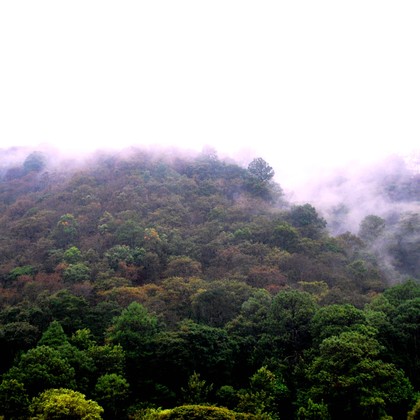
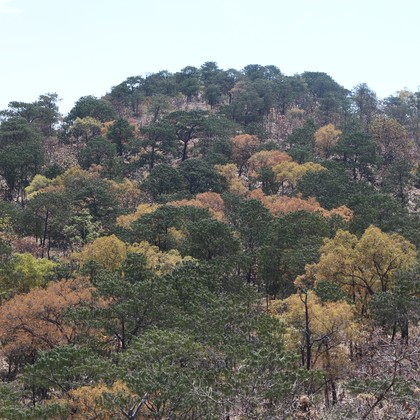
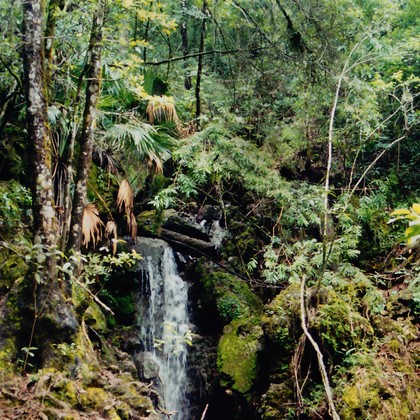
Pine-oak forest, oak forest, cloud forest and coniferous forest in the mountains, mainly between about 1500 and 3500 m, at forest edges, clearings and along stream valleys; outside the breeding season also lower down, including riparian woodland. It perches high on a bare branch and sallies from there after insects.
Where the bird is most at home, classified by the vegetation units of Mexico and Central America.


Range and movements
In the mountains of Mexico, in the Sierra Madre Occidental from Sonora and Chihuahua, in the Sierra Madre Oriental from Coahuila and Nuevo León, and further in the Trans-Mexican Volcanic Belt, the Sierra Madre del Sur and the highlands of Chiapas; from there through the highlands of Guatemala, El Salvador and Honduras to northern Nicaragua. In the north some birds leave in winter or move to lower elevations. Outside the guide area it breeds in the mountains of south-eastern Arizona and south-western New Mexico.
- Resident
- Summer visitor (c. Apr–Sep)
- Winter visitor (c. Oct–Mar)
- Passage (Mar–Apr, Oct–Nov)
- dark = core range, pale = thinly spread
How and when to look
In pine-oak forest most easily found by its song and call; it often perches on top of a dead branch above the canopy.
Conservation status
Not threatened. Common in montane forest; disappears where the forest is cleared, but also occurs in semi-open woodland with scattered tall trees.
Scientific name
Contopus pertinax | Cabanis & Heine, 1860
Cabanis & Heine described the species in 1860 and placed it straight away in the genus where it still stands. The genus Contopus was introduced in 1855 by Cabanis. Contopus is Greek, from kontos 'pole, shaft' and pous 'foot', after the short legs. pertinax is Latin for 'persistent, stubborn'; the describers did not explain what the name refers to. The specimen the first description was based on came from Xalapa, Veracruz, Mexico.