All species › Passerines › New World sparrows › Green-backed Sparrow
Position in the tree Birds Aves › Birds with a flexible palate Neognathae › All other modern birds Neoaves › Landbirds Telluraves › Falcons, parrots and passerines Australaves › Falcons and passerines Eufalconimorphae › Parrots and passerines Psittacopasserae
Green-backed Sparrow | Arremonops chloronotus
Groenruggors | Rascador dorso verde
The Green-backed Sparrow is an olive-green sparrow with a grey head and black head stripes that lives on and just above the ground in dense scrub and forest edges. Its range lies entirely within the guide area: from the southern Yucatán Peninsula to northern Honduras.

Voice
The song is a series of clear, whistled notes that starts slowly and then speeds up, roughly chew chew chew-chew-chewchewchew. The call is a dry chip and a thin, high tseet.
Recording: GABRIEL LEITE — CC BY-NC-SA 4.0 · shortened to the first 60 s, mono · xeno-canto
Identification
14–15 cm. Upperparts bright olive-green, wings and tail slightly greener. Head grey with two broad black crown stripes and a black eye-stripe. Throat white, breast and flanks grey, belly whitish. A yellow patch at the bend of the wing, often hidden. Upper mandible dark, lower mandible paler. The sexes are alike; juveniles are browner and faintly streaked below.
Confusion species
Olive Sparrow Arremonops rufivirgatus has brown rather than black crown and eye stripes, a duller olive back and lives in drier scrub, mainly in the northern Yucatán Peninsula. Black-striped Sparrow Arremonops conirostris closely resembles Green-backed Sparrow but is larger, with a greyer back, and lives further south; both occur in Honduras but barely overlap. Orange-billed Sparrow Arremon aurantiirostris has a black head and an orange bill.
Habitat
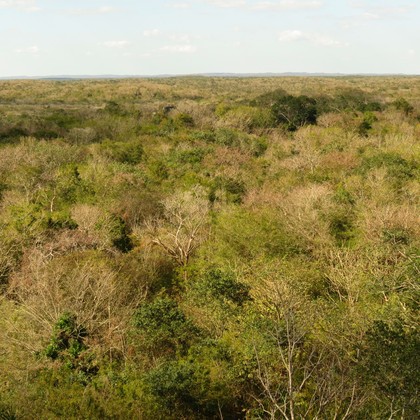
Dense secondary forest, scrub along forest edges, overgrown fields and plantations and the understorey of humid and semi-humid lowland forest, mostly below 500 m. It forages on the ground and in low bushes for insects and seeds. It builds a domed nest low in dense scrub.
Where the bird is most at home, classified by the vegetation units of Mexico and Central America.




Range and movements
Endemic to the guide area: the southern Yucatán Peninsula in Mexico (Campeche, Quintana Roo, eastern Tabasco and northern Chiapas), Belize, northern Guatemala and northern Honduras.
- Resident
- dark = core range, pale = thinly spread
How and when to look
Best found early in the morning by listening for the accelerating whistled song at forest edges and along overgrown tracks, for example around Tikal and in inland Belize.
Conservation status
Not threatened (LC). Common in secondary forest and scrub and benefits locally from small-scale farming with overgrown margins.
Scientific name
Arremonops chloronotus | (Salvin, 1861)
Salvin described the species in 1861 as Embernagra chloronota; because it was later moved to another genus, the author and year stand in brackets. The genus Arremonops was introduced in 1896 by Ridgway. Arremonops is formed from the genus Arremon and Greek ōps 'appearance': 'resembling Arremon', as Ridgway considered it closely related. chloronotus is Greek, from khlōros 'green' and nōtos 'back', after the olive-green back. The specimen the first description was based on came from Choctum, Alta Verapaz, Guatemala.