All species › Swifts › Hummingbirds › Green-crowned Brilliant
Position in the tree Birds Aves › Birds with a flexible palate Neognathae › All other modern birds Neoaves › Birds of the elements Elementaves › Nightjars and swifts Strisores
Green-crowned Brilliant | Heliodoxa jacula
Groenkruinbriljantkolibrie | Brillante coroniverde
The Green-crowned Brilliant is a large, heavy hummingbird of the wet mountain forests of Costa Rica and Panama. Brilliants often perch on a flower to feed instead of hovering in front of it. In Costa Rica it is a regular visitor to the feeders of lodges at middle elevations.

Voice
A loud, sharp chip or chak, often repeated, and in chases a rapid, chattering twitter.
Recording: José María Loaiza B. — CC BY-NC-SA 4.0 · converted to mono · xeno-canto
Identification
12–14 cm, with a straight, sturdy black bill. The male is entirely dark green, with a glittering green crown and throat, a small violet-blue spot at the base of the throat and a small white spot behind the eye. The tail is fairly long, forked and blue-black. The female is green above and white below, densely marked with round green spots, with a white malar stripe and a small white spot behind the eye; the tail is less deeply forked and the outer feathers have white tips.
Confusion species
Violet Sabrewing Campylopterus hemileucurus is larger, with a decurved bill and much white in the tail; males are violet. Male Crowned Woodnymph Thalurania colombica is smaller and has a violet belly and a violet crown or back. Female Purple-throated Mountaingem Lampornis calolaemus has rufous underparts and a clear white stripe behind the eye. The spotted underparts of the female Green-crowned Brilliant are distinctive.
Habitat
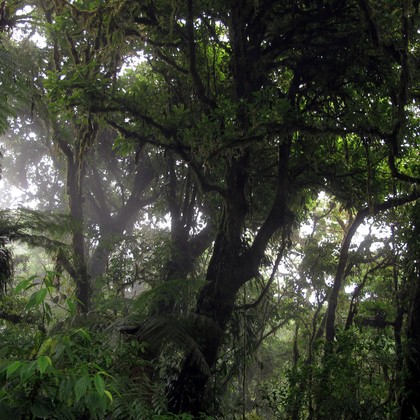
Humid foothill and montane forest and cloud forest, mainly in the middle and lower strata of the forest, along forest edges, in clearings with flowering shrubs and in gardens near forest, also in shade coffee. It often perches on flowers to feed and catches insects in short sallies.
Where the bird is most at home, classified by the vegetation units of Mexico and Central America.




Range and movements
In Costa Rica on the Caribbean and Pacific slopes of the mountain ranges, mainly at middle elevations, and in Panama in the mountains on both slopes from Chiriquí and Bocas del Toro east to Darién. Outside the guide area in western Colombia and western Ecuador.
- Resident
- dark = core range, pale = thinly spread
How and when to look
Common at the feeders of lodges and visitor centres at middle elevations in Costa Rica, such as around Monteverde, at the La Paz waterfalls and at Cinchona; in Panama for example around Boquete and Cerro Azul.
Conservation status
Not threatened. The species is common in most of its range and also occurs in gardens and shade coffee, but remains dependent on nearby forest.
Scientific name
Heliodoxa jacula | Gould, 1850
Gould described the species in 1850 and placed it straight away in the genus where it still stands. He introduced the genus Heliodoxa in that same work. Heliodoxa is Greek, from hēlios 'sun' and doxa 'glory': 'sun-glory', after the brilliant plumage. jacula probably derives from Latin iaculum 'javelin, dart', perhaps after the quick, darting flight. The specimen the first description was based on came from Bogotá, Colombia.