All species › Passerines › Tanagers and allies › Green Honeycreeper
Position in the tree Birds Aves › Birds with a flexible palate Neognathae › All other modern birds Neoaves › Landbirds Telluraves › Falcons, parrots and passerines Australaves › Falcons and passerines Eufalconimorphae › Parrots and passerines Psittacopasserae
Green Honeycreeper | Chlorophanes spiza
Groene suikervogel | Mielero verde
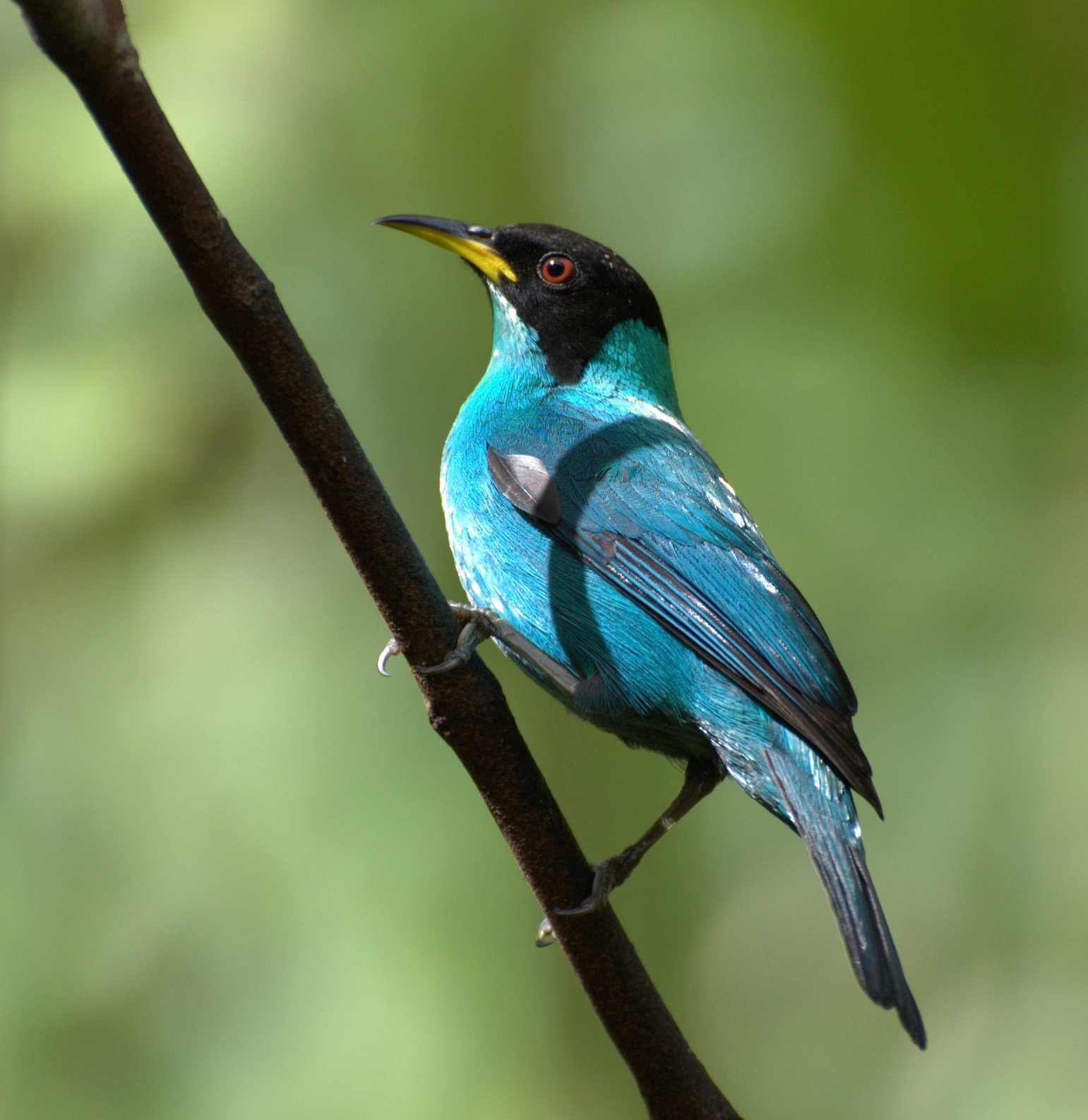
The Green Honeycreeper is a fairly large, glossy green tanager with a slightly curved, yellow bill. The male has a black head. It mainly eats fruit, also nectar and insects, and often forages with mixed flocks in the canopy of humid forest. In the guide area it occurs from southern Mexico to Panama.
Voice
A sharp, dry chip, often repeated; the song is a series of thin, hissing notes.
Recording: Juan Freile — CC BY-NC-SA 4.0 · converted to mono · xeno-canto
Identification
13–14 cm. A sturdy tanager with a fairly long, slightly curved bill; the lower mandible and the base of the upper mandible are bright yellow, the eye is red. The male is glossy blue-green to emerald-green with a black head down to the cheeks. The female is uniformly grass-green, paler and yellower on the throat, without a black head; her bill is also yellowish.
Confusion species
The female Red-legged Honeycreeper Cyanerpes cyaneus is smaller, duller olive-green with faint streaks and has a dark bill. The female Swallow Tanager Tersina viridis (eastern Panama) has a broad, flat bill and bars on the flanks. The female Viridian Dacnis Dacnis viguieri is smaller and has a short, pointed bill.
Habitat
Canopy and edges of humid lowland and foothill forest, up to about 1200 m; also mature secondary forest, tall trees in clearings and shade coffee. It visits fruit feeders.
Where the bird is most at home, classified by the vegetation units of Mexico and Central America.




Range and movements
Southern Mexico (Veracruz, Oaxaca and Chiapas) through the Caribbean slope of Guatemala, Belize, Honduras and Nicaragua to Costa Rica and Panama, there on both slopes. Outside the guide area across much of tropical South America to Bolivia and south-eastern Brazil.
- Resident
- dark = core range, pale = thinly spread
How and when to look
Often seen at fruit feeders at lodges in Costa Rica and Panama, and in fruiting trees along forest edges, together with tanagers and honeycreepers.
Conservation status
Not threatened (LC). Fairly common in the south of the guide area, scarcer in Mexico and Guatemala.
Scientific name
Chlorophanes spiza | (Linnaeus, 1758)
Linnaeus described the species in 1758 as Motacilla Spiza; because it was later moved to another genus, the author and year stand in brackets. The genus Chlorophanes was introduced in 1853 by Reichenbach. Chlorophanes is Greek, from khlōros 'green' and -phanēs 'showing': 'showing green', after the glossy green plumage. spiza is the Greek word for 'finch'. The specimen the first description was based on came from Suriname.