All species › Passerines › Tyrant flycatchers and allies › Greenish Elaenia
Position in the tree Birds Aves › Birds with a flexible palate Neognathae › All other modern birds Neoaves › Landbirds Telluraves › Falcons, parrots and passerines Australaves › Falcons and passerines Eufalconimorphae › Parrots and passerines Psittacopasserae
Greenish Elaenia | Myiopagis viridicata
Groene elenia | Elenia verdosa
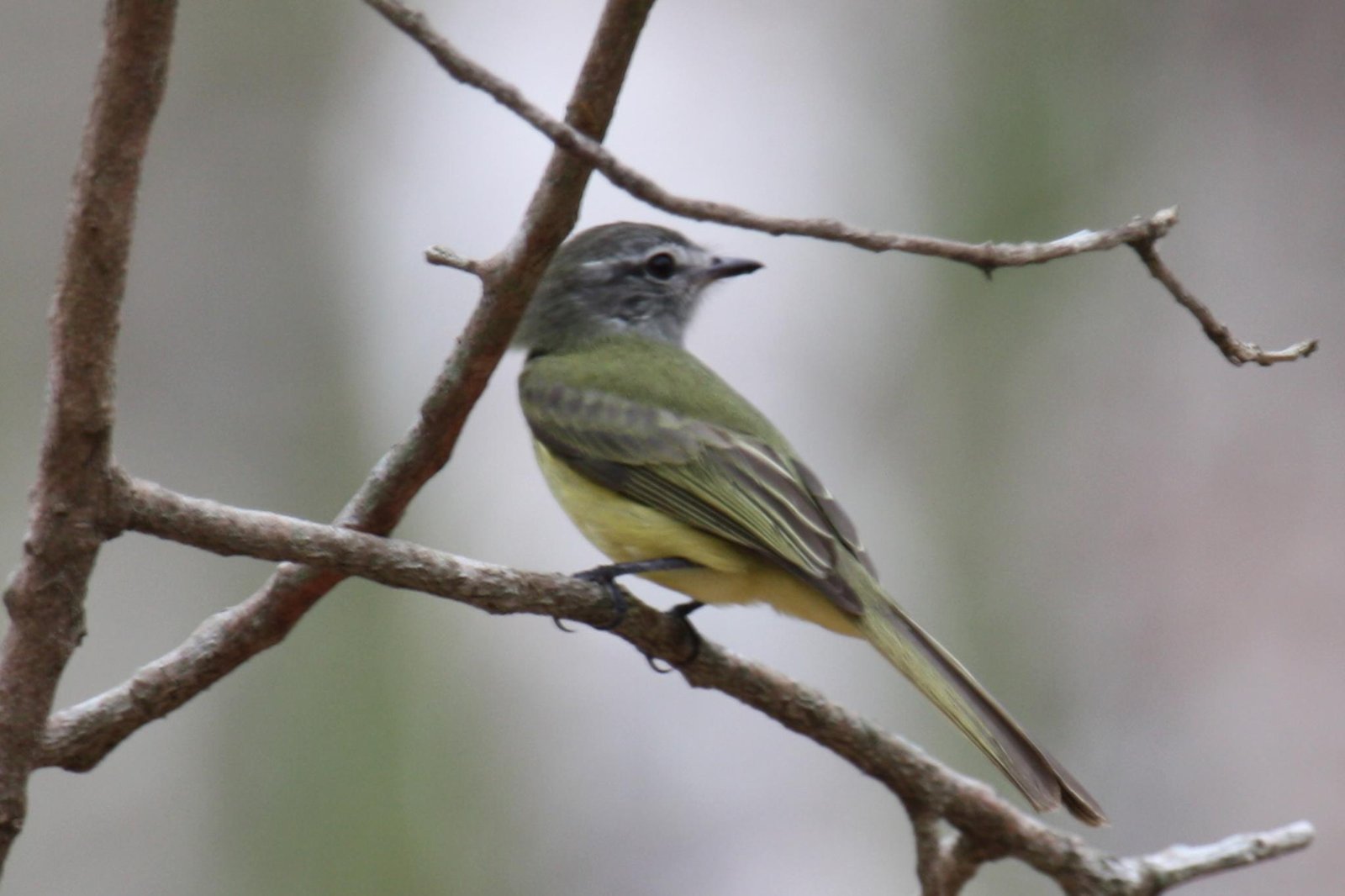
The Greenish Elaenia is an inconspicuous, olive-green elaenia with a grey head, a concealed yellow crown patch and almost plain wings without distinct wing-bars. It lives in the canopy of dry and humid forest and is heard more often than seen. In the guide area it occurs from Mexico to Panama.
Voice
A thin, high, slightly scratchy tsree-eep or chee-reep, repeated at intervals from the canopy.
Recording: Mateus Gonçalves Santos — CC BY-NC-SA 4.0 · shortened to the first 60 s, mono · xeno-canto
Identification
13–14 cm. Head grey, with a yellow central crown patch that is usually hidden, a narrow pale supraloral line and a dark eye-line. Back olive-green. Wings olive with pale yellow edges to the flight feathers, but without or with only faint wing-bars. Throat greyish white, breast pale grey washed olive, belly pale yellow. Bill slender, dark with a pale base. Male and female are alike.
Confusion species
Forest Elaenia Myiopagis gaimardii (Panama only) has two distinct yellow wing-bars. Yellow-green Vireo Vireo flavoviridis and Red-eyed Vireo Vireo olivaceus have a thicker bill and a distinct eyebrow, and Red-eyed Vireo has a red iris. Flatbills (Tolmomyias) have a broad, flat bill and distinct wing-bars. Yellow-bellied Elaenia Elaenia flavogaster is larger, with a crest and whitish wing-bars.
Habitat
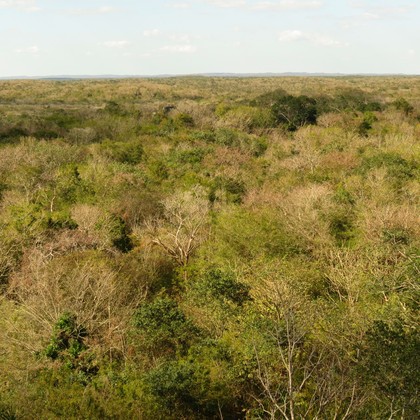
Canopy and middle levels of dry forest, semi-evergreen forest, gallery and riparian forest, also the edges of humid lowland forest, mature secondary forest and shade plantations; mainly in the lowlands and foothills. It gleans insects from the foliage and also eats small fruit.
Where the bird is most at home, classified by the vegetation units of Mexico and Central America.





Range and movements
In the guide area in Mexico on both the Pacific and the Caribbean slopes, including the Yucatán Peninsula, and on through Central America to Panama; in Costa Rica and Panama mainly on the Pacific slope. Outside the guide area over much of South America to northern Argentina.
- Resident
- dark = core range, pale = thinly spread
How and when to look
The thin call from the canopy of dry forest is the best clue. A bird that shows itself stands out by the combination of a grey head and wings without distinct wing-bars.
Conservation status
Not threatened. Widespread and fairly common, but easily overlooked because of its inconspicuous habits in the canopy. Whether the northernmost populations are partly migratory is not well known.
Scientific name
Myiopagis viridicata | (Vieillot, 1817)
Vieillot described the species in 1817 as Sylvia viridicata; because it was later moved to another genus, the author and year stand in brackets. The genus Myiopagis was introduced in 1888 by Salvin & Godman. Myiopagis is Greek, from muia 'fly' and pagis 'trap, snare': 'fly-trap'. viridicata is Latin for 'greenish' (viridicatus), after the olive-green plumage. The specimen the first description was based on came from Paraguay.