All species › Cranes, rails and allies › Rails, gallinules and coots › Grey-cowled Wood Rail
Position in the tree Birds Aves › Birds with a flexible palate Neognathae › All other modern birds Neoaves › Birds of the elements Elementaves › Cranes and waders Gruimorphae
Grey-cowled Wood Rail | Aramides cajaneus
Cayennebosral | Rascón cuello gris
The Grey-cowled Wood Rail is a large, colourful rail of swamp forest, mangroves and stream banks, with a grey head and neck, a rufous breast and black rear parts. In the guide area it occurs only in Costa Rica and Panama, at the northern edge of a large South American range. It is most noticeable at dusk for the loud, cackling duets of pairs. Until recently it was treated as one species with Russet-naped Wood Rail of Mexico and northern Central America.

Voice
A loud, repeated cackling, often in duet, such as pop-tiyi pop-tiyi ko-ko-ko-ko-ko, heard mainly at dawn and dusk. In alarm a hoarse, loud cackle or screeching clucking.
Recording: Juan Freile — CC BY-NC-SA 4.0 · shortened to the first 60 s, mono · xeno-canto
Identification
33–40 cm, a sturdy rail on long legs, with a long, slightly flattened bill. Head and neck are grey, reaching onto the upper back, with a brownish patch on the hindcrown. Mantle and wings are olive-green to dark brown; breast and flanks are bright rufous. Belly, rump and the short tail are black. The bill is greenish-yellow, the eye red and the legs coral-red. The sexes are alike; juveniles are duller and darker. Walks with the tail cocked and seldom flies.
Confusion species
Russet-naped Wood Rail Aramides albiventris, from Mexico to northern Costa Rica, is very similar, but has a rufous nape separating the grey neck from the mantle. Rufous-necked Wood Rail Aramides axillaris is smaller, with an entirely chestnut head and neck and a grey patch on the upper back. Uniform Crake Amaurolimnas concolor is much smaller and entirely brown. Common Gallinule Gallinula galeata is slate-grey with a red frontal shield and swims a lot.
Habitat
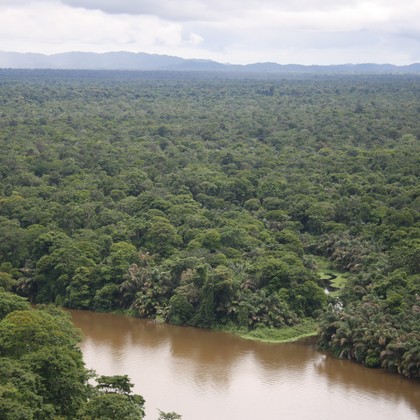
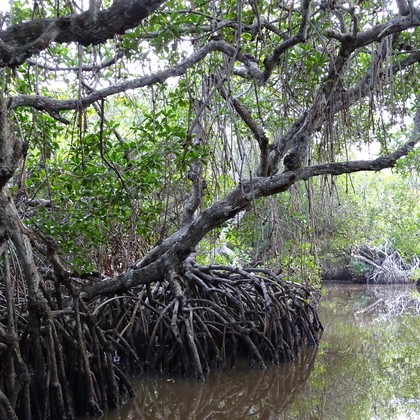
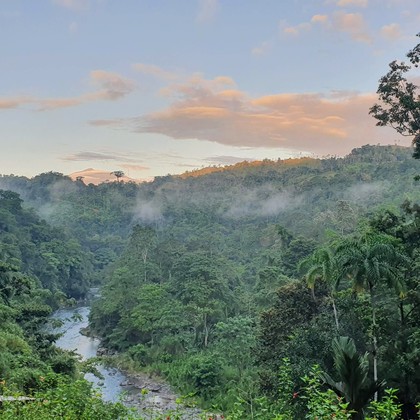
Swamp forest, mangroves, the banks of streams and rivers in lowland forest and wet forest edges, up into the lower mountains; also secondary forest, shade coffee plantations and locally parks and gardens with water, even in the Central Valley of Costa Rica. Forages on the ground, mainly at dusk, for invertebrates, molluscs, crabs, seeds and fruit. Pairs stay together year-round and defend a territory. The nest is a cup of twigs and leaves in a shrub or low tree.
Where the bird is most at home, classified by the vegetation units of Mexico and Central America.




Range and movements
In the guide area in Costa Rica, mainly on the Pacific side and in the Central Valley, and throughout Panama, from Bocas del Toro and Chiriquí to Darién. In northern Costa Rica its range meets that of Russet-naped Wood Rail. Outside the guide area in much of South America east of the Andes and on the Pacific side of Colombia, south to northern Argentina and Uruguay, and on Trinidad.
How and when to look
On the Pacific side of Costa Rica, for example at Carara, and around the Panama Canal birds often show on forest trails and at the water's edge, especially early in the morning. Locally they are used to people and walk across lawns in parks. The duet at dusk reveals territories.
Conservation status
Least Concern. Fairly common in Costa Rica and Panama and locally even present in built-up areas. Deforestation and drainage of swamp forest locally reduce its habitat; hunting occurs.
Scientific name
Aramides cajaneus | (Müller, 1776) (GBIF: Aramides cajanea)
Müller described the species in 1776 as Fulica Cajanea; because it was later moved to another genus, the author and year stand in brackets. The genus Aramides was introduced in 1845 by Pucheran. Aramides is Aramus (Limpkin) with Greek -oidēs 'resembling': 'Limpkin-like'. cajaneus refers to Cayenne in French Guiana, where the described specimen came from. The specimen the first description was based on came from Cayenne, French Guiana.