All species › Passerines › Tanagers and allies › Grey-headed Tanager
Position in the tree Birds Aves › Birds with a flexible palate Neognathae › All other modern birds Neoaves › Landbirds Telluraves › Falcons, parrots and passerines Australaves › Falcons and passerines Eufalconimorphae › Parrots and passerines Psittacopasserae
Grey-headed Tanager | Eucometis penicillata
Amazonetangare | Tángara cabeza gris
The Grey-headed Tanager is a medium-sized tanager with a grey head and a crest that lives low in forest and often follows army-ant swarms. In the guide area it occurs from south-eastern Mexico to Panama; beyond that in much of tropical South America.

Voice
Calls with a high, sharp tseet. The song is a fast, high series of whistled and chipping notes, often at dawn.
Recording: JAYRSON ARAUJO DE OLIVEIRA — CC BY-NC-SA 4.0 · converted to mono · xeno-canto
Identification
17–18 cm. A slender tanager with a fairly long tail and a pointed, pale bill. Head grey with a ragged crest that is often slightly raised; the throat is paler grey to whitish. Upperparts olive-green, underparts bright ochre-yellow. Legs pink. Male and female are alike; young birds are duller, with an olive-tinged head.
Confusion species
The female White-shouldered Tanager Loriotus luctuosus has a similar pattern but is much smaller, lacks a crest and has a dark bill. Ant tanagers such as Red-crowned Ant Tanager Habia rubica are browner and lack a grey head.
Habitat
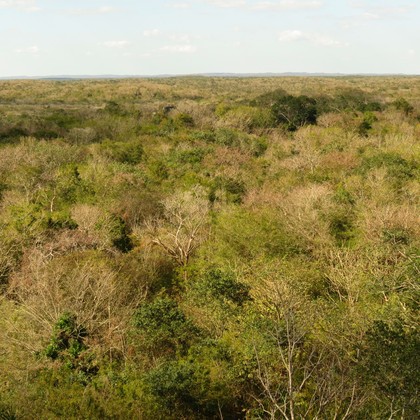
Understorey and lower middle levels of humid lowland forest, gallery forest, swamp forest, semi-evergreen forest and dense second growth, mainly below 1000 m. It regularly follows army-ant swarms to catch flushed insects; it also eats fruit.
Where the bird is most at home, classified by the vegetation units of Mexico and Central America.



Range and movements
South-eastern Mexico, from Tabasco and Chiapas to the Yucatán Peninsula, through Belize, Guatemala, Honduras and Nicaragua to Costa Rica and Panama, on both sides of the mountains. Beyond that from Colombia and Venezuela through Amazonia to Bolivia, Paraguay and southern Brazil.
- Resident
- dark = core range, pale = thinly spread
How and when to look
Best found at an army-ant swarm in lowland forest, such as along Pipeline Road in Panama, where it forages low over the ants together with antbirds.
Conservation status
Not threatened (LC). Fairly common, but often overlooked because it lives in the understorey.
Scientific name
Eucometis penicillata | (Spix, 1825)
Spix described the species in 1825 as Tanagra penicillata; because it was later moved to another genus, the author and year stand in brackets. The genus Eucometis was introduced in 1856 by Sclater. Eucometis is Greek, from eukomēs 'with lovely hair', after the erectile crest on the grey head. penicillata is Latin for 'pencilled, tufted', a diminutive of peniculus 'brush', after the crest. The specimen the first description was based on came from unknown; suggested: Fonte Boa on the Solimões, Brazil.