All species › Waterfowl › Ducks, swans and geese › Hooded Merganser
Position in the tree Birds Aves › Birds with a flexible palate Neognathae › Fowl Galloanserae
Hooded Merganser | Lophodytes cucullatus
Kokardezaagbek | Serreta capuchona
The Hooded Merganser is the smallest merganser and occurs only in North America. In northern Mexico it is a scarce winter visitor on lakes, reservoirs and rivers, usually in pairs or small groups. It nests in tree cavities and nest boxes along wooded waters.

Voice
Usually silent in winter. The female gives a hoarse krrek; in display the male utters a deep, rolling, frog-like sound.
Recording: Dan Lane — CC BY-NC-SA 4.0 · converted to mono · xeno-canto
Identification
40–49 cm. Slim, with a thin, narrow, serrated bill, a crest that can lie flat on the nape or be raised like a fan, and a long tail. The male has a black head and back, a large black-bordered white patch in the crest, a white breast with two black bars on the side, rufous flanks and a yellow eye. The female and juveniles are greyish-brown with a warm rufous, shaggy crest and a dark upper mandible with a yellow to orange lower mandible. In flight small, fast and elongated, with a white patch on the secondaries.
Confusion species
The male Bufflehead Bucephala albeola also has a large white patch on the head, but white flanks and a short bill. The female Red-breasted Merganser Mergus serrator is larger and greyer, with a long red bill and a ragged crest. The female Wood Duck Aix sponsa has a white teardrop patch around the eye and a short bill.
Habitat
Lakes, reservoirs, ponds and quiet rivers, preferably with wooded banks; also sheltered coastal lagoons. It dives in clear water for small fish, crustaceans and aquatic insects.
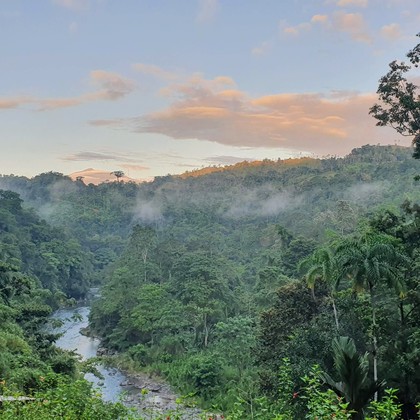
Where the bird is most at home, classified by the vegetation units of Mexico and Central America.



Range and movements
Winters in small numbers in northern Mexico, mainly in Coahuila, Chihuahua, Nuevo León and Durango, further in Sonora, Baja California and Baja California Sur, Zacatecas and Tamaulipas; rarer further south, with records as far as the Yucatán Peninsula. Breeds in eastern North America and in the north-west, from Alaska to Oregon.
- Resident
- Winter visitor (c. Oct–Mar)
- dark = core range, pale = thinly spread
How and when to look
Quiet reservoirs and rivers with wooded banks in Coahuila and Chihuahua; the birds often sit close to the bank and dive when disturbed or fly off low and fast.
Conservation status
Not threatened globally. The North American population has increased in recent decades, partly thanks to nest boxes and the recovery of beavers, whose ponds provide new breeding habitat. In the guide area a scarce winter visitor.
Scientific name
Lophodytes cucullatus | (Linnaeus, 1758)
Linnaeus described the species in 1758 as Mergus cucullatus; because it was later moved to another genus, the author and year stand in brackets. The genus Lophodytes was introduced in 1853 by Reichenbach. Lophodytes is Greek, from lophos 'crest' and dutēs 'diver', after the diving duck with its conspicuous crest. cucullatus is Latin for 'hooded', from cucullus 'hood', after the white crest the male raises like a cowl. The specimen the first description was based on came from Virginia and Carolina.