All species › Passerines › New World warblers › Kentucky Warbler
Position in the tree Birds Aves › Birds with a flexible palate Neognathae › All other modern birds Neoaves › Landbirds Telluraves › Falcons, parrots and passerines Australaves › Falcons and passerines Eufalconimorphae › Parrots and passerines Psittacopasserae
Kentucky Warbler | Geothlypis formosa
Kentuckyzanger | Chipe patilludo
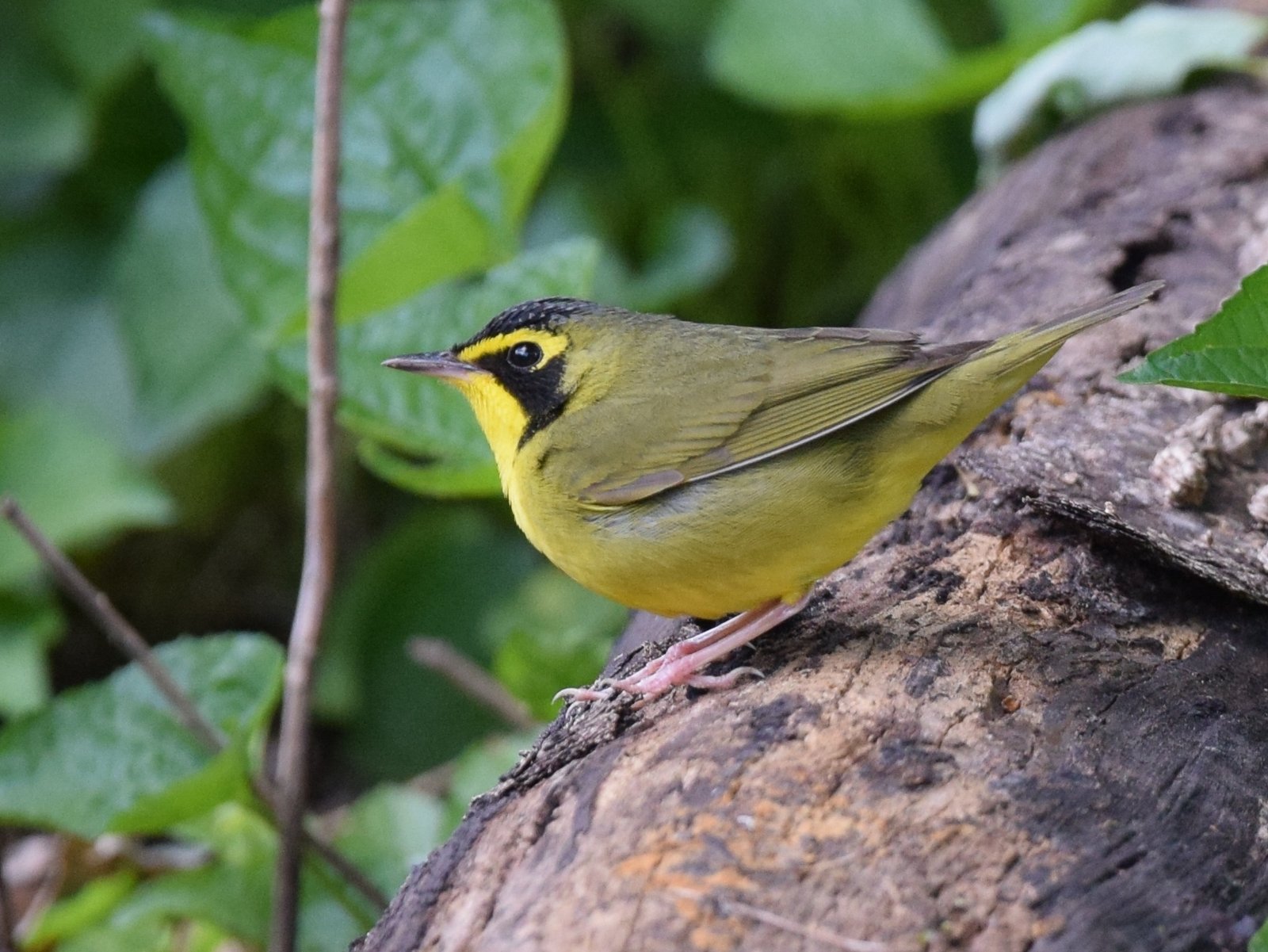
The Kentucky Warbler is a sturdy, ground-dwelling warbler with olive-green upperparts, bright yellow underparts and yellow "spectacles" above a black sideburn. It breeds in broadleaf forest in the eastern United States and winters in the undergrowth of humid forest from southern Mexico to Panama. It walks on the forest floor, turning over leaves.
Voice
The song is a loud, rolling series of identical paired notes, such as churree-churree-churree-churree. The call is a low, hollow chuk.
Recording: David A. Brinkman — CC BY-NC-SA 4.0 · shortened to the first 60 s, mono · xeno-canto
Identification
13–14 cm. Sturdy, with a short tail and long pink legs. Upperparts plain olive-green, underparts bright yellow. A yellow supercilium runs in front of the eye and curves round behind it; together with a yellow crescent below the eye it forms yellow spectacles. Forecrown, lores and a broad sideburn below the eye black. The female and young birds have less black on the crown and a fainter sideburn.
Confusion species
Common Yellowthroat Geothlypis trichas lacks the yellow spectacles, has a paler belly and lives in marshes and rank grassland. Hooded Warbler Setophaga citrina has a yellow face surrounded by a black hood (male) or an olive-green crown without black (female) and white spots in the tail. Canada Warbler Cardellina canadensis has blue-grey upperparts and a white eye-ring.
Habitat
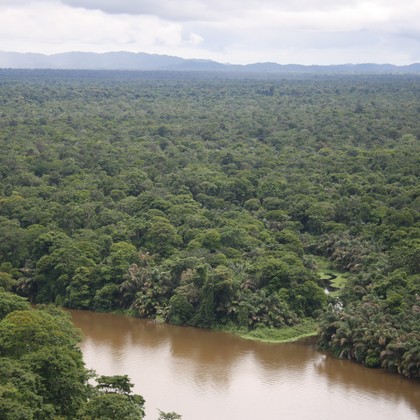
In winter the undergrowth of humid evergreen lowland and foothill forest, mature secondary forest, swamp forest and shade coffee, mostly below 1200 m. It lives on or just above the forest floor and searches the leaf litter for insects and spiders; in winter it defends a territory of its own.
Where the bird is most at home, classified by the vegetation units of Mexico and Central America.




Range and movements
Breeds in the eastern and east-central United States. Migrates through eastern Mexico, mainly along the Gulf coast and across the Yucatán Peninsula. Winters from southern Veracruz, Oaxaca and the Yucatán Peninsula through Central America to Panama; outside the guide area to northern Colombia and north-western Venezuela.
- Winter visitor (c. Oct–Mar)
- dark = core range, pale = thinly spread
How and when to look
In winter regularly found in the undergrowth at Tikal in Guatemala, at La Selva in Costa Rica and along Pipeline Road (Camino del Oleoducto) in Panama. Listen for the low call and watch the forest floor, where the bird often walks close to a trail.
Conservation status
Not threatened (LC). Fairly common, but slowly declining in its breeding range through fragmentation of broadleaf forest; in the wintering areas the loss of lowland forest is a threat.
Scientific name
Geothlypis formosa | (Wilson, 1811)
Wilson described the species in 1811 as Sylvia formosa; because it was later moved to another genus, the author and year stand in brackets. The genus Geothlypis was introduced in 1847 by Cabanis. Geothlypis is Greek, from gē 'ground' and thlupis, an unidentified small bird: 'ground warbler', after its life low in dense cover. formosa is Latin for 'beautiful'. The specimen the first description was based on came from Kentucky (USA).