All species › Passerines › Mockingbirds and thrashers › Long-billed Thrasher
Position in the tree Birds Aves › Birds with a flexible palate Neognathae › All other modern birds Neoaves › Landbirds Telluraves › Falcons, parrots and passerines Australaves › Falcons and passerines Eufalconimorphae › Parrots and passerines Psittacopasserae
Long-billed Thrasher | Toxostoma longirostre
Langsnavelspotlijster | Cuitlacoche pico largo
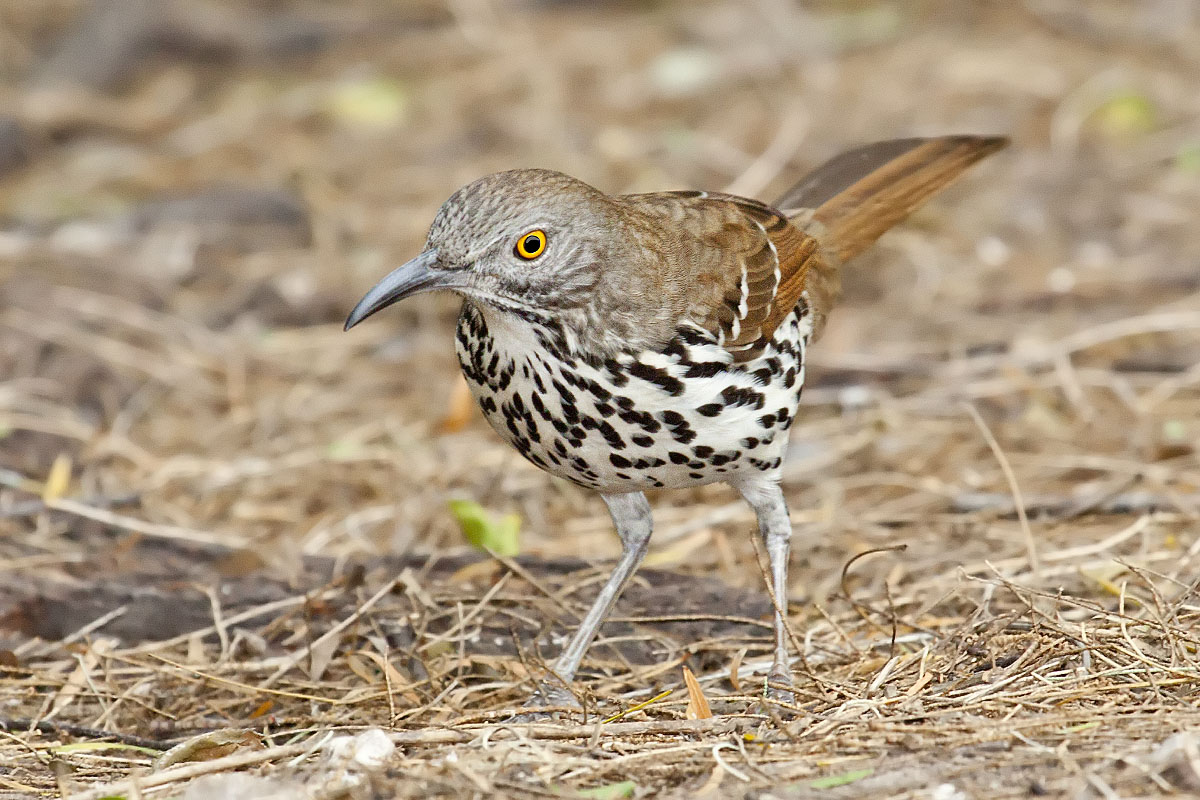
The Long-billed Thrasher is a rufous-brown thrasher with black-streaked white underparts and a long, slightly decurved bill. It lives in dense thorn scrub and riparian woodland in north-eastern Mexico and extreme southern Texas. It is usually heard, or seen on the ground among the leaf litter.
Voice
A long, rich song of whistled, hoarse and clucking phrases, often repeated two or three times, from a hidden perch or the top of a bush. Calls a dry chak and a whistled choo-ee.
Recording: Scott Gravette — CC BY-NC-SA 4.0 · converted to mono · xeno-canto
Identification
26–29 cm. Upperparts warm rufous-brown, head greyer, especially on the cheeks. Underparts white with rows of black streaks on breast and flanks. Eye orange. Two white wing bars bordered with black. Bill long, black and slightly decurved; tail long and rufous-brown. The sexes are alike.
Confusion species
Ocellated Thrasher Toxostoma ocellatum of the highlands is grey-brown with round black spots. Curve-billed Thrasher Toxostoma curvirostre is grey, with faint round breast spots and a more strongly curved bill, and lives in more open, drier country. Thrushes such as Clay-colored Thrush Turdus grayi have a short, straight bill and unstreaked underparts.
Habitat
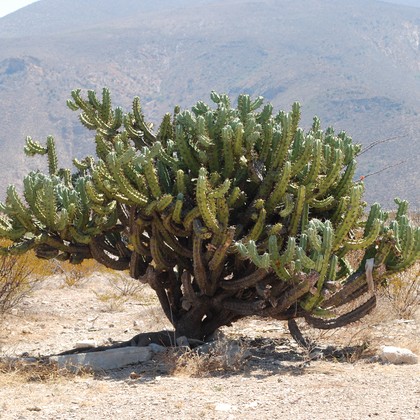
Dense thorn and mesquite woodland, riparian woodland, edges of semi-deciduous forest and overgrown secondary forest, also large gardens and parks; from the lowlands to about 1500 m. It forages on the ground for insects by tossing leaves aside with its bill.
Where the bird is most at home, classified by the vegetation units of Mexico and Central America.



Range and movements
Extreme southern Texas. In the guide area from Coahuila, Nuevo León and Tamaulipas south through San Luis Potosí, Querétaro and Hidalgo to central Veracruz and northern Puebla.
- Resident
- dark = core range, pale = thinly spread
How and when to look
The sound of leaves being tossed under dense shrubs often gives away a foraging bird. In the breeding season it sings early in the morning from an open perch.
Conservation status
Not threatened (LC). Common in suitable habitat, but much of the thorn scrub of north-eastern Mexico has been converted to farmland and pasture.
Scientific name
Toxostoma longirostre | (de Lafresnaye, 1838)
De Lafresnaye described the species in 1838 as [Orpheus] longirostris; because it was later moved to another genus, the author and year stand in brackets. The genus Toxostoma was introduced in 1831 by Wagler. Toxostoma is Greek, from toxon 'bow' and stoma 'mouth', after the long, curved bill. longirostre is Latin, from longus 'long' and rostrum 'bill': 'long-billed'. The specimen the first description was based on came from Mexico (not specified further).