All species › Swifts › Hummingbirds › Lucifer Sheartail
Position in the tree Birds Aves › Birds with a flexible palate Neognathae › All other modern birds Neoaves › Birds of the elements Elementaves › Nightjars and swifts Strisores
Lucifer Sheartail | Calothorax lucifer
Luciferkolibrie | Colibrí lucifer
The Lucifer Sheartail is a hummingbird of the dry plateaus of Mexico, with a distinctly decurved bill. The male has a purple throat with elongated side points and a long, narrow, deeply forked tail. The northern breeding birds move in winter to the central highlands, where the species is present year-round.

Voice
A dry, hard chip or chit, and in chases a rapid twitter. In the display flight the male's wings make a rattling sound.
Recording: Manuel Grosselet — CC BY-NC-SA 4.0 · converted to mono · xeno-canto
Identification
9–10 cm, with a fairly long, distinctly decurved black bill. The male is green above, with a glittering magenta-purple throat whose sides project backwards, a white breast, green and cinnamon flanks and a long, narrow, deeply forked dark tail that is usually held closed in a point. The female has a dark eyestripe with a pale supercilium, buff underparts with cinnamon flanks and a rounded tail with a rufous base, a black band and white tips.
Confusion species
Beautiful Sheartail Calothorax pulcher of southern Mexico is very similar but has a shorter, less decurved bill; the male has a longer tail with broader outer feathers. Females of Black-chinned Hummingbird Archilochus alexandri and Costa's Hummingbird Calypte costae have a straight bill and greyer underparts without cinnamon. Male Costa's Hummingbird also has a purple crown and a short tail.
Habitat
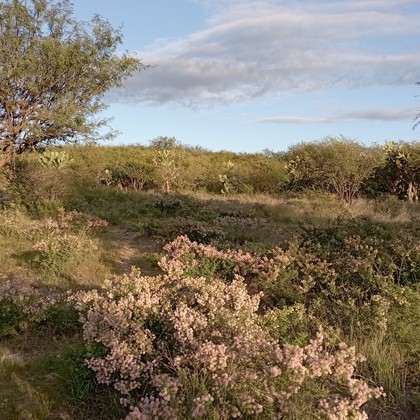
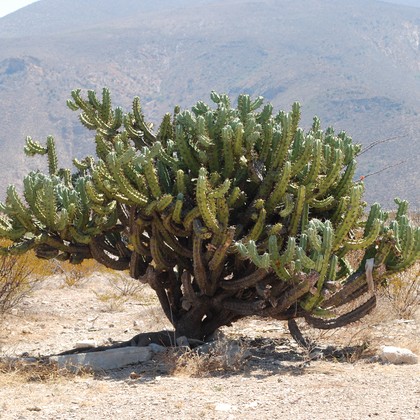
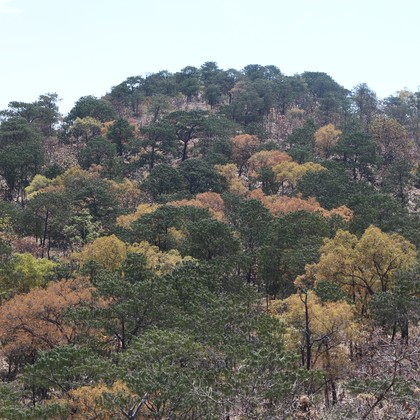
Dry plateaus and slopes with scrub, agaves, yuccas, ocotillo and cacti, semi-desert grassland, dry canyons and the edges of open oak woodland, at about 1000 to 2700 m; also in gardens in villages and towns. It feeds much at flowering agaves and at tubular flowers of shrubs and herbs.
Where the bird is most at home, classified by the vegetation units of Mexico and Central America.



Range and movements
Breeds in northern Mexico in the Chihuahuan Desert and the surrounding plateaus, including Chihuahua, Coahuila, Durango, Zacatecas, Nuevo León and San Luis Potosí, and in the adjacent southern United States. Present year-round in the central highlands of Mexico, from Guanajuato and Querétaro to Hidalgo, Mexico City, Puebla and western Veracruz; the northern birds also winter there.
- Resident
- Summer visitor (c. Apr–Sep)
- Winter visitor (c. Oct–Mar)
- Passage (Mar–Apr, Oct–Nov)
- dark = core range, pale = thinly spread
How and when to look
In Mexico City in gardens and parks with dry scrub and agaves, such as on the lava field of El Pedregal in the south of the city; in summer in the dry canyons and at flowering agaves in Coahuila and Chihuahua.
Conservation status
Least Concern. Fairly common in suitable dry scrub. Overgrazing and the loss of flowering agaves may affect it locally.
Scientific name
Calothorax lucifer | (Swainson, 1827)
Swainson described the species in 1827 as Cynanthus Lucifer; because it was later moved to another genus, the author and year stand in brackets. The genus Calothorax was introduced in 1840 by Gray. Calothorax is Greek, from kalos 'beautiful' and thōrax 'breast', after the male's splendid throat and breast. lucifer is Latin for 'light-bringer', from lux 'light' and ferre 'to carry', after the radiant purple throat. The specimen the first description was based on came from Temascaltepec, Mexico.