All species › Gannets and cormorants › Frigatebirds › Magnificent Frigatebird
Position in the tree Birds Aves › Birds with a flexible palate Neognathae › All other modern birds Neoaves › Birds of the elements Elementaves › Tropicbirds and waterbirds Phaethoquornithes › Core waterbirds Aequornithes
Magnificent Frigatebird | Fregata magnificens
Amerikaanse fregatvogel | Rabihorcado magnífico
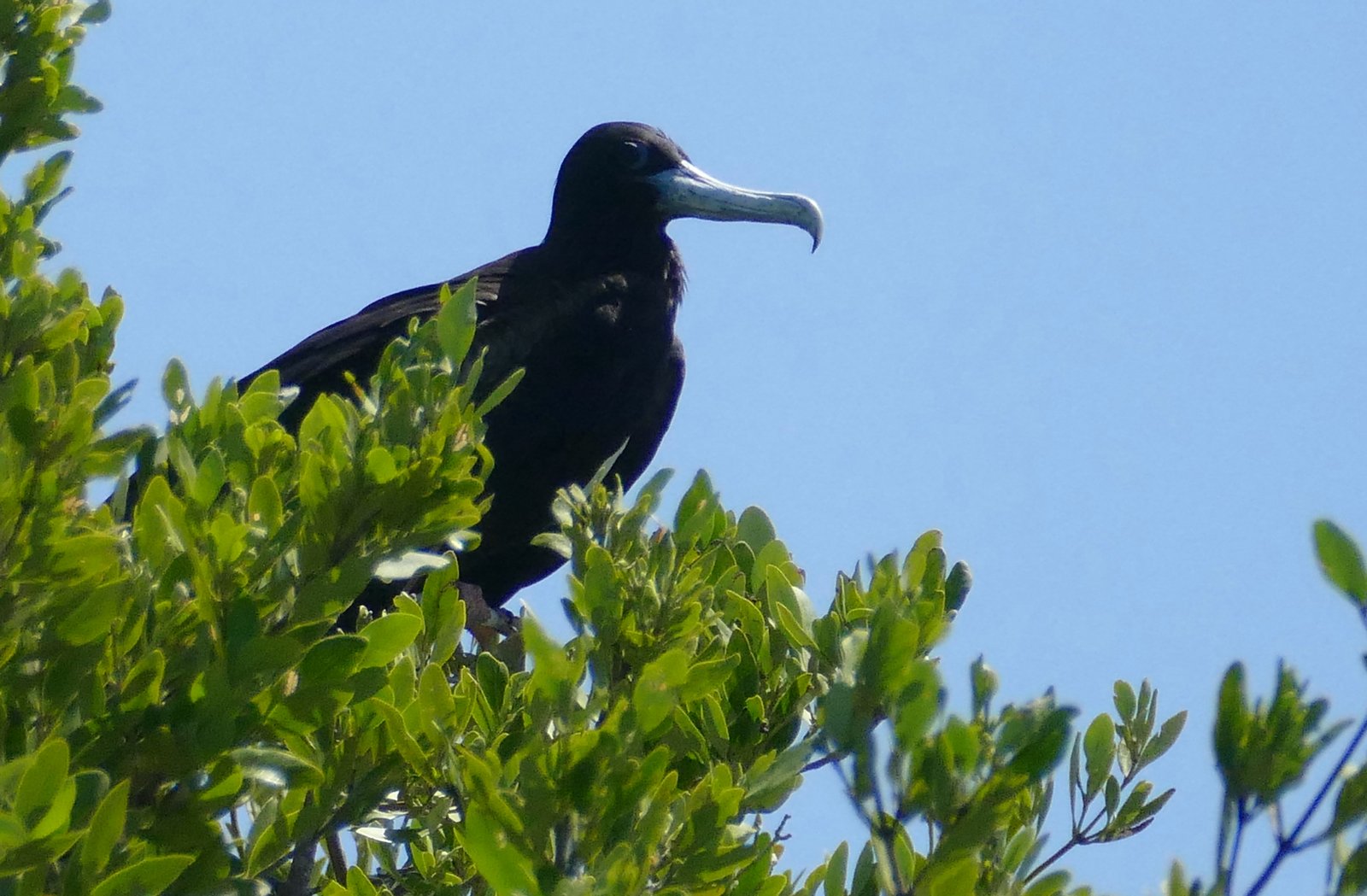
The Magnificent Frigatebird is the frigatebird of the guide area and can be seen over almost every coast: a large, black seabird with long, angled wings and a long, forked tail that hangs on the wind for hours without a wingbeat. It cannot swim and does not land on the water; it takes food from the surface in flight or chases other seabirds until they drop their catch.
Voice
Silent at sea. At the colony males drum a hollow, rattling drrrrr with the inflated pouch and both sexes clatter their bills.
Recording: Leonardo Ordóñez-Delgado — CC BY-NC-SA 4.0 · shortened to the first 60 s, mono · xeno-canto
Identification
89–114 cm, with a wingspan of well over two metres; much of the length is tail. The bill is long and hooked at the tip, the legs are short and dark. The male is all black, with a purple gloss on the head and mantle, and has a red gular pouch that is inflated into a large balloon in display and otherwise shows as a red patch on the throat. The female is blackish-brown with a black head and throat, a white breast that extends to the sides into the armpits, and a pale brown bar across the upperwing; the eye-ring is blue. Juveniles have a white head, neck and belly; the white gradually darkens and immature plumage lasts several years.
Confusion species
Great Frigatebird Fregata minor, which lives mainly around the islands far out in the Pacific, is slightly smaller; the male has a green rather than purple gloss, a pale brown wing bar and reddish legs, the female a greyish-white throat and a pink to red eye-ring, and juveniles a rust-tinged head. At a distance a soaring frigatebird can recall Turkey Vulture Cathartes aura or Swallow-tailed Kite Elanoides forficatus, but the former has broad wings and a short tail and the latter a white head and underparts.
Habitat
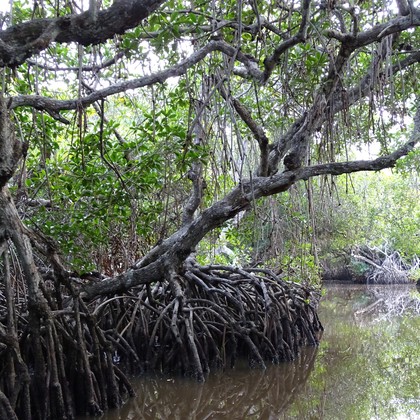
Coastal waters, bays, lagoons, harbours and open sea near land. It roosts and breeds in colonies in mangroves and low scrub on islets and cays. It feeds on flying fish, squid and other food snatched from the surface, on fish scraps in harbours and at fishing boats, and by chasing boobies, pelicans and terns until they drop their catch.
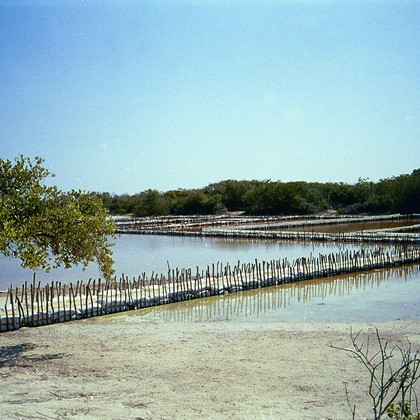
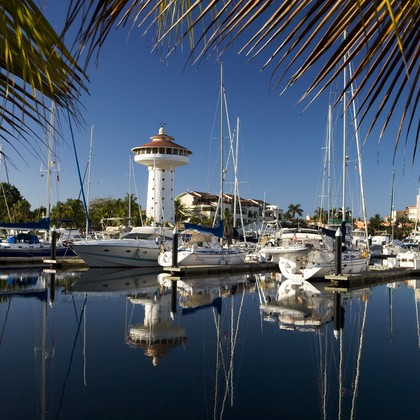
Where the bird is most at home, classified by the vegetation units of Mexico and Central America.



Range and movements
Year-round along both coasts of the whole guide area, from Baja California and the Gulf of California to Panama and from Tamaulipas to the Caribbean coast of Panama. Breeding colonies include Isla Isabel off Nayarit, islands in the Gulf of California and in Bahía Magdalena, Isla Contoy off Quintana Roo, Half Moon Caye and Man-O-War Caye in Belize, Isla Bolaños in Costa Rica and islands in the Gulf of Panama. Rare over the interior, sometimes after storms. Outside the guide area along the Atlantic and Pacific coasts of the Americas, from Florida to Brazil and to Ecuador, in the Caribbean and on the Galápagos Islands, with a small relict population on the Cape Verde Islands.
- Resident
- dark = core range, pale = thinly spread
How and when to look
Frigatebirds hang over almost every harbour and fishing beach. Isla Isabel and Man-O-War Caye can be visited by boat; there males with inflated red pouches can be seen at close range in the colony.
Conservation status
Not threatened. Colonies are vulnerable to disturbance, mangrove clearance, introduced predators and hurricanes. Birds also become entangled in fishing lines.
Scientific name
Fregata magnificens | Mathews, 1914
Mathews described the species in 1914 and placed it straight away in the genus where it still stands. The genus Fregata was introduced in 1799 by De Lacépède. Fregata derives from the French frégate, 'frigate', a fast warship — for the swift flight and the habit of robbing other seabirds. magnificens is Latin for 'magnificent, splendid' — for its size and impressive flight. The specimen the first description was based on came from Santa Fe (Barrington), Galápagos.