All species › Pigeons and doves › Doves and pigeons › Maroon-chested Ground Dove
Position in the tree Birds Aves › Birds with a flexible palate Neognathae › All other modern birds Neoaves › Doves, turacos and allies Columbaves › Doves and sandgrouse Columbimorphae
Maroon-chested Ground Dove | Paraclaravis mondetoura
Purperborstgrondduif | Tórtola pecho morado
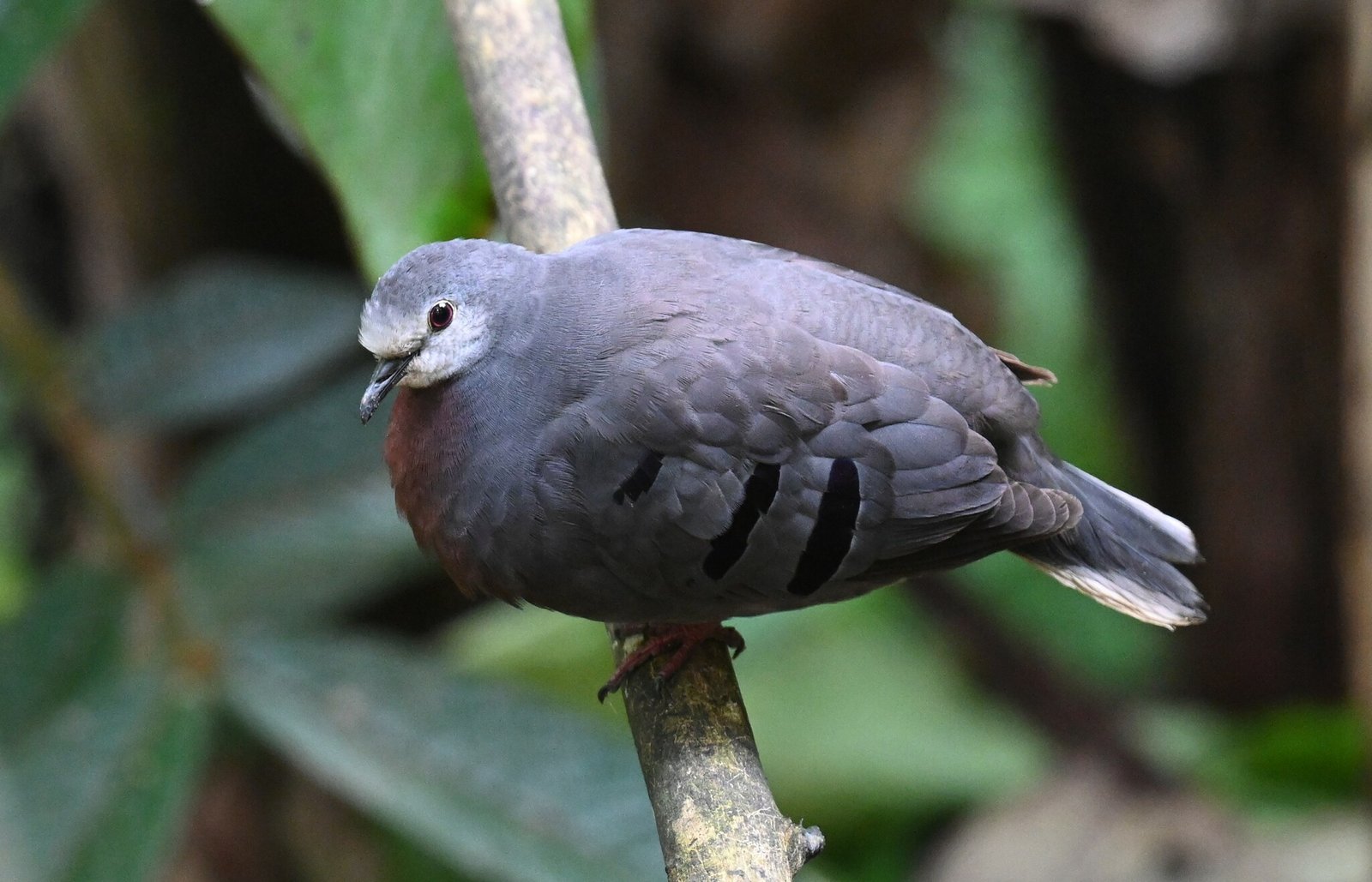
Maroon-chested Ground Dove is a rare, shy dove of montane forest, closely tied to bamboo. The species wanders and sometimes turns up in numbers where bamboo is seeding en masse, only to disappear for years afterwards. In the guide area it is therefore one of the hardest doves to find.
Voice
A series of low, slightly rising, two-syllable cooing notes, hoo-woop, lower than the call of Blue Ground Dove; often from dense bamboo.
Recording: Manuel Espejo — CC BY-NC-SA 4.0 · converted to mono · xeno-canto
Identification
19–23 cm, compact, with a fairly short tail. The male has a greyish-white forehead and face, a dark maroon-purple breast grading into a grey to white belly, and blue-grey upperparts with two dark purple wing bars. The outer tail feathers are white, which shows when the bird flushes. The eye is orange with a ring of yellow bare skin. The female is brown, with a cinnamon face, less distinct dark wing bars and pale tail corners. Young birds resemble the female but are redder.
Confusion species
Blue Ground Dove Claravis pretiosa lives lower down, in the humid lowlands and foothills; the male is paler and uniformly blue-grey, without a purple breast, with black wing spots and black outer tail feathers. Its female has chestnut wing spots and a rufous tail. Quail-doves such as Ruddy Quail-Dove Geotrygon montana are larger and have a facial stripe and no wing bars.
Habitat
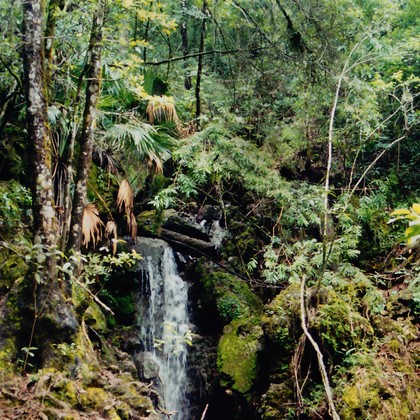
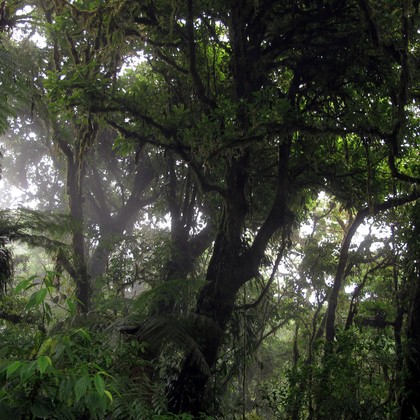
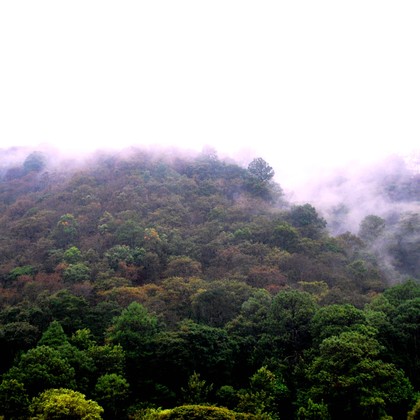
Dense undergrowth of humid montane forest and cloud forest, forest edges and secondary thickets, especially where bamboo grows, between about 900 and 3000 m. Searches the ground for seeds, especially bamboo seed, and fallen fruit. Where bamboo flowers and seeds en masse after many years, many birds may suddenly appear, disappearing again afterwards.
Where the bird is most at home, classified by the vegetation units of Mexico and Central America.
Range and movements
Very local and irregular in the mountains of southern Mexico, from Veracruz to Chiapas, and in Guatemala, El Salvador and Honduras; further south in the mountains of Costa Rica and western Panama. Most recent records come from the highlands of Chiapas and Guatemala and from Costa Rica and western Panama. Outside the guide area in the Andes from Venezuela to Bolivia.
- Resident
- dark = core range, pale = thinly spread
How and when to look
A targeted search makes little sense; the best chance is to respond to reports of flowering and seeding bamboo in montane forest, such as in the Talamanca of Costa Rica or in Chiriquí. The bird then walks on the ground under the bamboo or flushes fast and low, the white tail corners of the male flashing.
Conservation status
Not threatened globally, but scarce and irregular everywhere. Its wandering habits make numbers and trends hard to establish. Loss of montane forest with a bamboo understorey is the main threat.
Scientific name
Paraclaravis mondetoura | (Bonaparte, 1856) (GBIF: Claravis mondetoura)
Bonaparte described the species in 1856 as Peristera mondetoura; because it was later moved to another genus, the author and year stand in brackets. The genus Paraclaravis was introduced in 2018 by Sangster, Sweet & Johnson. Paraclaravis is Greek para 'beside, near' plus the genus Claravis (Latin clarus 'bright, brilliant' and avis 'bird'), after its resemblance to the Blue Ground Dove. mondetoura honours Pauline Brière de Mondétour (1785–1876), wife of the French zoologist Étienne Geoffroy Saint-Hilaire. The specimen the first description was based on came from Caracas, Venezuela.