All species › Parrots › African and New World parrots › Military Macaw
Position in the tree Birds Aves › Birds with a flexible palate Neognathae › All other modern birds Neoaves › Landbirds Telluraves › Falcons, parrots and passerines Australaves › Falcons and passerines Eufalconimorphae › Parrots and passerines Psittacopasserae
Military Macaw | Ara militaris
Soldatenara | Guacamaya verde
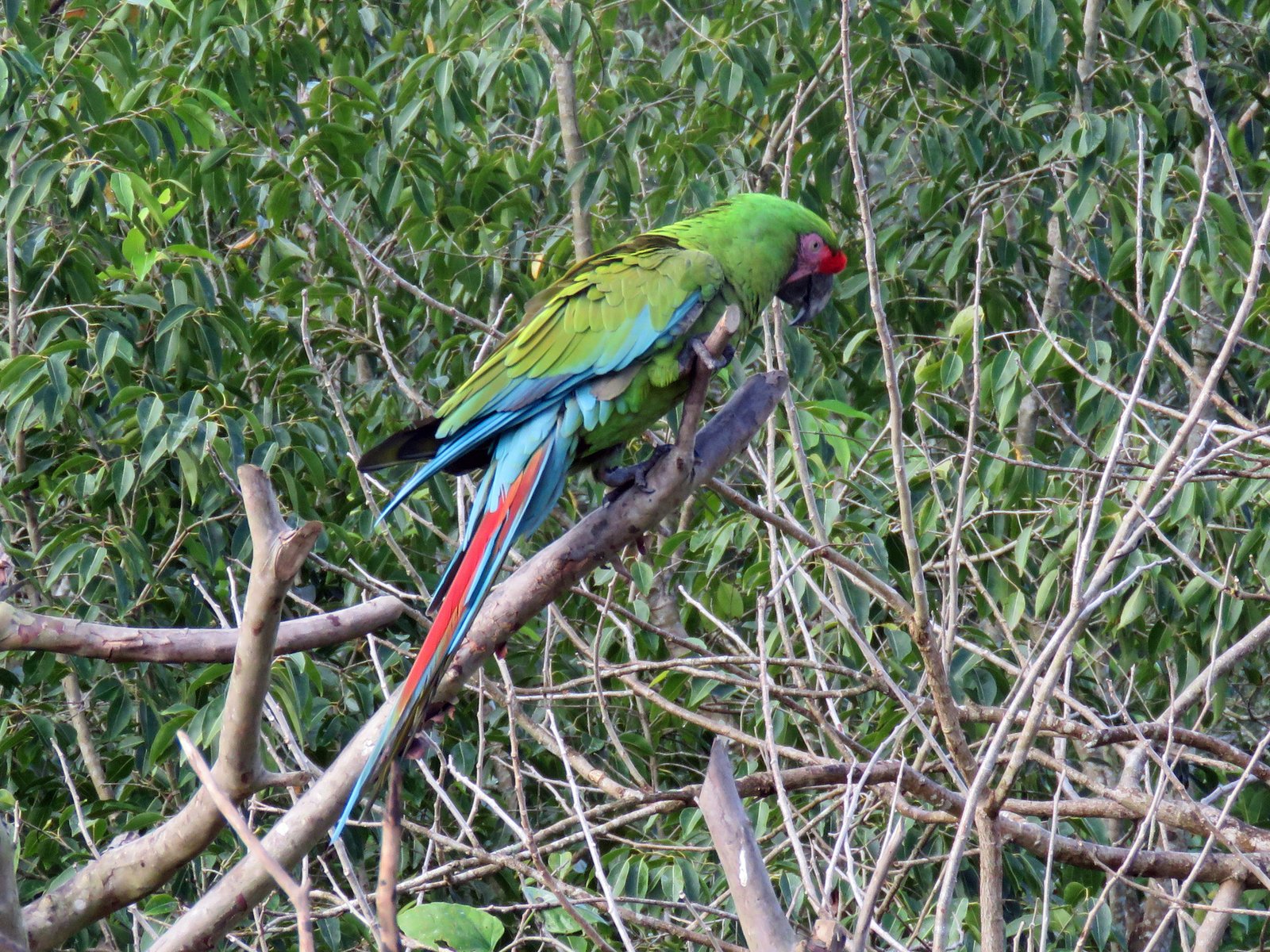
The Military Macaw is the large green macaw of Mexico, a bird of dry mountain slopes and canyons that shows a red forehead and blue flight feathers in flight. It often nests in holes in steep cliff faces. It does not occur naturally in Central America south of Mexico; elsewhere the species lives in scattered populations in the Andes of South America.
Voice
A loud, raw, grating kraa-aak, often repeated in flight and audible over a great distance; groups are noisy at nests and roosts.
Recording: Juan Freile — CC BY-NC-SA 4.0 · converted to mono · xeno-canto
Identification
70–80 cm including the long, pointed tail. Mostly green, with a red forehead and a bare, pinkish-white face with lines of small black feathers; the throat is brownish. The flight feathers, rump and lower back are blue. The tail is reddish brown above with a blue tip and olive-yellow below, as is the underside of the flight feathers. The bill is dark grey. The sexes are alike.
Confusion species
Great Green Macaw Ara ambiguus, which occurs only from Honduras to Panama and so not alongside the Military Macaw, is larger and paler, more yellowish green. Scarlet Macaw Ara macao is red. Large green parakeets such as Green Parakeet Psittacara holochlorus are much smaller and lack a bare face.
Habitat
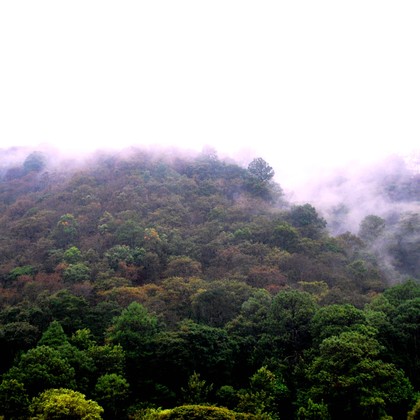
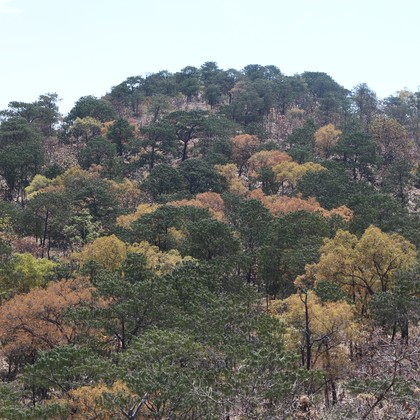
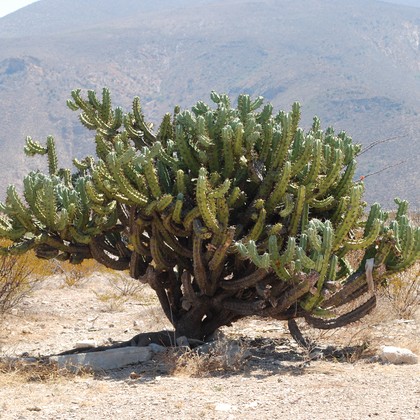
Dry and semi-deciduous forest and pine-oak forest on mountain slopes, in canyons and ravines, also gallery forest along rivers in dry regions; mainly between 500 and 2500 m, locally lower. It nests in holes in cliffs and in large trees. It eats seeds, nuts and fruit, flying long distances daily to find them.
Where the bird is most at home, classified by the vegetation units of Mexico and Central America.



Range and movements
In Mexico in two separate areas: on the Pacific slope and in the Sierra Madre Occidental, from south-eastern Sonora and south-western Chihuahua through Sinaloa, Durango, Nayarit, Jalisco, Michoacán and Guerrero to Oaxaca and southern Puebla; and in the Sierra Madre Oriental, from Nuevo León and Tamaulipas to San Luis Potosí and Querétaro. Records in Honduras, on the Bay Islands, involve escaped or released birds. Outside the guide area locally in Colombia and Venezuela and along the Andes to Bolivia and north-western Argentina.
- Resident
- dark = core range, pale = thinly spread
How and when to look
In the Cañón del Sabino near Santa María Tecomavaca in Oaxaca a colony nests in the cliff faces and can be watched early in the morning from the canyon rim. Also in the El Cielo Biosphere Reserve in Tamaulipas.
Conservation status
Vulnerable. It has declined and become fragmented through trapping for the cage-bird trade and loss of forest; in Mexico it is legally protected as an endangered species.
Scientific name
Ara militaris | (Linnaeus, 1766)
Linnaeus described the species in 1766 as Psittacus militaris; because it was later moved to another genus, the author and year stand in brackets. The genus Ara was introduced in 1799 by De Lacépède. Ara comes from Tupí, where ará is an onomatopoeic name for the macaws. militaris is Latin for 'military, of soldiers', presumably after the bird's green 'uniform'. The specimen the first description was based on came from not stated (probably Colombia).