All species › Passerines › New World blackbirds, troupials and allies › Nicaraguan Grackle
Position in the tree Birds Aves › Birds with a flexible palate Neognathae › All other modern birds Neoaves › Landbirds Telluraves › Falcons, parrots and passerines Australaves › Falcons and passerines Eufalconimorphae › Parrots and passerines Psittacopasserae
Nicaraguan Grackle | Quiscalus nicaraguensis
Nicaraguaanse troepiaal | Zanate nicaragüense
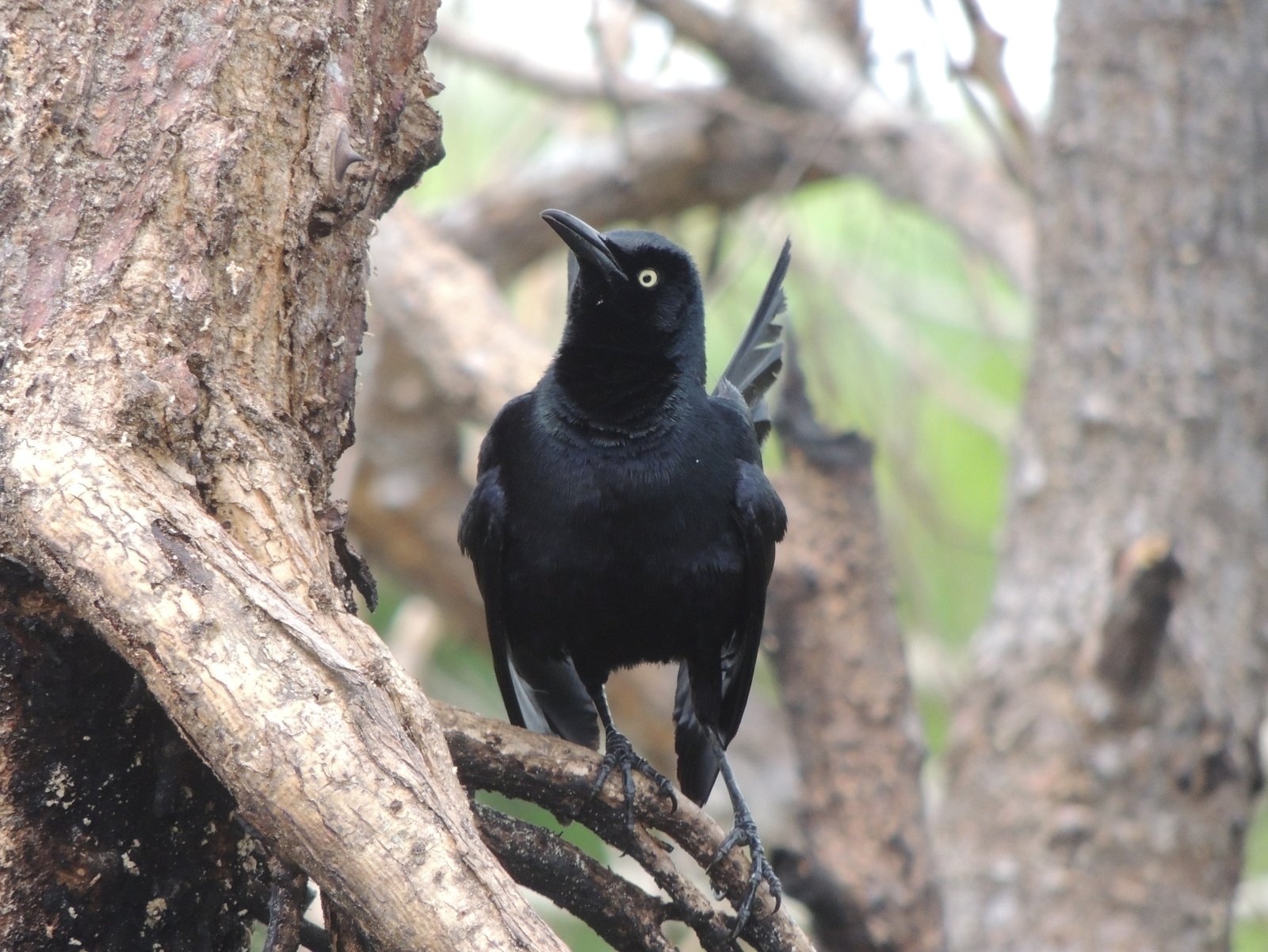
The Nicaraguan Grackle is a small relative of Great-tailed Grackle with a very restricted range around the great lakes of Nicaragua and in northern Costa Rica. It is tied to freshwater marshes and wet pastures.
Voice
The song is a series of clear, rising whistles followed by a dry rattle. The call is a short chuk.
Recording: GABRIEL LEITE — CC BY-NC-SA 4.0 · converted to mono · xeno-canto
Identification
25–31 cm; the male is larger than the female. Male black with a purple-blue gloss; eye pale yellow. Bill fairly slim and pointed. Tail long and keeled, but proportionately shorter than in Great-tailed Grackle. Female smaller: upperparts grey-brown, underparts pale, almost white to pale grey, with a distinct pale supercilium; eye pale.
Confusion species
Great-tailed Grackle Quiscalus mexicanus, which occurs in the same area, is much larger, with a longer tail and a heavier bill; the female is warm brown below rather than pale. Melodious Blackbird Dives dives has a dark eye and a square tail. Red-winged Blackbird Agelaius phoeniceus, which lives in the same marshes, is smaller, with a shorter tail; the male has red shoulder patches.
Habitat
Freshwater marshes with water hyacinth, reeds and grasses, wet pastures and flooded grassland along lakes and rivers; also rice fields and cattle pastures near water. It forages mainly on the ground and in floating vegetation, and eats insects and seeds. It breeds in small colonies.
Where the bird is most at home, classified by the vegetation units of Mexico and Central America.




Range and movements
Endemic to the guide area. Restricted to the lowlands around Lake Nicaragua and Lake Managua, along the Río San Juan and in adjacent northern Costa Rica, especially around Caño Negro and the Río Frío basin.
- Resident
- dark = core range, pale = thinly spread
How and when to look
In Costa Rica best searched for in the marshes of Caño Negro, for example from a boat; in Nicaragua along the shores of the great lakes. The pale female is the easiest to separate from Great-tailed Grackle.
Conservation status
Not threatened (LC). The range is small, but within it the species is locally common. Drainage of marshes and conversion to fields and rice paddies may reduce its habitat.
Scientific name
Quiscalus nicaraguensis | Salvin & Godman, 1891
Salvin & Godman described the species in 1891 and placed it straight away in the genus where it still stands. The genus Quiscalus was introduced in 1816 by Vieillot. Quiscalus goes back to Linnaeus's species name Gracula quiscula; where he got the word is uncertain, possibly from Taíno quisqueya, a name for Hispaniola. nicaraguensis means 'of Nicaragua', where the species is almost confined to the great lakes. The specimen the first description was based on came from Momotombo, Lake Managua, Nicaragua.