All species › Passerines › Crows, jays and magpies › Northern Raven
Position in the tree Birds Aves › Birds with a flexible palate Neognathae › All other modern birds Neoaves › Landbirds Telluraves › Falcons, parrots and passerines Australaves › Falcons and passerines Eufalconimorphae › Parrots and passerines Psittacopasserae
Northern Raven | Corvus corax
Raaf | Cuervo grande
The Northern Raven is the largest songbird in the guide area: entirely black, with a heavy bill and a wedge-shaped tail. It lives in pairs in mountains, deserts and other open or rocky country, from Baja California and northern Mexico to the highlands of Central America. It often soars and tumbles over cliffs and slopes.

Voice
A deep, resonant kroak or krok, also a great variety of gurgling, rattling and grating sounds.
Recording: Richard E. Webster — CC BY-NC-SA 4.0 · shortened to the first 60 s, mono · xeno-canto
Identification
56–69 cm. Entirely black with a bluish-purple gloss. Bill large and heavy, with a curved upper mandible. Throat feathers long and shaggy, most visible when the bird calls. Tail long and clearly wedge-shaped, easy to see in flight. Wings long, with finger-like primaries. It often soars like a bird of prey.
Confusion species
Chihuahuan Raven Corvus cryptoleucus is smaller, with a shorter bill, a less wedge-shaped tail, white bases to the neck feathers and a higher call; it lives mainly in flat, open country. American Crow Corvus brachyrhynchos, Tamaulipas Crow Corvus imparatus and Sinaloa Crow Corvus sinaloae are much smaller, with a slimmer bill and a square-ended tail.
Habitat
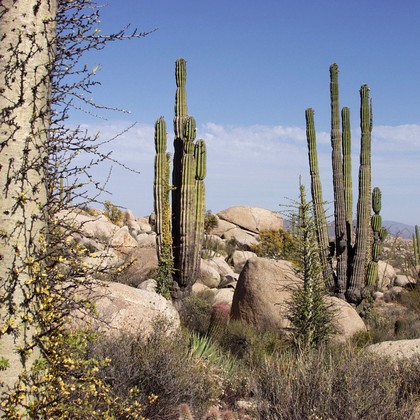
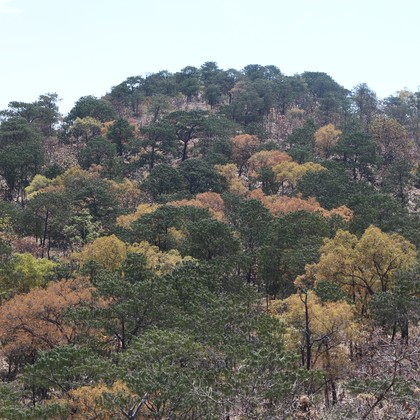
Mountains, cliffs and canyons, desert and semi-desert, open pine-oak forest, rocky coasts and islands; also visits rubbish dumps and roadsides. It eats carrion, small vertebrates, eggs, insects, fruit and refuse. It nests on cliffs, in tall trees or on pylons.
Where the bird is most at home, classified by the vegetation units of Mexico and Central America.





Range and movements
In the guide area in Baja California and offshore islands, in northern Mexico and across the central plateau, and south through the mountains of Oaxaca and Chiapas, Guatemala, El Salvador and Honduras to northern Nicaragua. Absent from the humid lowlands of eastern Mexico and from southern Central America. Outside the guide area in much of North America, Europe, Asia and North Africa.
- Resident
- dark = core range, pale = thinly spread
How and when to look
Often seen over cliffs, mountain passes and desert roads in northern Mexico. Pairs tumble and roll in the air; the deep call carries far.
Conservation status
Not threatened. Widespread in northern Mexico; scarcer and more local in the southern part of its range in Central America.
Scientific name
Corvus corax | Linnaeus, 1758
Linnaeus described the species in 1758 and placed it straight away in the genus where it still stands. He introduced the genus Corvus in that same work. Corvus is the Latin word for 'raven'. corax is the Latinised form of Greek korax 'raven', so the name says the same thing in both languages. The specimen the first description was based on came from Sweden.