All species › Owls › Owls › Northern Saw-whet Owl
Position in the tree Birds Aves › Birds with a flexible palate Neognathae › All other modern birds Neoaves › Landbirds Telluraves › Raptors, owls, kingfishers and woodpeckers Afroaves › Hawks and owls Hieraves
Northern Saw-whet Owl | Aegolius acadicus
Zaaguil | Tecolote afilador
The Northern Saw-whet Owl is a small owl with a large head and a short tail that breeds in conifer and mixed forest from Alaska and Canada to the mountains of Mexico. In the guide area it is a scarce resident of high-elevation conifer, oak and pine-oak forest, south to Oaxaca. It is strictly nocturnal and is mostly detected by its song. The name refers to a rasping call that recalls the sharpening of a saw.

Voice
The song is a long, monotonous series of whistled toots, too-too-too-too, about two per second, sometimes continuing for minutes. Also a rasping, saw-like sound and high, squeaky calls. Sings mainly in late winter and spring.
Recording: Ray Cooke — CC BY-NC 4.0 · converted to mono · xeno-canto
Identification
18–21 cm, with a large round head without ear tufts, yellow eyes and a black bill. The facial disc is pale brown to white with fine dark streaks and a white V between the eyes; the forehead and crown are finely streaked white. The upperparts are brown with white spots on the wing; the underparts are white with broad reddish-brown streaks. Juveniles are chocolate brown with a white V above the bill and a plain cinnamon belly.
Confusion species
The Unspotted Saw-whet Owl Aegolius ridgwayi, which lives south of the Isthmus of Tehuantepec, has plain buff underparts without streaks and an unstreaked crown; it closely resembles a juvenile Northern Saw-whet Owl, but the two species do not overlap. Pygmy owls (Glaucidium), such as the Northern Pygmy Owl Glaucidium gnoma, are smaller, with a longer, barred tail and false eyes on the nape. The Flammulated Owl Psiloscops flammeolus has dark eyes and small ear tufts.
Habitat
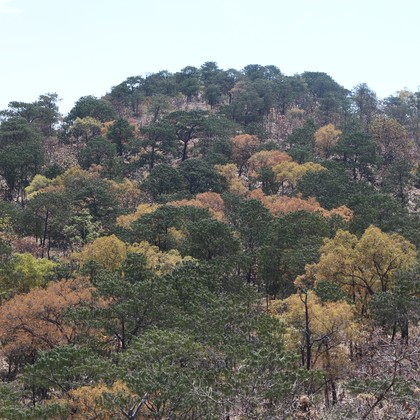
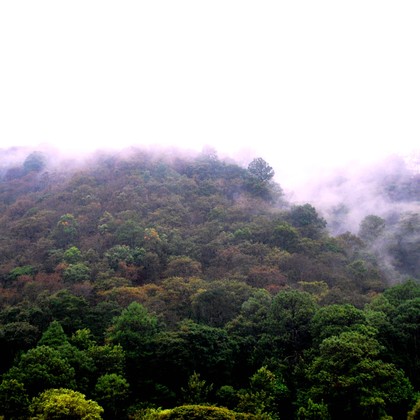
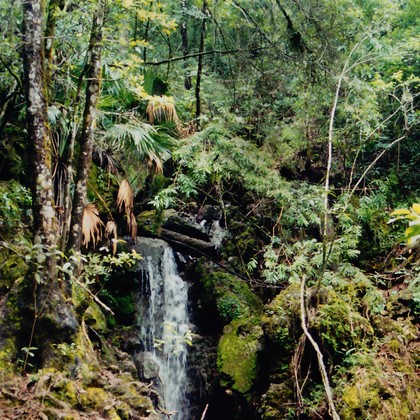
Montane conifer and pine-oak forest with fir, pine and oak, often in ravines and along streams; in Mexico mainly in the high mountains above about 2000 m. It nests in old woodpecker holes. At night it hunts mice and other small mammals from a low perch, sometimes small birds and large insects. By day it sits motionless, often low in dense foliage.
Where the bird is most at home, classified by the vegetation units of Mexico and Central America.

Range and movements
Resident in the mountains of Mexico: in the Sierra San Pedro Mártir in Baja California, in the Sierra Madre Occidental from Sonora and Chihuahua to Sinaloa, Durango and Jalisco, in the Sierra Madre Oriental of Coahuila and Nuevo León, and in the volcanic belt from Michoacán to Veracruz, south to the mountains of Oaxaca. Everywhere scarce and local, and probably often overlooked. South of the Isthmus of Tehuantepec it is replaced by the Unspotted Saw-whet Owl. Outside the guide area it breeds in Canada, southeastern Alaska and much of the United States; northern birds move south in winter but rarely reach the guide area.
- Resident
- Summer visitor (c. Apr–Sep)
- Winter visitor (c. Oct–Mar)
- Passage (Mar–Apr, Oct–Nov)
- dark = core range, pale = thinly spread
How and when to look
In March and April the song can be heard at night in conifer and oak forest on the slopes of the volcanoes around the Valley of Mexico and in the mountains of Oaxaca. A perched bird can usually be found only by tracking the song; once found it often stays put.
Conservation status
Not threatened. The Mexican population is small and little studied and is sometimes treated as a separate subspecies; it is vulnerable to logging and forest fires in the high mountains.
Scientific name
Aegolius acadicus | (Gmelin, 1788)
Gmelin described the species in 1788 as Strix acadica; because it was later moved to another genus, the author and year stand in brackets. The genus Aegolius was introduced in 1829 by Kaup. Aegolius is the Latin word for a screech owl, taken from Greek aigōlios, 'a bird of ill omen'. acadicus means 'of Acadia', the old French name for the region around Nova Scotia, from where the species was described. The specimen the first description was based on came from Nova Scotia, Canada.