All species › Passerines › Tits, chickadees and titmice › Oak Titmouse
Position in the tree Birds Aves › Birds with a flexible palate Neognathae › All other modern birds Neoaves › Landbirds Telluraves › Falcons, parrots and passerines Australaves › Falcons and passerines Eufalconimorphae › Parrots and passerines Psittacopasserae
Oak Titmouse | Baeolophus inornatus
Grijze mees | Carbonero sencillo
The Oak Titmouse is a plain grey-brown titmouse without any markings. It lives in oak woodland and scrub with oaks in California and, in the guide area, only in north-western Baja California. Pairs stay in their territory all year.

Voice
The song is a series of repeated, clear whistled phrases of two or three syllables. The call is a hoarse, scratchy tsi-tsi-cher.
Recording: Ed Pandolfino — CC BY-NC-SA 4.0 · converted to mono · xeno-canto
Identification
13–14 cm. Entire plumage plain grey-brown, underparts slightly paler. Short pointed crest of the same colour. No markings on the head or wings. Eye and bill dark. Sexes alike.
Confusion species
American Bushtit Psaltriparus minimus is smaller, with a long tail and a tiny bill, lacks a crest and lives in flocks. Bridled Titmouse Baeolophus wollweberi has a black-and-white face and does not occur in Baja California.
Habitat
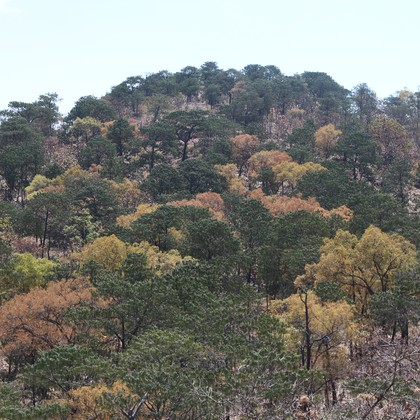
Oak woodland and open woodland with oaks, chaparral with scattered oaks, riparian woodland and parks and gardens with old oaks. It eats insects, spiders, seeds and acorns. It nests in a tree cavity or an old woodpecker hole.
Where the bird is most at home, classified by the vegetation units of Mexico and Central America.


Range and movements
In the guide area only in north-western Baja California, in the hills and mountains south of the border. Outside the guide area in California and south-western Oregon.
- Resident
- dark = core range, pale = thinly spread
How and when to look
The plainest titmouse in the guide area: any small grey-brown crested titmouse in the oaks of northern Baja California is this species.
Conservation status
Not threatened. Fairly common in California; in the guide area restricted to a small area in northern Baja California.
Scientific name
Baeolophus inornatus | (Gambel, 1845)
Gambel described the species in 1845 as Parus inornatus; because it was later moved to another genus, the author and year stand in brackets. The genus Baeolophus was introduced in 1851 by Cabanis. Baeolophus is Greek, from baios 'small' and lophos 'crest': 'small crest', after the crest of these tits. inornatus is Latin for 'unadorned', after the plain grey-brown plumage without markings. The specimen the first description was based on came from near Monterey, California, USA.