All species › Passerines › Shrike-babblers, Erpornis and vireos › Ochre-crowned Greenlet
Position in the tree Birds Aves › Birds with a flexible palate Neognathae › All other modern birds Neoaves › Landbirds Telluraves › Falcons, parrots and passerines Australaves › Falcons and passerines Eufalconimorphae › Parrots and passerines Psittacopasserae
Ochre-crowned Greenlet | Tunchiornis ochraceiceps
Okerkapvireo | Verdillo ocre
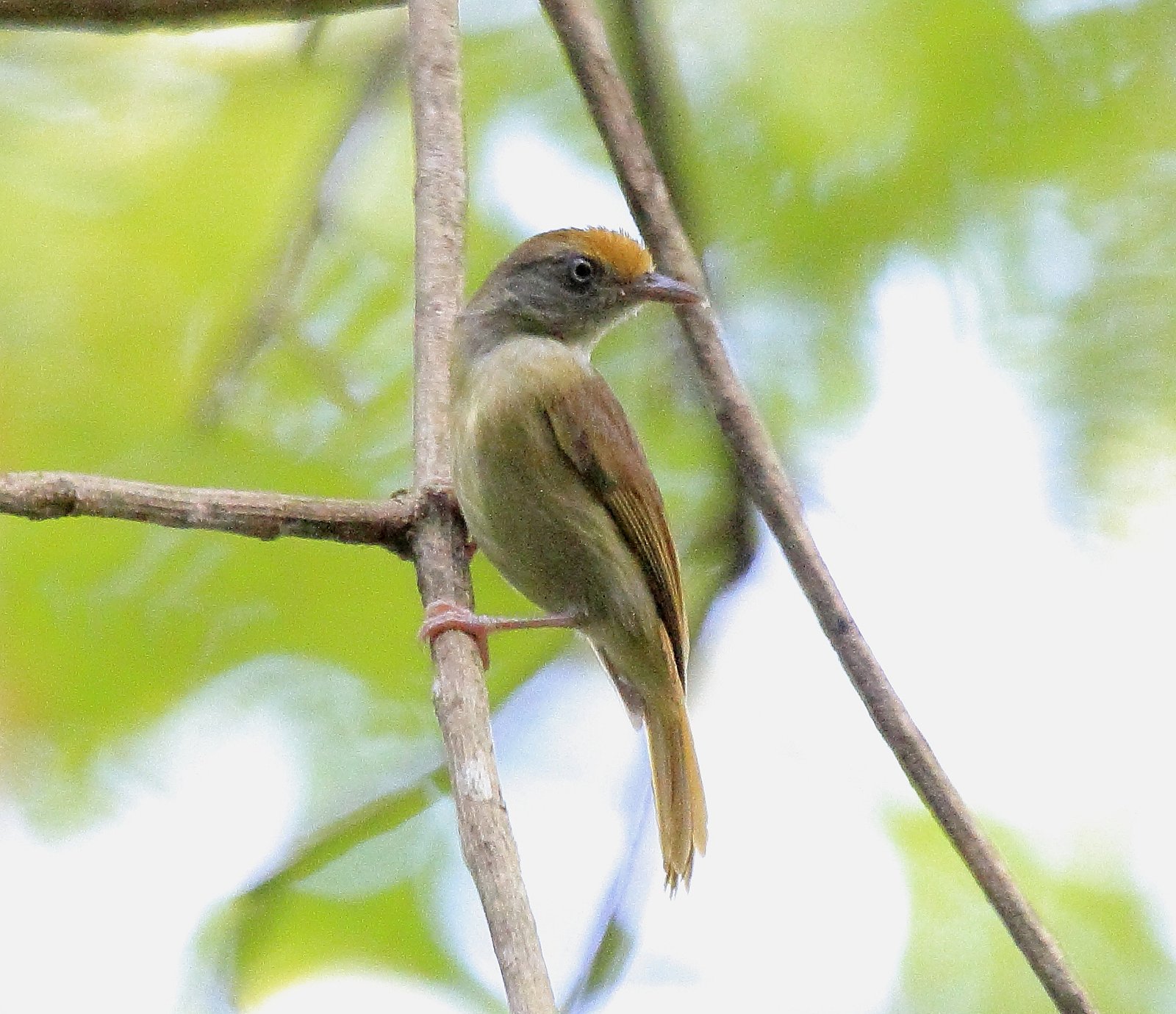
The Ochre-crowned Greenlet is a small, brownish vireo of the understorey of humid lowland forest, with an ochre forehead and a pale eye. It is a regular member of understorey mixed flocks. In the guide area it lives from south-eastern Mexico to Panama.
Voice
The song is a high, drawn-out, rising whistle repeated at intervals. The call is a nasal, somewhat plaintive nyeh, often heard in mixed flocks.
Recording: Juan Freile — CC BY-NC-SA 4.0 · shortened to the first 60 s, mono · xeno-canto
Identification
11–12 cm. Forehead and forecrown ochre to rusty brown. Upperparts olive-brown, tail warmer brown. Throat pale grey, rest of the underparts greyish with an olive to yellowish wash. Eye pale. Bill fairly short.
Confusion species
Lesser Greenlet Pachysylvia decurtata lives in the canopy, is greener and has a white eye-ring and a dark eye. Its brown colour and understorey habits can suggest females of small antbirds, but these lack the ochre forehead and have a different bill shape.
Habitat
Understorey and lower middle levels of humid lowland and foothill forest, also mature secondary forest. Searches leaves for insects, nearly always in understorey mixed flocks.
Where the bird is most at home, classified by the vegetation units of Mexico and Central America.



Range and movements
Caribbean slope of south-eastern Mexico (including the southern Yucatán Peninsula) through Belize, Guatemala, Honduras and Nicaragua to Costa Rica; in Panama on both slopes. Outside the guide area in north-western South America.
- Resident
- dark = core range, pale = thinly spread
How and when to look
In understorey mixed flocks, look for a small brown bird with a pale eye and an ochre forehead; the nasal call often gives it away.
Conservation status
Not evaluated separately in the current species limits; the former, broader species was considered not threatened. Fairly common in continuous forest; disappears where forest becomes fragmented.
Scientific name
Tunchiornis ochraceiceps | (Sclater, 1860) (GBIF: Hylophilus ochraceiceps)
Sclater described the species in 1860 as Hylophilus ochraceiceps; because it was later moved to another genus, the author and year stand in brackets. The genus Tunchiornis was introduced in 2014 by Slager & Klicka. Tunchiornis joins Tunche, the whistling guardian spirit of the forest in Peruvian Amazonian myth, with Greek ornis 'bird', after the simple whistled song in the understorey. ochraceiceps is Latin, from ochraceus 'ochraceous' and -ceps '-headed', after the tawny crown. The specimen the first description was based on came from Playa Vicente, Mexico (then Oaxaca, now Veracruz).