All species › Passerines › Ovenbirds and woodcreepers › Olivaceous Woodcreeper
Position in the tree Birds Aves › Birds with a flexible palate Neognathae › All other modern birds Neoaves › Landbirds Telluraves › Falcons, parrots and passerines Australaves › Falcons and passerines Eufalconimorphae › Parrots and passerines Psittacopasserae
Olivaceous Woodcreeper | Sittasomus griseicapillus
Grijze muisspecht | Trepatroncos oliváceo
The Olivaceous Woodcreeper is a small, slender woodcreeper with a greyish-olive head and underparts and rufous wings and tail. It occurs in many forest types, from humid lowland forest to dry seasonal forest and pine-oak woodland. The species has a very large range and is split into several species by some authors.

Voice
The song is a fast series of high, shrill notes, often a trill that first swells and then fades. Also short, sharp calls.
Recording: Juan Freile — CC BY-NC-SA 4.0 · converted to mono · xeno-canto
Identification
14–16 cm. Head, mantle and underparts plain greyish olive, without streaks. Wings, rump and tail bright rufous. Bill short, thin and straight. In flight a pale buffy band across the flight feathers. Male and female are alike.
Confusion species
Wedge-billed Woodcreeper Glyphorynchus spirurus is just as small but browner, with fine pale streaks on the breast, a pale eyebrow and a wedge-shaped bill. Piping Long-tailed Woodcreeper Deconychura typica is larger and plainer brown. All other woodcreepers in the guide area are larger and have brown or streaked heads.
Habitat
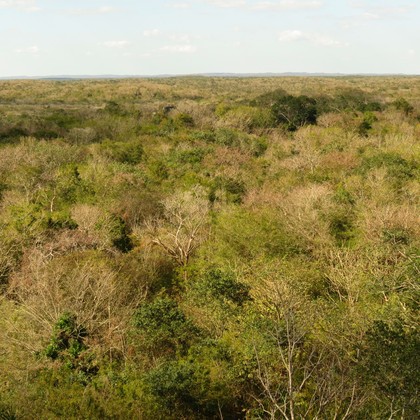
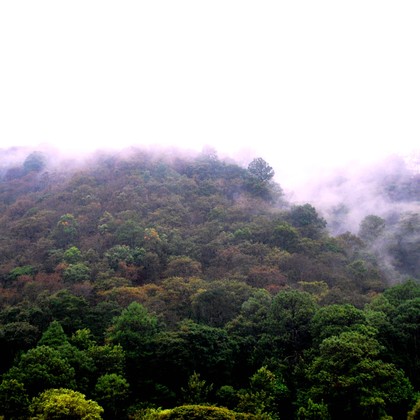
Humid and drier forest in the lowlands, foothills and lower mountains, also seasonal forest, pine-oak woodland, mature secondary forest and forest edges. It climbs trunks and branches in short hops and sometimes catches insects in the air. It often joins mixed flocks. It nests in a tree cavity.
Where the bird is most at home, classified by the vegetation units of Mexico and Central America.




Range and movements
From eastern and southern Mexico, including the Yucatán Peninsula, through Belize, Guatemala, El Salvador, Honduras, Nicaragua and Costa Rica to Panama. Outside the guide area widespread in South America, south to northern Argentina.
- Resident
- dark = core range, pale = thinly spread
How and when to look
Often found in mixed flocks at Tikal in Guatemala and in drier forest in north-western Costa Rica. The plain greyish-olive body with a rufous tail stands out against the trunk.
Conservation status
Not threatened. Common and widespread; also tolerates partly logged forest.
Scientific name
Sittasomus griseicapillus | (Vieillot, 1818)
Vieillot described the species in 1818 as Dendrocopus griseicapillus; because it was later moved to another genus, the author and year stand in brackets. The genus Sittasomus was introduced in 1827 by Swainson. Sittasomus combines the genus Sitta (nuthatches) with Greek sōma 'body': 'with the body of a nuthatch'. griseicapillus is Latin, from griseus 'grey' and capillus 'hair (of the head)', after the grey head. The specimen the first description was based on came from Concepción, Paraguay.