All species › Passerines › Finches, euphonias and allies › Orange-bellied Euphonia
Position in the tree Birds Aves › Birds with a flexible palate Neognathae › All other modern birds Neoaves › Landbirds Telluraves › Falcons, parrots and passerines Australaves › Falcons and passerines Eufalconimorphae › Parrots and passerines Psittacopasserae
Orange-bellied Euphonia | Euphonia xanthogaster
Vuurbuikorganist | Eufonia ventrinaranja
The Orange-bellied Euphonia is a small, stocky euphonia of humid forest in north-western South America. In the guide area it occurs only in the far east of Panama, where it keeps mainly to the canopy and feeds largely on mistletoe berries.
Voice
The call is a clear, nasal dee-dee or pee-pee, often repeated several times. The song is a short, rapid series of clear notes and twitters, incorporating imitated calls of other birds.
Recording: Juan Freile — CC BY-NC-SA 4.0 · shortened to the first 60 s, mono · xeno-canto
Identification
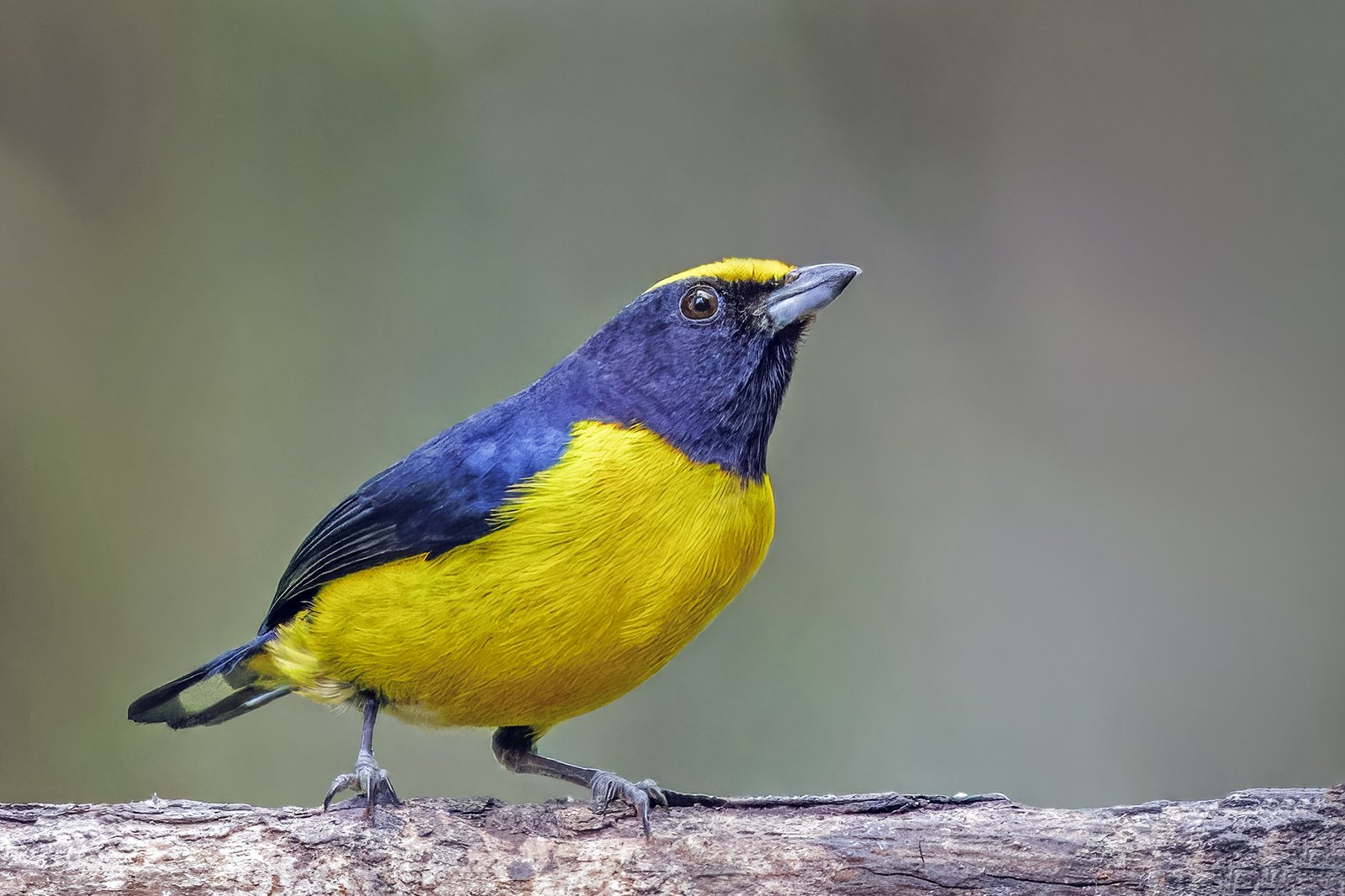
10–11 cm. Small and compact, with a short, thick bill and a short tail. The male is dark steel-blue above, on the head and on the throat; the forehead and forecrown are yellow to orange-yellow, and this yellow extends back above the eye. Breast and belly deep orange-yellow. The female is olive-green above, with a rufous forehead and a grey nape; the underparts are grey in the centre and olive-yellow on the flanks. Immature males resemble the female.
Confusion species
Other euphonias in eastern Panama resemble Orange-bellied Euphonia. The male Yellow-crowned Euphonia Euphonia luteicapilla has an entirely yellow crown and a paler yellow belly. The male Thick-billed Euphonia Euphonia laniirostris has a yellow throat instead of a blue one. Fulvous-vented Euphonia Euphonia fulvicrissa has rufous undertail coverts in both sexes; the female Orange-bellied Euphonia lacks these and is identified by the rufous forehead combined with the grey belly.
Habitat
Humid foothill and montane forest, forest edges and tall secondary growth, mainly between about 300 and 1,500 m. It lives in pairs or small groups in the canopy, often with tanagers in mixed flocks. It feeds mainly on mistletoe berries and other small fruits.
Where the bird is most at home, classified by the vegetation units of Mexico and Central America.




Range and movements
Occurs from eastern Panama through the Andes of Colombia and Ecuador and east to Venezuela, the Guianas and the western Amazon basin. In the guide area only in eastern Panama, mainly in the mountains of Darién and the east of Panamá province.
- Resident
- dark = core range, pale = thinly spread
How and when to look
Best found at fruiting mistletoes along the forest edge; the nasal call usually gives the birds away before the plumage does.
Conservation status
Not threatened (LC). Widespread and locally common in South America; in the guide area restricted to a small part of eastern Panama. Deforestation is the main threat.
Scientific name
Euphonia xanthogaster | Sundevall, 1834
Sundevall described the species in 1834 and placed it straight away in the genus where it still stands. The genus Euphonia was introduced in 1806 by Desmarest, A-G. Euphonia is Greek, from eu 'good' and phōnē 'sound': 'sweet-voiced', after the pleasing calls. xanthogaster is Greek, from xanthos 'yellow' and gastēr 'belly', after the yellow to orange belly. The specimen the first description was based on came from Rio de Janeiro, Brazil.