All species › Passerines › Thrushes and allies › Orange-billed Nightingale-Thrush
Position in the tree Birds Aves › Birds with a flexible palate Neognathae › All other modern birds Neoaves › Landbirds Telluraves › Falcons, parrots and passerines Australaves › Falcons and passerines Eufalconimorphae › Parrots and passerines Psittacopasserae
Orange-billed Nightingale-Thrush | Catharus aurantiirostris
Geelbekdwerglijster | Zorzal pico naranja
The Orange-billed Nightingale-Thrush is a small grey and brown thrush with an orange bill, eye-ring and legs. It lives in the undergrowth of scrub, forest edges and coffee plantations in hills and mountains and is often heard more than seen. In the guide area it occurs from north-western and eastern Mexico to western Panama.

Voice
The song is a short, scratchy, halting phrase of squeaky and chattering notes, slightly different each time and lacking the fluty quality of other nightingale-thrushes. The call is a nasal, falling waaa or meeah.
Recording: Manuel Grosselet — CC BY-NC-SA 4.0 · converted to mono · xeno-canto
Identification
15–17 cm. Head grey to greyish brown, back, wings and tail warm olive-brown to rufous-brown. Narrow orange eye-ring; bill and legs bright orange. Throat whitish, breast and flanks pale grey, centre of belly white. The sexes are alike. Juveniles are browner, with pale spots on the upperparts and dark spots on the breast, and a darker bill.
Confusion species
Black-headed Nightingale-Thrush Catharus mexicanus has a black cap and lives in more humid, denser forest. Russet Nightingale-Thrush Catharus occidentalis (mountains of Mexico) has a dark bill with only a pale lower mandible, faint spots on the breast and no orange eye-ring. Ruddy-capped Nightingale-Thrush Catharus frantzii has a rufous crown and an upper mandible darker than the lower. Black-billed Nightingale-Thrush Catharus gracilirostris (high mountains of Costa Rica and Panama) has a black bill.
Habitat
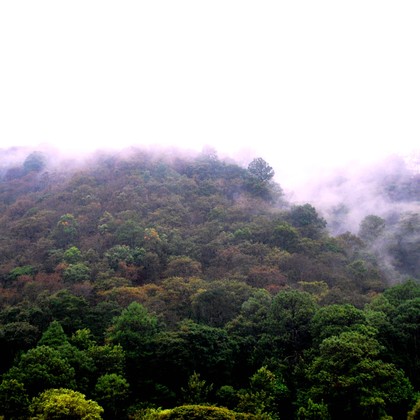
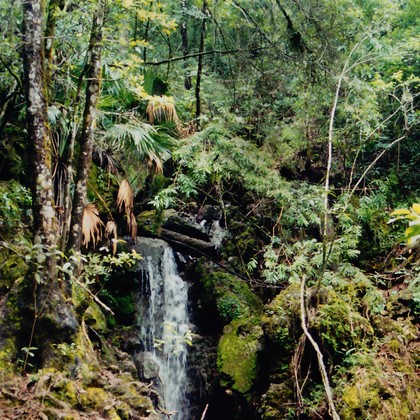
Undergrowth of scrub, secondary forest, forest edges, hedgerows, ravines and shade coffee, also gardens with dense shrubs; mostly between about 600 and 2500 m, locally lower. It avoids closed humid forest. It searches the ground and low shrubs for insects and other invertebrates and also eats berries.
Where the bird is most at home, classified by the vegetation units of Mexico and Central America.



Range and movements
In Mexico on the Pacific slope from southern Sinaloa and Durango southward and on the Caribbean slope from Tamaulipas southward, then through the interior and highlands of Guatemala, El Salvador, Honduras and Nicaragua to Costa Rica and western Panama. Outside the guide area in Colombia and Venezuela.
- Resident
- dark = core range, pale = thinly spread
How and when to look
Common in the coffee districts and higher villages of the Central Valley of Costa Rica and around Monteverde. The song often comes from dense shrubs along roads and trails.
Conservation status
Not threatened (LC). Common and widespread; able to persist in semi-open landscapes altered by people.
Scientific name
Catharus aurantiirostris | (Hartlaub, 1850)
Hartlaub described the species in 1850 as Turdus aurantiirostris; because it was later moved to another genus, the author and year stand in brackets. The genus Catharus was introduced in 1850 by Bonaparte. Catharus is from Ancient Greek katharos 'pure, clean', a name given for the clean plumage of the orange-billed nightingale-thrush. aurantiirostris is Latin, from aurantius 'orange' and -rostris '-billed', after the orange bill. The specimen the first description was based on came from Caracas, Venezuela.