All species › Swifts › Hummingbirds › Pale-bellied Hermit
Position in the tree Birds Aves › Birds with a flexible palate Neognathae › All other modern birds Neoaves › Birds of the elements Elementaves › Nightjars and swifts Strisores
Pale-bellied Hermit | Phaethornis anthophilus
Bleke heremietkolibrie | Ermitaño ventripálido
The Pale-bellied Hermit is a South American hermit that reaches the northern limit of its range in eastern Panama. Like all hermits it lives in the forest understorey and flies fixed routes between scattered flowers. Males sing in small groups at traditional display sites.

Voice
In flight a high, sharp tseep. At the display site males repeat a short, squeaky phrase for hours from a low branch, pumping the tail up and down.
Recording: Jerome Fischer — CC BY-NC-SA 4.0 · shortened to the first 60 s, mono · xeno-canto
Identification
11–12 cm excluding the elongated central tail feathers, with a long, slightly decurved bill of about 3.5 cm; the lower mandible is yellow at the base. The upperparts are dull bronzy green, the rump and uppertail coverts with pale fringes. The face has a blackish mask between a pale supercilium and a pale malar stripe. The underparts are pale greyish white, without a dark central throat stripe. The tail is graduated, with elongated, white-tipped central feathers. The sexes are almost alike.
Confusion species
Long-billed Hermit Phaethornis longirostris is larger, with warmer buff underparts and a dark central throat stripe. Stripe-throated Hermit Phaethornis striigularis is much smaller, with a shorter bill and cinnamon underparts. Bronzy Hermit Glaucis aeneus and Band-tailed Barbthroat Threnetes ruckeri lack the long central tail feathers.
Habitat
The understorey and edges of lowland forest, gallery forest and older secondary forest, also in somewhat drier forest than other hermits. It visits flowers of Heliconia, gingers and other plants with long corolla tubes, and catches small spiders and insects.
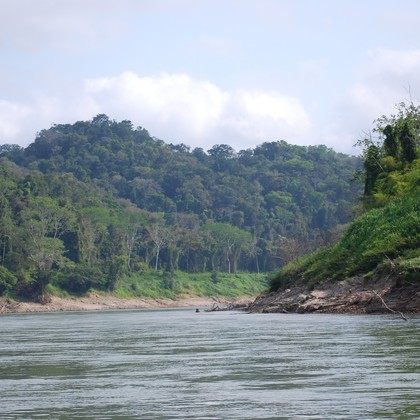
Where the bird is most at home, classified by the vegetation units of Mexico and Central America.



Range and movements
In the guide area only in eastern Panama, in eastern Panamá Province around Lake Bayano, in Guna Yala and in Darién. Outside the guide area in northern and central Colombia and north-western Venezuela.
- Resident
- dark = core range, pale = thinly spread
How and when to look
The best chance is to wait at flowering Heliconia along forest edges and trails in eastern Panama, around Lake Bayano and in Darién. The birds pass briefly on their regular route and then move swiftly on.
Conservation status
Least Concern. The species is fairly common within its range. In the guide area it is restricted to eastern Panama, where deforestation has affected part of its habitat.
Scientific name
Phaethornis anthophilus | (Bourcier, 1843)
Bourcier described the species in 1843 as Trochilus anthophilus; because it was later moved to another genus, the author and year stand in brackets. The genus Phaethornis was introduced in 1827 by Swainson. Phaethornis is Greek, from phaethōn 'sun, shining' and ornis 'bird': 'sun-bird'. anthophilus is Greek, from anthos 'flower' and philos 'loving': 'flower-lover', after its visits to flowers for nectar. The specimen the first description was based on came from not stated.